
Building “elite, compact, and strong” local military agencies is a strategic policy of the Party, the State, the Central Military Commission, and the Ministry of National Defence, aimed at strengthening national defence and firmly safeguarding the Fatherland in the new era. Fully aware of this, the Party Committee and High Command of Military Region 4 have prioritised leadership and direction in implementing this important task through a range of resolute and synchronised measures.
In response to the urgent and decisive requirements of the ongoing reform to streamline the organisational apparatus of the political system towards being elite, compact, and strong, enhancing performance and efficiency, alongside adjustments to administrative boundaries and the implementation of a two-tier local government model, the Central Military Commission and the Ministry of National Defence have proactively conducted research and advised the Party and the State in formulating and implementing Project No. 839-ĐA/QUTW, dated 25 April 2025, on continuing the reorganisation of local military structures in an elite, compact, and strong direction to meet the demands of the new situation.
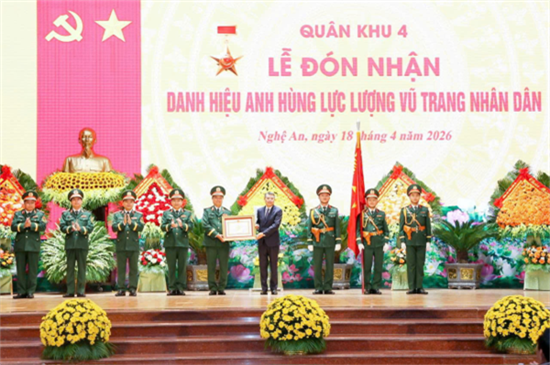 |
| Military Region 4 receives the Hero of the People's Armed Forces title in 2026 |
With a strong sense of political responsibility, immediately following the promulgation of the Project by the Central Military Commission, the Standing Board of the Party Committee and the High Command of the Military Region swiftly organised dissemination, study, and concretisation of leadership and direction to ensure its rigorous implementation through comprehensive and synchronised solutions. To date, the Military Region has largely completed the reorganisation and adjustment of the organisational structures and staffing of its units and local military agencies in accordance with the established plan. The composition among components, forces, and operational areas has been structured in a balanced and appropriate manner. The operations of local military agencies at all levels have been maintained with effectiveness and efficiency. Coordination, advisory, direction, and command mechanisms in implementing local military and defence tasks have functioned smoothly, without gaps, ensuring the timely and effective handling of defence and security situations, thereby maintaining stability across the area. Notably, in implementing the conclusions of the Politburo and the Secretariat, as well as the directives of the Central Military Commission and the Ministry of National Defence regarding the policy of assigning military officers to the commune level, the Military Region has proactively reviewed and balanced its personnel, and promptly reassigned and appointed officials to commune, ward, and special-zone military command boards. At present, the rate of appointments has reached 100% for commanders, 86.7% for deputy commanders, 71.6% for deputy political commissars, and 40.5% for staff officers.
2026 marks the first year in which the entire Party, the People, and the armed forces implement the Resolution of the 14th National Party Congress; the task of building a modern Army therefore imposes very high requirements. Within the Military Region, the security and political situation remains stable, while the economy, culture, and society continue their growth trajectory. However, hostile and reactionary forces persist in exploiting ethnic and religious issues to undermine the system, seeking to fracture the great national unity bloc and the close-knit bond between the military and the People.
To successfully fulfil tasks in the new era, the Party Committee and High Command of the Military Region have set forth the policy of continuing to build the region’s armed forces, especially local military agencies, into “elite, compact, and strong” organisations that truly serve as a politically reliable force and a loyal fighting force of local party committees, authorities, and the People, through the following key measures:
First, to continue thoroughly grasping and effectively implementing higher-level resolutions, directives, conclusions, and guidelines on building local military agencies. The focus is placed on Resolution No. 866-NQ/QUTW, dated 14 June 2025, of the Central Military Commission; Plan No. 3433/KH-BQP, dated 14 June 2025, of the Ministry of National Defence; and the Project on reorganising local military structures in an “elite, compact, and strong” direction to meet the requirements of the new situation. This also includes Decision No. 142/QĐ-BQP, dated 11 January 2026, issued by the Minister of National Defence, on reorganising commune-, ward-, and special-zone-level military command boards under provincial and municipal military commands, as well as the High Commands of Hanoi Capital and Ho Chi Minh City; and Directive No. 149-CT/ĐU, dated 7 January 2026, of the Standing Board of the Military Region Party Committee on leading the implementation of the project to adjust the organisational structure of commune-level military command boards. On this basis, the Party Committee and High Command of the Military Region direct agencies and units, particularly provincial and municipal military commands as the core, to internalise and concretise objectives, targets, tasks, and measures into programmes and plans, ensuring their implementation is conducted in a rigorous, scientific manner aligned with the specific characteristics of each unit and area. Emphasis is placed on clearly identifying key tasks and breakthrough areas, ensuring adherence to the established roadmap with tangible outcomes.
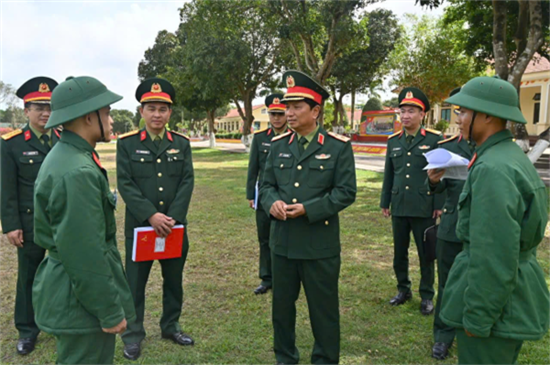 |
| Lt. Gen. Ha Tho Binh meets and encourages new recruits of Regiment 842, Quang Tri Military Command |
Throughout the implementation process, agencies and units are to promote proactiveness, flexibility, and creativity, while assigning clear and specific responsibilities to each component, force, and individual in charge. Inspection, examination, and supervision are to be strengthened in order to promptly detect and resolve difficulties and obstacles. Firm measures must be taken to eliminate manifestations of shirking responsibility, avoidance, fear of accountability, or the tendency to “say without doing,” as well as to address cases where implementation lacks quality and effectiveness. Continuous attention is given to promoting the role, responsibility, and exemplary conduct of party committees and commanders at all levels, especially key cadres, while linking task performance outcomes with annual cadre evaluation and assessment. At the same time, sustained investment is directed towards building a contingent of key officials within local military agencies who possess strong advisory capabilities, leadership competence, and effective implementation capacity, truly serving as centres of unity, with the courage to think, to act, and to take responsibility.
Second, to continue reviewing and consolidating the organisational structure and staffing of local military agencies, especially at the commune level, ensuring smooth and efficient operation. The Military Region directs provincial and municipal military commands to continue implementing the new organisational and staffing structure in strict accordance with the prescribed framework, while ensuring effective operation under the two-tier local government model. Newly reorganised and established local military agencies must promptly define their functions, tasks, and working relationships; effectively advise local party committees and authorities on military and defence tasks; and build party committees and party organisations within military agencies that are strong in political stance, ideology, ethics, organisation, and personnel, possessing comprehensive leadership capacity and high combativeness. At the same time, they must promptly identify shortcomings and overlaps, and propose solutions to remove “bottlenecks”, thereby enhancing the quality and effectiveness of the grassroots political system.
In parallel, it is essential to maintain a firm grasp of both the quantity and quality of cadres within local military agencies; to develop plans for training, retraining, and personnel utilisation; and to prioritise the selection of those who have received fundamental training and possess extensive practical experience for reassignment and placement in positions aligned with their capabilities and professional expertise. The aim for 2026 is to fully supplement the contingent of commanders, staff officers, and specialised technical personnel at commune-level military command boards, with priority given to key communes and wards in terms of defence and security, as well as the Con Co Special Zone. Efforts will also continue to implement the project on establishing standing militia units at the commune level and standing maritime militia squadrons tasked with safeguarding national sovereignty over seas and islands in the new context, striving for 100% of communes to establish standing militia squads, ensuring they are “strong and widespread.” Close attention must be paid to monitoring and effectively addressing the ideological situation of officers and soldiers, particularly those affected by organisational restructuring and adjustments. Resolute measures are to be taken to refute wrongful viewpoints and counter attempts to exploit organisational restructuring for distortion and sabotage, thereby maintaining unity and cohesion, and promoting the overall strength in building “elite, compact, and strong” local military agencies at all levels that operate with effectiveness and efficiency.
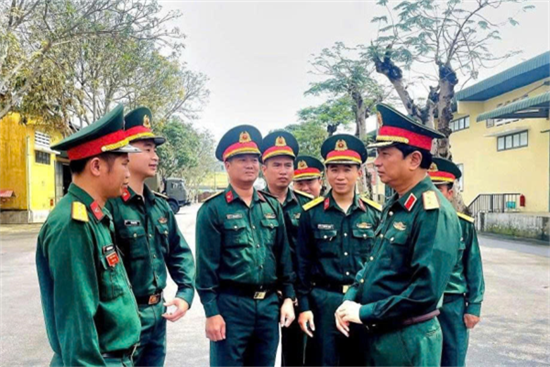 |
| Lt. Gen. Ha Tho Binh checks Depot 55 under MR4 Logistical and Technical Department |
Third, to enhance the quality of training and combat readiness. The Party Committee and High Command of the Military Region direct party committees and commanders at all levels to strengthen education, ensure thorough understanding, and rigorously implement higher-level resolutions and directives on training and exercises, thereby fostering a high degree of unity in both awareness and action. Thorough preparation for training must be ensured; in particular, identifying, training, and improving the professional capacity of commune-level military command cadres, enhancing knowledge of local military and defence work for border guard command boards, and strengthening border affairs expertise for cadres of provincial and municipal military commands are regarded as key breakthroughs. Efforts are to be made to actively innovate training content and methods, while flexibly and creatively applying guiding principles and combinations; training must be conducted in a serious, disciplined, and well-organised manner, in accordance with plans, ensuring quality and effectiveness.
Military agencies of provinces and centrally governed cities are to conduct training in a synchronised, specialised, and task-oriented manner, closely aligned with specific subjects and operational areas. The focus is placed on improving the quality of recruit training; in-service training for officers, professional service members, and specialised technical personnel; and training and inspection of mobilisation readiness for reserve forces. Border guard command boards are to effectively carry out military and defence tasks, integrating professional border management activities with strengthening the overall defensive posture of local defensive zones. Particular emphasis is placed on enhancing the working capacity of commune-level military command cadres; training militia and self-defence forces to proficiently use weapons, equipment, supporting tools, and improvised weapons; and ensuring firm mastery and flexible application of tactics. Attention is also given to training combat plans, conducting coordinated exercises with other forces within defensive zones, and participating in responses to non-traditional security challenges in the area.
In the immediate term, in 2026, the Military Region directs the Military Commands of Nghe An and Ha Tinh provinces to thoroughly prepare for and successfully organise defensive zone exercises within the framework of its defensive operations exercises. The remaining provinces and cities are to organise exercises for area defence command boards (one board per province or city) and to conduct defensive combat exercises at the commune level (25% of communes, wards, and special zones), ensuring they are carried out in a rigorous, safe, and high-quality manner. Strict maintenance of combat readiness regimes is required; operational and civil defence plans and documentation at all levels must be reviewed, adjusted, supplemented, and refined to suit specific adversaries and operational areas. Training in manoeuvre plans is to be strengthened to improve mobility, alongside active participation in disaster prevention and control, as well as search and rescue operations.
Fourth, to effectively ensure logistical and technical support, meeting the operational requirements of local military agencies in the new context. The Military Region directs provincial and municipal military commands to proactively advise local party committees and authorities in determining land funds for the construction of headquarters and provision of working equipment for commune-level military command boards, prioritising the utilisation of existing facilities following administrative restructuring. Close coordination is required between renovation and upgrading and the mobilisation of resources for new construction, with priority given to key communes in terms of defence and security, as well as border, mountainous, remote, and isolated areas. Adequate provision of material conditions for training and combat readiness must be ensured; emphasis is placed on consolidating training grounds, drill fields, fortifications, and defensive positions, as well as on the effective management and utilisation of weapons, technical equipment, and supporting tools, ensuring synchronisation and responsiveness to both routine and contingency tasks. Continued implementation of the Project on “Investment in equipment and software for command and management within the armed forces of Military Region 4” is required, ensuring seamless connectivity from the Military Region down to the commune level, thereby effectively supporting command, control, and situation handling. At the same time, policies for militia and self-defence forces and reserve forces must be properly implemented, ensuring that all entitlements and standards are provided fully, accurately, and in a timely manner, enabling personnel to devote themselves with confidence to training and duty performance.
Building on the achieved results, Military Region 4 will continue to focus on developing “elite, compact, and strong” local military agencies, thereby enhancing overall quality and combat strength, maintaining stability across the area, and remaining ready to successfully handle all situations, meeting the requirements of safeguarding the Fatherland in the new period.
Lieutenant General HA THO BINH, Commander of Military Region 4