
The Air Defence Division 363 is tasked with managing and protecting the North-Eastern airspace of the Fatherland, a region encompassing critical targets across inland areas, coastal zones, and islands.
Given its extensive area of responsibility and the dispersion of its units, the Division faces considerable challenges in the execution of its mission. In addition, the rapid development of the Fourth Industrial Revolution has led to the emergence of a wide range of modern aerial attack platforms, particularly unmanned aerial vehicles (UAVs), generating new operational methods and tactics. This places increasingly stringent demands on the Division in safeguarding the airspace in general, and in training and combat readiness in particular.
To successfully fulfil all assigned tasks, alongside a focus on building strong political foundations, the Division has synchronously implemented a range of measures to enhance the quality of training and combat readiness. In recent years, thanks to the resolute engagement of party committees and commanders at all levels, as well as the solidarity and proactive spirit of officers and soldiers in overcoming difficulties, the Division has achieved positive improvements in both training quality and readiness. Awareness and responsibility among personnel have been steadily enhanced; management, command, and operational methods, as well as training and exercise practices, have been renewed to align closely with mission requirements and adversary characteristics. Combat readiness has been strictly maintained from the Division level down to subordinate agencies and units, contributing to the effective handling of situations and preventing passivity or strategic surprise.
 |
| Conduct training with air defence missile |
From practical experience, the Division has drawn several lessons, which also constitute key measures to be further implemented in the time ahead:
First, to intensify education and dissemination efforts to raise awareness and a sense of responsibility among officers and soldiers in carrying out training and combat readiness tasks. Given the nature of duties that require strict, regular, continuous, long-duration, and high-intensity readiness, it is difficult to accomplish missions without appropriate awareness, responsibility, and determination. Accordingly, the Division directs its agencies and units to strengthen education and dissemination so that personnel develop a profound understanding of the position, role, and importance of training and combat readiness, thereby fostering a high degree of unity in awareness and ideology. The content of such education is implemented in a comprehensive, focused, and systematic manner, concentrating on higher-level resolutions, directives, and guidance on training and combat readiness; hostile schemes and tactics involving air infiltration, reconnaissance, and strikes; the development of aerial attack platforms and requirements for air defence operations; as well as the tasks of the Service and the Division in the new context, etc.
During the implementation process, the Division has directed its subordinate agencies and units to intensify the execution of Directive No. 2423-CT/QUTW, dated 9 November 2023, issued by the Standing Board of the Central Military Commission, “On renewing and improving the quality of political education in the new period.” It has proactively innovated forms of delivery and updated content to align closely with target groups and the specific characteristics of air defence missions, combining fundamental education with mission-oriented education.
At the same time, due attention has been paid to tradition-based education, promoting the cultural values of the “Ho Chi Minh’s Soldiers” in the new era and the model of the “Exemplary Air Defence–Air Force Troops”, in association with the vigorous implementation of the Determined to Win Emulation Movement and peak and special emulation campaigns. The Division has actively grasped, managed, and promptly resolved emerging issues, while regularly caring for the material and spiritual well-being of officers and soldiers, particularly those stationed in dispersed and remote locations, as well as personnel facing difficult family circumstances, thereby fostering trust, attachment to the unit, and peace of mind in task performance. As a result, officers and soldiers have maintained firm political steadfastness, a strong sense of responsibility, and a proactive spirit in overcoming difficulties and striving to successfully fulfil training and combat readiness tasks.
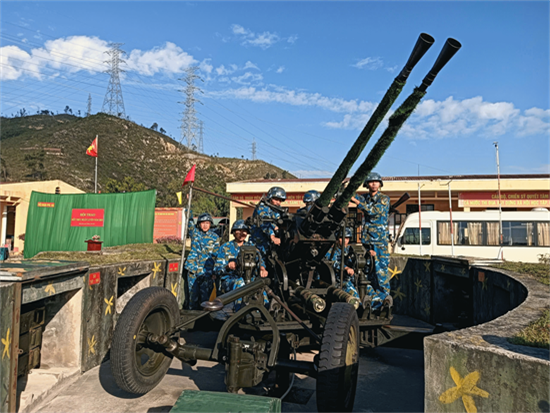 |
| Conduct training with anti-aircraft artillery |
Second, to conduct training and exercises in close alignment with mission requirements and operational characteristics. Based on higher-level resolutions, directives, and guidance on training, the Division directs its agencies and units to thoroughly prepare for training, with emphasis on refresher training and capacity-building for cadres, especially platoon and company-level officers and newly commissioned graduates. In the course of training, the Division adheres closely to the principle of “fundamental, practical, firm, safe, and economical", placing emphasis on comprehensive and specialised training in a modern direction, aligned with missions, operational areas, and the characteristics of air defence operations. For cadres, priority is given to improving operational planning and training advisory capabilities, ensuring they are “proficient at their own level and knowledgeable of higher levels". For sub-units, emphasis is placed on crew-based training, striving to achieve the objective of “crew 1 proficient, crew 2 competent", while mastering and effectively exploiting the capabilities of newly introduced and upgraded weapons and equipment. Greater attention is also devoted to night training, physical training, rapid manoeuvre and deployment for combat, as well as camouflage and deception drills under conditions in which the adversary employs high-tech weaponry and extensive electronic warfare. Concurrently, the Division coordinates with functional agencies of the Service to study and draw lessons from recent air defence operations in contemporary armed conflicts, promptly incorporating updated content, scenarios, and training plans, such as handling large-scale aerial incursions into fire zones and swarm UAV attacks, etc.
In parallel, the Division has focused on renewing training management and command in accordance with the principle of “centralised, unified, synchronised, effective, and non-overlapping", clearly defining responsibilities while promoting the initiative and creativity of agencies and units. Combat crews are organised in a scientific and rational manner, with comparable levels of knowledge to ensure uniformity in training. The Division has also accelerated the “Digital Literacy for All” movement, advanced the building of a “Digital Division”, and prepared high-quality human resources for the implementation of the “Sustainable Air Defence Dome” Project. The effectiveness of competitions and training contests has been brought into full play; model units in training have been established, and innovative practices widely replicated, while resolutely combating manifestations of subjectivity, excessive delegation, or the lowering of training standards. Through these scientific and appropriate measures, in 2025, 100% of training contents met requirements, with over 82% rated good or excellent; many Service-level competition events achieved excellent results; and all exercises were conducted with absolute safety.
Third, to strictly maintain duty regimes for surveillance and combat readiness. To effectively implement this task, the Division directs its agencies and units to thoroughly grasp higher-level orders, directives, and guidance, with emphasis on Order No. 750-CL/TM, dated 19 November 2021, issued by the Chief of the General Staff on handling air defence combat situations, readiness states, and transitions between combat levels. A high level of vigilance is upheld, with proactive coordination with local party committees, authorities, and armed forces stationed in the area to review, develop, supplement, and refine the system of documents and plans for combat readiness in protecting assigned key targets.
At the same time, the Division has proactively adjusted its air defence posture, rationally deploying radar stations, artillery positions, and missile sites in accordance with range, engagement envelopes, and the adversary’s directions of attack. This has created a multi-layered, integrated, and robust air defence posture capable of engaging targets from long range to close range, leaving no gaps in fire coverage. Strict duty regimes are maintained, from the Division Command Post down to sub-units, including duty officers, command duty, and combat duty, with clearly defined regulations on forces, equipment, and reserves for combat readiness. Communications are ensured to remain smooth and stable in any contingency, particularly for notification and alert networks; regular information exchange and coordination with other air defence forces in the area are maintained. The Division also frequently organises joint training and exercises in air defence operations with ground-based air defence forces, naval air defence forces, and militia and self-defence forces, thereby promoting the synergy of all forces in managing and safeguarding the airspace. As a result, the Division’s combat readiness capability has been steadily enhanced, with no incidents of error, omission, delay, or false alarms; 100% of sub-units have achieved the standard of “Good Combat-Ready Duty Unit", and readiness coefficients have met and exceeded assigned targets.
Fourth, to ensure comprehensive support, with a focus on technical support for training and combat readiness tasks. The Division has directed its agencies and units to review, supplement, and refine the system of logistics and technical support documents and plans in the new context, aligning them with existing capabilities while prioritising training, exercises, and combat readiness missions. Logistical regimes and standards are fully ensured, with particular attention paid to enhancing nutritional standards and providing healthcare for officers and soldiers, especially those in detached elements and units stationed in areas with harsh climatic and weather conditions, thereby maintaining the rate of personnel fit for training and combat readiness at over 99%.
As a technical combat unit being developed directly towards modernity, equipped with numerous new, high-tech weapons and systems, and operating in coastal and island environments with scarce replacement components, the Division faces demanding requirements in technical support. To meet these demands, it has directed the strict management of receipt, issuance, recovery, and handover of weapons and equipment, prioritising the introduction of new and upgraded systems into training and readiness tasks. Regulations on maintenance and preservation are strictly observed; repair facilities are regularly consolidated and upgraded, while mobile repair teams are effectively employed to promptly address malfunctions and maintain stable technical conditions in any contingency. Inspection and calibration work is conducted rigorously in accordance with legal provisions and procedures, enabling accurate assessment of technical conditions, operational capability, and safety indicators (with 100% of measurement and testing equipment meeting quality standards, synchronisation requirements, and full documentation). For newly introduced weapons and equipment, the Division coordinates with suppliers to conduct training, technology transfer, and mastery of operational, exploitation, maintenance, and servicing procedures. It has also vigorously promoted the campaign “Good, durable, safe, and economical management and exploitation of weapons and technical equipment, and traffic safety”, while encouraging research, innovation, and the application of science and technology in technical support. These efforts ensure that equipment availability and technical coefficients meet and exceed prescribed standards, thereby contributing to its successful fulfilment of training and combat readiness tasks and to the firm protection of the North-Eastern airspace of the Fatherland.
Senior Colonel, MSc. CAO VAN LU, Division Commander