
Achieving mastery of new and modern weapons and equipment is of decisive importance in enhancing overall quality and combat strength. Fully cognisant of this, Brigade 679 has been implementing a wide range of comprehensive, practical, and effective measures to create a firm transformation in proficiency and combat readiness, contributing to the building of a modern Navy and to the steadfast protection of the nation’s sovereignty over its seas and islands.
In 2026, Brigade 679, under Naval Region 1, has been assigned the task of serving as the model unit for training in the mastery of new weapons and equipment within the Navy. This represents a significant honour; however, it also presents numerous difficulties and challenges. The new weapons and equipment possess complex technical and tactical characteristics, integrate a wide range of modern technologies, and impose stringent requirements in terms of operation, utilisation, storage, maintenance, and repair, with marked differences from previous-generation systems. Meanwhile, the number of officers and technical personnel who have undergone transfer training remains limited, and the system of training grounds, ranges, facilities, and supporting equipment has yet to be fully synchronised. Confronted with this reality, to fulfil its role as a model unit, the Brigade has resolutely and comprehensively implemented a range of measures, guided by the objective of “rapid acquisition, firm mastery, and the safe, effective exploitation of new weapons and equipment.”
Enhancing Party commissioners and commanders’ leadership and direction at all levels; promoting the vanguard and exemplary role of cadres and party members
This constitutes the foundational measure, decisive to the quality of training for mastering new weapons and technical equipment. Immediately upon receiving the Navy’s decision designating it as a model unit, the Brigade Party Committee and Command issued a specialised resolution on leading the tasks of reception, training, operation, and mastery of new weapons and equipment. This document clearly defines training objectives and targets for each category of personnel and each phase, with a specific roadmap, while also setting out comprehensive measures to address the difficulties and challenges identified. On that basis, subordinate organs and units were directed to concretise these orientations through their own specialised resolutions, programmes, and training plans appropriate to their respective functions and responsibilities.
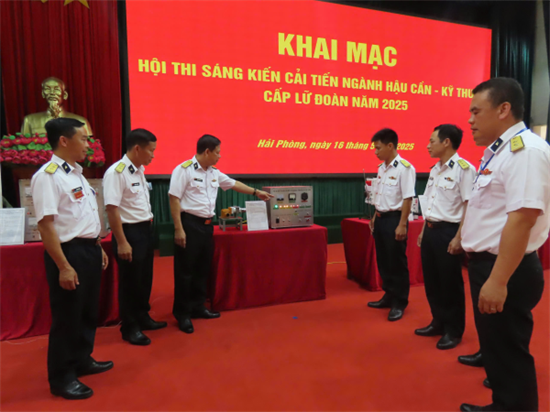 |
| Leader of the Brigade checks a model in the technical innitiative contest in 2025 |
During implementation, the Brigade required all organs and units - particularly party committees and commanders at every level - to thoroughly grasp and strictly adhere to the guiding principle: “train to mastery step by step, without haste or skipping stages.” Close coordination was ensured, avoiding overlaps in both the formulation and execution of training programmes. Priority was given to training for the mastery of new equipment, while not neglecting the effective operation of legacy systems. At the same time, decentralisation in management was strengthened, with clear assignment of responsibilities to each organ and unit. Cadres, especially those in key command positions, were required to demonstrate a vanguard, exemplary role, exercising initiative and creativity in organisation and execution. Inspection regimes and after-action reviews were rigorously maintained on a weekly, monthly, and periodical basis, enabling the timely identification and rectification of shortcomings. In parallel, the Brigade intensified political and ideological education to heighten awareness and responsibility among officers and soldiers regarding this critical task. Democratic practices were further promoted, creating conditions for personnel to exchange experience, proposing solutions to difficulties, and contribute to improving training quality. Through these efforts, unity in both awareness and action has been strengthened, fostering determination and generating strong motivation for officers and soldiers to actively study, train, and progressively achieve mastery of new weapons and technical equipment.
Thorough and comprehensive preparation for training
Proceeding from the stringent requirements and inherent complexity of the tasks of training, operation, and mastery of new weapons and equipment, as well as drawing upon many years of experience in training, the Brigade has determined that preparation must be conducted in a comprehensive and synchronised manner, with personnel as the central factor and material conditions as a crucial guarantee. Accordingly, the Brigade has proactively directed its subordinate organs and units to review and consolidate their forces, selecting cadres and technical personnel who possess strong professional competence, experience, agility of thought, and good age and physical condition. These are combined with those already trained through technology transfer programmes to form the core of specialised training detachments for new equipment, capable of meeting both immediate and long-term requirements. At the same time, plans have been actively developed to organise refresher courses and training programmes aimed at improving the qualifications of cadres and personnel at all levels. The content focuses on training organisation and methodology, the technical and tactical characteristics of new systems, and procedures for operation, utilisation, and the handling of technical contingencies arising during their employment. In parallel, dedicated instructor teams have been established according to specific components and systems of equipment (such as command vehicles, launcher vehicles, radar vehicles, etc.), thereby facilitating in-depth study and enhancing training effectiveness.
Alongside personnel preparation, the Brigade has attached due importance to ensuring adequate material conditions in support of training. Based on the overarching training programme, it has studied and developed specialised curricula tailored to the characteristics of new weapons and equipment, and has compiled lesson plans, diagrams, and training models. Particularly, it has drawn upon the experience of officers and technical personnel directly involved in the reception and transfer training of equipment to research, synthesise, and compile a comprehensive system of technical and tactical documentation, including operational procedures, sequences of actions, and command terminology for individual members of combat crews. On this basis, seminars have been held and reports submitted to higher authorities for appraisal and approval, providing an authoritative foundation for training implementation. From practical training activities, the Brigade has contributed more than 40 substantive recommendations to manufacturing units, assisting in the adjustment and refinement of certain operational procedures and equipment functions, thereby enhancing the stability, safety, and efficiency of equipment utilisation.
Concurrently, the Brigade has actively mobilised resources to invest in and upgrade training grounds, ranges, specialised classrooms, and simulation facilities; while promoting initiatives and technical innovations and developing numerous new training models and aids. These efforts have created a vivid and intuitive training environment, enabling troops to rapidly familiarise themselves with and master new equipment.
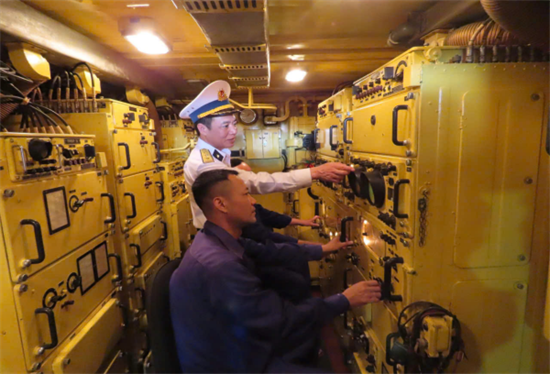 |
| Leader of the Brigade checks training work |
Conducting comprehensive, focused training closely aligned with objects and characteristics of new equipment
This is both a principled requirement and a key measure for rapidly mastering new weapons, materiel, and equipment. The Brigade has concentrated on training in a practical and effective manner, closely aligned with operational tasks, specific categories of personnel, and the distinctive features of new equipment. In this regard, technical training is regarded as fundamental, while tactical training constitutes the focal point; particular emphasis is placed on mastering new functions and capabilities that differ from those of legacy systems. Close integration is ensured between technical and tactical training, as well as between training according to individual roles and responsibilities and coordinated action within crews and sub-units.
To achieve high effectiveness, training is conducted along a structured progression from basic to advanced levels, with practical application as the central element. Personnel are required to grasp thoroughly the theoretical foundations, structure, and operating principles of the equipment; this is followed by training on models and simulation devices before progressing to practice on actual systems, thereby minimising the risk of damage arising from procedural errors. Due importance is attached to leveraging the expertise of officers and technical personnel who have undergone transfer training, enabling them to guide, mentor, and pass on practical experience in operating and mastering new equipment.
In particular, to meet the demands of operations under new conditions, the Brigade requires each serviceman not only to be proficient in his assigned duties but also to master two to three additional positions within the same crew, thereby ensuring the capacity for substitution and mutual support when required. At the same time, greater emphasis is placed on supplementary training in foreign languages and information technology for officers and soldiers, enabling them to proactively study, access new technologies, and enhance the effective exploitation of modern systems. In parallel, strict adherence is maintained to the regime of after-action reviews following each training subject, module, and on a daily, weekly, and monthly basis. Time is also allocated for crew members to exchange experience, engage in discussion, and promote self-study, self-research, and mutual development.
Closely integrating training for mastery of new weapons and equipment with combat training and technical support training
This constitutes an important measure for rapidly bringing new-generation weapons and equipment systems into operational use. Accordingly, the Brigade has directed its subordinate organs and units to proactively develop training scenarios closely aligned with combat realities; to intensify exercises aimed at enhancing capabilities in deployment and recovery of equipment, manoeuvre of positions, camouflage and deception, countering enemy reconnaissance and electronic warfare, and responding to the use of high-technology weaponry. Notably, through practical training, the Brigade has collected data on the execution time of each position within combat crews, the stability of technical parameters, and the ability to handle contingencies in specific situations. These data serve as a basis for determining technical standards, operational timelines, and for supplementing and refining the system of training documentation for new equipment.
As a unit combining both technical and combat functions, the Brigade places particular emphasis on linking training for equipment mastery with training in technical support. It requires that cadres and members of combat crews not only master operational procedures but also be proficient in inspection, preservation, maintenance, and the handling of common faults that may arise during use. In implementing the Brigade’s directives, subordinate organs and units have adopted a range of coordinated measures to improve the quality of technical support training, focusing on consolidating the corps of technical personnel and developing specialised technical cadres and skilled technicians capable of mastering technologies for the maintenance, servicing, and repair of new equipment in accordance with assigned levels of responsibility. At the same time, refresher courses and professional development programmes are regularly organised to enhance the expertise of technical personnel and commanders at all levels. To date, the Brigade has attained the capacity to provide effective technical support for new weapons and equipment, remaining ready to repair and rectify common faults, and to maintain optimal technical readiness in support of training.
With strong determination and the implementation of comprehensive and well-founded measures, the Brigade has achieved solid and positive results in training for the mastery of new weapons and equipment. This provides an important foundation for further enhancing its overall quality and combat strength, ensuring readiness to undertake and successfully accomplish all assigned missions, thereby contributing to the steadfast protection of the nation’s sacred sovereignty over its seas and islands.
Senior Colonel TRAN PHU BINH, Brigade Commander