
Planning and general affairs work in party and political work within the Vietnam People’s Army (VPA) constitutes an important component and a central link in ensuring that party and political work activities are conducted in a methodical, coherent, unified, and effective manner. Therefore, improving the quality of this important work will ensure that agencies and units successfully fulfil the objectives and requirements of party and political work activities, contributing to building a politically strong military in the new era.
In recent years, under the leadership of the Central Military Commission (CMC) and the direction and guidance of the General Department of Politics (GDP), directly by party committees and leading cadres of agencies and units, planning and general affairs work in party and political work throughout the VPA has been implemented in a synchronous and unified manner. The system of viewpoints, principles, regulations, rules, procedures, stages, and steps has been established and increasingly perfected. The dissemination and implementation of resolutions, directives, plans, and guidance issued by party committees and party organisations, as well as directives, orders, plans, and military tasks issued by commanders at all levels, have closely reflected the operational realities of agencies and units. Agencies, cadres and staff responsible for planning and general affairs work have consistently kept close to political tasks, practical developments, and the contents of party and political work activities in order to study, synthesise, and report results, while promptly proposing policies and measures to resolve emerging issues. This has enabled commissars, political officers, and heads of political agencies at all levels to direct and administer party and political work activities in a methodical, scientific, and effective manner, thereby contributing to improving the quality of task performance.
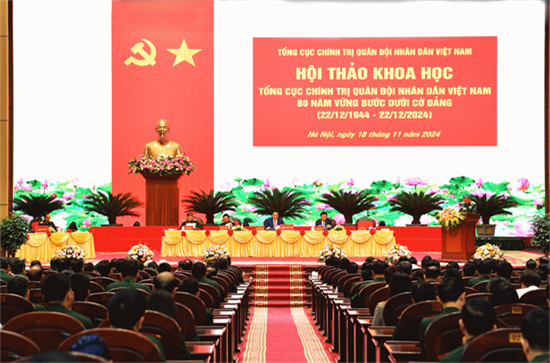 |
| A conference which was advised and recommended by the Office of the General Department of Politics |
In the coming period, the world and regional situation is forecast to undergo rapid and complex changes in the direction of multipolarity, multi-centredness, multilayered structures, fragmentation, and intensified bloc formation. Strategic competition among major powers will become increasingly fierce. Conflicts and wars will continue to occur in many regions with new and more dangerous forms and methods. The Fourth Industrial Revolution, particularly artificial intelligence (AI) and the Internet of Things (IoT), is developing rapidly and exerting profound impacts across all fields, including national defence and security.
Domestically, alongside fundamental advantages, our country continues to face numerous difficulties and challenges, while natural disasters and epidemics remain unpredictable. Hostile forces are intensifying sabotage activities against our revolution. Many breakthrough strategic decisions are being resolutely implemented. The VPA is being developed into a revolutionary, regular, elite, and modern force. At the same time, the continued adjustment and reorganisation of agencies and units towards a lean, compact, and strong structure are placing increasingly high demands on party and political work activities. This situation requires continued improvement in the quality of planning and general affairs work in party and political work, with focus placed on effectively implementing several fundamental tasks and solutions as follows:
First, enhanced awareness and responsibility of all relevant entities and forces regarding the position, role, and importance of planning and general affairs work in party and political work. This is an important component and central link ensuring that party and political work activities are conducted in a planned and unified manner. Accordingly, party committees, party organisations, commissars, political officers, commanders, and political agencies at all levels must continue to thoroughly grasp resolutions, conclusions, directives, and regulations of the Party Central Committee, the CMC, and party congresses at all levels, as well as regulations of the Politburo and Secretariat concerning party organisations and political agencies in the VPA, and concretise them to ensure close accordance with the practical situations of each agency and unit. Greater efforts should be made to educate and raise awareness and responsibility among party committees, commissars, political officers, commanders, political agencies, and political cadres regarding the position, role, and importance of planning and general affairs work in party and political work. Through the practical implementation of regulations and rules, shortcomings and inadequacies should be promptly identified in order to study and propose amendments and supplements, thereby improving the quality and effectiveness of party and political work activities across agencies, units, and the entire military, meeting the requirements of building a “revolutionary, regular, elite, and modern” military.
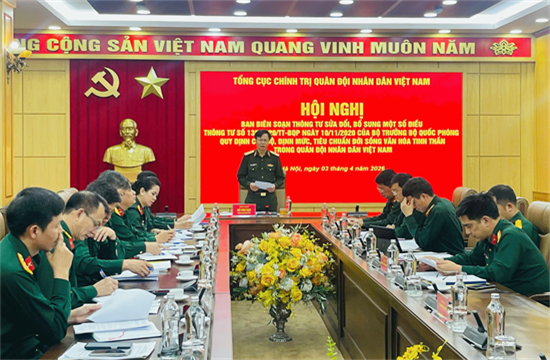 |
| Major General Do Van Dao chairs a law making meeting |
Second, strengthening of research, development, and perfection of regulations and rules concerning planning and general affairs work in party and political work. Agencies and units should continue to study and concretise regulations and rules issued by the Party Central Committee, the CMC, and the Ministry of National Defence (MND), while promptly proposing amendments and supplements to regulations governing planning and general affairs work in party and political work in line with each level, type of unit, function, duty, and organisational structure. The quality of staff work, recommendation, formulation, and implementation of directives, plans, and party and political work programmes at each level must be improved. Regulations on the system of party and political work documents for agencies and units, especially newly established, reorganised, and specialised units such as factories, companies, depots, stations, and faculties, departments, and offices within academies and schools, should be studied, concretised, and implemented. Documents at each level should be developed and promulgated in line with assigned functions and tasks. Systems of books and records for party and political work should be registered in a unified, scientific, and practical manner. Criteria for evaluating the results of party and political work activities appropriate to each level and type of agency or unit must be thoroughly grasped and strictly implemented to ensure comprehensiveness and substantive effectiveness. The spirit of self-criticism and criticism in self-assessment should be upheld; assessments and evaluations by higher levels must be objective, fair, accurate, and persuasive, thereby creating motivation for emulation within agencies and units.
Third, actively renewing methods of conducting planning and general affairs work in party and political work. Party committees, commissars, political officers, and commanders at all levels must regularly maintain close contact with grassroots units, closely coordinate with functional agencies to firmly grasp the situation, and enhance research and forecasting capacity in order to proactively advise on and propose guidelines and measures for timely and effective settlement of all situations, especially issues arising in the practical conduct of party and political work. Strict implementation of regimes for command duty, staff duty, combat readiness duty, and professional duty must be maintained in order to receive information within units and throughout the military, especially unexpected incidents, promptly report them according to decentralised authority, and direct handling within competence. Regulations and routines for reporting and notification in party and political work must be strictly observed. The quality of periodic (weekly, monthly, quarterly, biannual, and annual) and ad hoc research and synthesis of results should be improved. On that basis, guidelines and solutions should be proposed to enhance the effectiveness and efficiency of party and political work activities, remove difficulties and obstacles, and address newly arising or serious unexpected issues. Attention should be paid to information security to prevent leakage of military secrets. Administrative reform, digital transformation in party and political work, and the application of information technology in document development and management should be promoted. Registration and archival work should be well carried out to effectively serve briefings, preliminary reviews, final reviews, and the leadership and direction of party and political work activities at all levels.
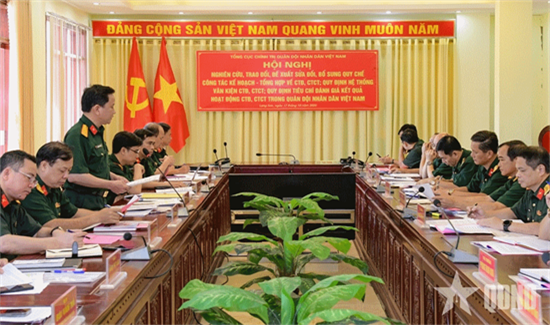 |
| The Office of the General Department of Politics chairs the conference on professional work at Lang Son province (Photo: qdnd.vn) |
Fourth, it is necessary for building a strong contingent of cadres and staff engaged in planning and general affairs work, commensurate with task requirements. Party committees, party organisations, commissars, political officers, and commanders at all levels should regularly pay attention to consolidating and fostering the qualifications and capabilities of political agencies and political cadres, with emphasis placed on creating personnel sources, fostering, arranging, and effectively utilising cadres and staff engaged in planning and general affairs work in both dedicated and concurrent positions. A contingent of cadres and staff engaged in planning and general affairs work in party and political work should be built with the qualities and working capacity required to meet task demands in the new situation, especially at the strategic level. Budget investment and adequate supplies and equipment for party and political work activities must be ensured. Based on task requirements, political agencies at all levels should proactively coordinate with finance agencies at the same level to formulate annual budget estimates, gradually meeting the requirements of party and political work activities in general and planning and general affairs work in particular. During implementation, attention should be paid to proper, economical, and effective use, management, and exploitation.
Fifth, regularly conducting preliminary reviews, final reviews, and lessons-learned activities regarding planning and general affairs work in party and political work. Agencies and units should attach importance to training courses, competitions, drills, inspections, evaluations, preliminary reviews, and final reviews at all levels. On a monthly, quarterly, biannual, and annual basis, alongside briefings and reviews of party and political work activities, comprehensive assessment of the implementation of regulations and rules concerning planning and general affairs work should be emphasised. Inspection should be strengthened in order to promptly identify, commend, and replicate creative and effective approaches, while drawing profound lessons from shortcomings and weaknesses so as to continuously improve the quality and effectiveness of implementing regulations and rules. Military academies and schools should study and incorporate planning and general affairs work in party and political work into teaching curricula, including probationary and extracurricular practical activities for officer cadets at platoon and company level and for political cadre trainees at regiment and division level. Every year, the Office of the GDP should take the lead, in coordination with the Political Academy, in organising professional training courses on planning and general affairs work for political cadres throughout the military, and coordinate with the Political Officers School in researching and proposing training contents on planning and general affairs work for final-year cadets prior to their assignment to units.
The synchronous, resolute, and effective implementation of the above fundamental solutions will not only serve as a prerequisite for improving the quality of planning and general affairs work, but will also ensure that the overarching purpose of planning and general affairs work is aligned with the objectives of party and political work within the military. This will contribute to maintaining and strengthening the Party’s absolute, direct, and comprehensive leadership, as well as the State’s centralised and unified management and administration over the VPA; building a politically strong military that will always remain a reliable political and fighting force, “absolutely loyal to the Fatherland, the Party, the State, and the people, steadfast in the Party’s revolutionary goals and ideals,” successfully fulfilling all assigned tasks and meeting the requirements of firmly safeguarding the Fatherland in the new situation.
Major General, Dr. DO VAN DAO, Chief of the Office of the General Department of Politics of the Viet Nam People’s Army