
In response to the requirements of building the Military and protecting the Fatherland in the new situation, the Cryptography Technical College has been promoting its development towards a smart and modern model, continuing to affirm its role in training and providing high-quality human resources for the Military Cryptography Sector.
The Cryptography Technical College (formerly the Technical Training School of the General Staff) (hereinafter referred to as the College) was established on 14 May 1951 and is tasked with training cryptographic technical personnel at college, intermediate, and elementary levels and providing professional training for staff members of the Military Cryptography Sector and international cadets.
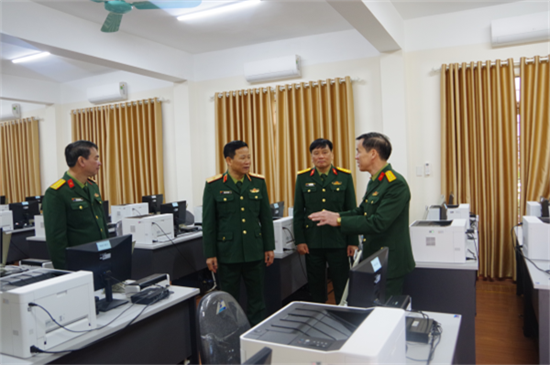 |
| The Department of Information and Training, General Department of Politics inspects a smart classroom of the College |
Throughout its 75-year journey of establishment, combat, and growth, generations of officers, lecturers, cadets, and soldiers of the College have consistently upheld the spirit of solidarity, proactiveness, and creativity, overcoming all difficulties, successfully fulfilling all assigned tasks. Their efforts have greatly contributed to the glorious achievements and proud tradition of the Vietnamese Cryptography Sector: “Loyalty, Devotion, Solidarity, Discipline, Creativity”. In recognition of these achievements, the College was awarded the title of Hero of the People’s Armed Forces (in 2011), along with many other prestigious distinctions.
In recent years, the tasks of ensuring information security and protecting state secrets amid the trend of digital transformation and the building of a modern Vietnamese Cryptography Sector have imposed new, higher, more comprehensive requirements on the College. However, the contingent of officers and lecturers in several specialities remains insufficient in number and uneven in qualifications, while equipment and technical infrastructure are still undergoing transition and modernisation. Against that backdrop, the College has stepped up a comprehensive reform, focusing on building itself into a smart, modern institution, creating a solid foundation for improving its training quality and developing high-calibre cryptographic human resources to meet the requirements of Fatherland protection in the new situation.
Grasping and implementing relevant resolutions and directives from higher echelons, the College Party Committee has issued a specialised resolution and plan to build a smart, modern College, with the goal of officially meeting the standards of a smart, modern institution by 2030. To realise this goal, the College has established a Steering Committee and specialised working groups for each criterion of the Smart Military School Criteria Framework. Specific responsibilities have been assigned to individuals to enhance the effectiveness of leadership, direction, management, and implementation. The College has also strictly maintained monthly and quarterly reporting, inspection, and evaluation mechanisms to promptly address emerging issues and ensure progress and quality in accordance with the established road map.
Furthermore, the College has promoted the roles and responsibilities of all-level party committees, commands, cadres, and party members in the implementation process, especially their exemplary role in applying digital technologies to leadership, command, and management, gradually creating a scientific, modern training environment. The College has regularly conducted preliminary and final reviews to draw lessons, promptly identify and rectify weaknesses, commend and replicate innovative, effective models and approaches. At the same time, political and ideological education has been strengthened to raise awareness and a sense of responsibility among cadres, lecturers, and cadets regarding the role, significance, and urgency of building a smart, modern College. Democracy has been promoted, while collective knowledge and strength have been harnessed to surmount difficulties and successfully fulfil this important task.
The contingent of officers and lecturers directly determines the quality of education and training and plays a core role in building a smart, modern College. Hence, the College has closely followed the Project “Building a contingent of teachers and educational managers in the Military for the period of 2023 - 2030 and beyond”, focusing its leadership and direction on developing a pool of officers and lecturers with sufficient quantity and high quality, properly structured, and standardised under regulations. Great value has been attached to enhancing in-depth expertise in cryptographic engineering and information security and fostering innovative thinking and technological mastery. Based on this orientation, the College has proactively reviewed and comprehensively evaluated its contingent of officers and lecturers as a basis for consolidating the organisational structure in a “streamlined and specialised” fashion. It has developed training and professional development plans with a focus on specialisation, ensuring sustainable development in line with the characteristics of specialised training and the requirements of expanding training programmes and target groups. At the same time, personnel have been utilised in accordance with their expertise to meet both immediate and long-term task requirements.
To further standardise and comprehensively enhance the capabilities of its contingent of officers and lecturers amid rapid scientific and technological advances, the College has actively advised higher echelons to send its officers and lecturers to training and professional development programmes at institutions both inside and outside the Military, especially in key fields such as cryptography, information security, and digital technology. It has intensified specialised training programmes on digital transformation, data utilisation, and operation of modern training management systems. It has fostered the development of e-lectures and digital learning materials, gradually establishing a digital teaching and learning environment suited to the characteristics of military education and training. Faculties and departments have actively conducted scientific research and developed products and software both serving teaching activities and meeting practical operational requirements.
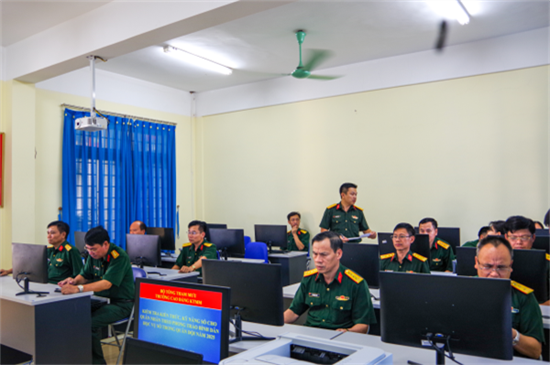 |
| Digital knowledge test for staff members of the College |
In addition to improving professional qualifications, the College has paid particular attention to building a pool of officers and lecturers with political steadfastness, a strong sense of discipline, absolute loyalty, and dedication to their duties, as role models for cadets to follow. Due regard has been paid to creating a favourable working environment and improving mechanisms and policies to attract highly qualified and capable cadres and lecturers to work at the College. Inspection, evaluation, and classification of personnel have been strengthened in a substantive, objective manner, serving as an important basis for personnel planning, utilisation, appointment, and long-term development. To date, the College has 2 Meritorious Teachers and 8 ministerial-level excellent lecturers; more than 30% of its lecturers hold postgraduate degrees; 100% of its lecturers are proficient in using information technology equipment and e-lectures. This serves as an important foundation for the College to keep improving the quality of education and training and further promote the development of a smart, modern institution in the coming years.
Grasping the mottos “Military schools must stay one step ahead” and “The quality of training at schools determines the combat readiness capacity of units”, the College has consistently adhered to higher echelons’ directives and units’ practical requirements to develop and refine outcome standards for each training group, ensuring that graduates would possess solid basic knowledge, specialised skills, and the ability to effectively manage, operate, and utilise their assigned cryptographic equipment and technical systems. It has reviewed, adjusted, supplemented, and improved training programmes and contents towards standardisation, practicality, and close alignment with operational functions and missions. Theoretical instruction has been reduced, while practical training, internships, and exercises have been increased. Scientific and technological advances in cryptography, information security, and digital transformation as well as knowledge and skills in management, operation, utilisation, and technical support of modern cryptographic equipment have been promptly updated and supplemented.
The College has promoted innovation in teaching methods, adopting a learner-centred approach to encourage initiatives and creativity, closely integrating knowledge delivery with the development of hands-on skills and experience in handling specific situations, linking training with units’ realities. Faculties and departments have actively applied information and simulation technologies in teaching activities, flexibly combining traditional and modern teaching methods, gradually forming a digital teaching and learning environment suited to the development trends of modern education and the requirements of digital transformation in the Cryptography Sector. Emphasis has been placed on reforming testing and assessment methods towards greater substance, objectivity, and comprehensiveness, shifting from knowledge-based evaluation to the assessment of practical application capabilities. Measures have been resolutely taken to deal with the “achievement-driven disease” and maintain strict discipline and order in education and training. As a result, the College’s training quality has significantly improved; graduates have demonstrated rapid adaptability, becoming proficient in operating technical equipment, receiving high evaluations from units.
Investing in synchronised and modern facilities and infrastructure and promoting digital transformation is an important factor directly underpinning the building and operation of a smart, modern College. Accordingly, the College has developed and submitted the Project on “Investing in facilities, improving the capacity and quality of training and professional development for cryptographic personnel at the Cryptography Technical College” for approval. Under this Project, priority has been given to procuring modern, specialised equipment, particularly cryptographic technical systems, standardising and modernising lecture halls, specialised classrooms, smart classrooms, and training grounds. The College has gradually acquired advanced teaching equipment, simulation devices, and specialised software for training in cryptography and information security to meet its practical training requirements.
Besides, the College has enhanced digital transformation under a proper road map, with a focus on completing digital infrastructure, developing shared databases, applying software for training, cadet, and teaching management, step by step digitalising documents and curricula, and building digital libraries. In particular, given the specific nature of the Cryptography sector as a “confidential and vital” field, the College has always placed strong emphasis on ensuring information security throughout the process of building and operating digital infrastructure. Procedures and regulations for managing and utilising equipment have been established and strictly maintained; regular inspections and evaluations have been conducted to promptly detect and address potential risks, and ensure stable, absolutely secure system operation under all circumstances. At the same time, the work of maintenance, repair, and preservation has been well carried out to increase the service life and operational efficiency of equipment.
Towards the 75th anniversary of its Traditional Day, the Cryptography Technical College will continue promoting innovation, digital transformation, and “digital literacy” and Determined to Win Emulation Movements. The College will also continue to strictly maintain discipline and regularity in all activities, especially in education and training, management, and operation of equipment systems and technological infrastructure. These efforts will provide a solid foundation for building a smart, modern College, thereby contributing to the development of a revolutionary, regular, elite, modern Cryptography Force in the new situation.
Sr. Col. MAI NGOC THINH
Rector of the College