The 14th National Party Congress identifies exemplary conduct by cadres and Party members as a key component of Party building and rectification. Effectively fulfilling this responsibility is a key factor in ensuring that the Vietnam People’s Army (VPA) remains politically strong and continuously enhances its overall quality and combat strength.
During his lifetime, President Ho Chi Minh attached special importance to the exemplary role of cadres and Party members. He affirmed that “A living example is worth more than a hundred propagation speeches”. At the same time, he required cadres and Party members to “match words with deeds” and to “take the lead” so that the masses would “follow their lead”.
Guided by his thinking, throughout the process of leading the revolution, especially since the beginning of Doi Moi (national renovation), the Party has consistently attached great importance to the exemplary responsibility of cadres and Party members, particularly leaders at all levels, as reflected in the documents of National Party Congresses and in resolutions, directives, and regulations issued by the Party Central Committee, the Politburo, and the Secretariat. This has been regarded as an issue of particular importance to Party building and rectification. The Party has also promulgated specific and clear regulations on exemplary responsibility for cadres and Party members to strive to fulfil.
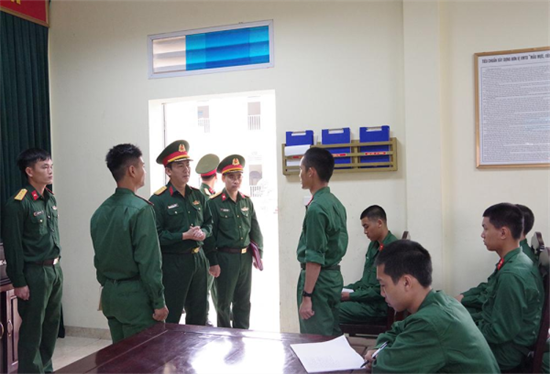 |
| Cadres and new soldiers of Division 308 (photo: dangcongsan.org.vn) |
Key highlights of the 14th National Party Congress perspective on the exemplary responsibility of cadres and Party members
Building on earlier perspectives, the 14th National Party Congress marks a new development in theoretical thinking and practical guidance on Party building and rectification, including the exemplary role of cadres and Party members, particularly leaders at all levels, as the country enters a new era of development.
First, the exemplary responsibility of cadres and Party members, especially leaders at all levels, is placed within the broader effort to renew the Party’s leadership methods and enhance its leadership and ruling capacity. The Congress stresses the need to “attach importance to cultivating and promoting the exemplary spirit of cadres and Party members in performing their assigned tasks and duties and in practising revolutionary ethics, professional ethics, and public-service ethics in their daily work”. It clearly states that “setting an example must truly become an important component of the Party’s leadership methods”. This is a notable feature of the 14th National Party Congress, which views exemplary conduct as not only an ethical standard, an organisational principle of the Party, and a political criterion for cadres and Party members, but also an important component of efforts to renew the Party’s leadership methods and improve its leadership and ruling capacity. In practice, any failure by cadres and Party members to set an example in words and deeds, or any lack of initiative and creativity in action, directly undermines the prestige, leadership capacity, and combativeness of Party organisations, eroding the people’s trust, diminishing the effectiveness of leadership and management.
Second, exemplary conduct by cadres and Party members must be demonstrated in action, including the courage to think, act, and take responsibility for the common good. This represents a breakthrough as our Party shifts the emphasis from merely “not doing wrong” to “having the courage to do what is right and see it through”, especially given that “a number of cadres and Party members, including high-ranking officials, lack self-cultivation and training, fail to set an example, and show signs of shirking or evading responsibility, lacking the courage to act and innovate”. Thus, setting an example is not only about maintaining integrity but also about leading by example in action, demonstrating the ability to implement tasks effectively, rally people, and mobilise collective strength to accomplish tasks. This is also an important measure to prevent avoidance of responsibility, buck-passing, and irresponsible conduct in the performance of official duties.
Third, exemplary responsibility must be closely linked to public-service ethics, accountability, and supervision by the people. The 14th National Party Congress emphasises “the relationship between building ethics within the Party, within the political system, and across society, and the exemplary role of cadres and Party members, especially leaders, before the people”. This viewpoint shows that the exemplary responsibility extends beyond the confines of internal discipline or assessment by Party organisations, to a broader sphere where the conduct of cadres and Party members is subject to the people’s supervision. Accordingly, each cadre and Party member must be subject to assessment not only by Party organisations but also by the people through work performance, attitude towards serving the people, and accountability, thereby ensuring that exemplary responsibility is fulfilled in a substantive and effective manner.
Fourth, the principle that “higher positions entail greater exemplary responsibility” has become a more stringent political and disciplinary requirement. The 14th National Party Congress builds on the perspective of the 13th National Party Congress while further developing the principle that “higher positions entail greater exemplary responsibility for cadres and Party members”. This is not only an ethical requirement but also a principle for exercising power control within the Party. Accordingly, the 14th National Party Congress calls for “enhancing the responsibility and exemplary role of cadres and Party members, especially leaders”. Leaders must be truly exemplary in political steadfastness, moral qualities, lifestyle, qualifications, competence, working style, dedication to serving the people, sense of discipline, sense of responsibility, and task performance. They must preserve their honour and integrity, and dare to speak, dare to act, dare to take responsibility, and dare to act for the common good.
Solutions for promoting the exemplary responsibility of cadres and Party members in the VPA under the Resolution of the 14th National Party Congress
Today, as the country enters a new era of development and the Military is being built into a revolutionary, regular, elite, modern force, promoting the exemplary responsibility of cadres and Party members in general, and those in the VPA in particular, in accordance with the Resolution of the 14th National Party Congress has become more important and urgent. Accordingly, the following key solutions should be effectively implemented.
First, thoroughly grasping the viewpoints of the 14th National Party Congress on promoting the exemplary responsibility of cadres and Party members. This represents the foremost solution, requiring Party committees, Party organisations at all levels, and units across the entire VPA to clearly recognise the importance of exemplary responsibility while strengthening their leadership and guidance. Exemplary responsibility should be promptly concretised into a specific, rigorous, consistent system of criteria closely aligned with the positions, responsibilities, and duties of each group of cadres and Party members. Qualitative and quantitative criteria should be appropriately combined to ensure that persons, tasks, and responsibilities are clearly identified. The requirements for setting an example should be closely linked to performing political tasks, building regularity, maintaining discipline, preserving internal unity, and safeguarding the prestige of cadres and Party members in their agencies and units. Effectiveness in fulfilling assigned tasks and the level of trust they command should serve as the main yardsticks for annual assessment of cadres and Party members’ exemplary conduct and their overall quality.
Second, strengthening the exemplary responsibility of leaders of agencies and units. This is crucial to the quality of leadership and command, as well as to the building of agencies and units. Accordingly, leaders, especially those at the operational and strategic levels, must be truly exemplary in political steadfastness, remain “absolutely loyal to the Fatherland, the Party, the State, and the people, and steadfast in the Party’s revolutionary goals and ideals”, strictly and exemplarily observe the Party’s lines and resolutions, the State’s laws, and military discipline, uphold high standards of morality and a healthy lifestyle, and adopt a scientific, hands-on, resolute working style. The practice of democracy must go hand in hand with strict discipline and order; words must be matched by deeds; cadres must dare to think, dare to act, and dare to take responsibility for the common good. It is necessary to resolutely overcome manifestations of saying much but doing little, avoiding difficult issues, shying away from confrontation, passing the buck, or failing to set an example before the collective. At the same time, due regard must be paid to taking the lead in realising the directions of General Secretary and State President To Lam on the “two steadfast commitments, two accelerations, and two preventions”, as well as the “five pillars” motto.
Third, closely combining exemplary responsibility with personnel work and the building of pure, strong Party organisations. Practice shows that Party committees and Party organisations can only be truly pure and strong when all cadres and Party members, especially leaders, properly fulfil their exemplary responsibility. Therefore, exemplary conduct should be made a mandatory criterion in Party organisation building and in personnel planning, training, appointment, evaluation, classification, and promotion. Exemplary responsibility should be regarded as an important yardstick for assessing the prestige and leadership and command capacity of cadres and Party members. Cadres who fail to set an example, have low prestige, or show signs of degradation must not be appointed or placed in positions of responsibility. At the same time, role models who demonstrate a strong sense of responsibility to set an example and a high level of task fulfilment should be promptly identified, commended, and promoted to create a positive ripple effect within units and throughout the VPA.
Fourth, strengthening inspection and supervision of the fulfilment of exemplary responsibility. This is an important solution for ensuring rigour and substantive implementation in promoting the exemplary responsibility of cadres and Party members. The Resolution of the 12th Congress of the Military Party Organisation advocates “strengthening leadership through inspection, supervision, and the exemplary role of cadres and Party members”. Accordingly, exemplary conduct should be incorporated into regular and ad hoc inspection programmes of Party committees and inspection commissions at all levels to promptly detect and correct deviations as soon as they arise. At the same time, violations must be strictly handled to ensure that all cadres and Party members are equally subject to Party discipline and military discipline, with “no forbidden zones” and no exceptions. Disciplinary action should be closely combined with education, prevention, and deterrence. The supervisory role of Party committees, inspection commissions, and mass organisations with regard to the exemplary responsibility of cadres and Party members should be brought into full play.
The coordinated implementation of the above solutions will make a practical contribution to building an increasingly strong contingent of cadres and Party members in the Military and building a politically strong VPA that remains an absolutely loyal and reliable political and fighting force of the Party, the State, and the people.
Col. KHUAT TRONG NAM, PhD
Faculty of Scientific Socialism
Political Academy