Throughout its 60-year history of construction and development (28 October 1966 – 28 October 2026), the Military Technical Academy has continuously pursued innovation, improved the quality of education, training and scientific research, and proactively expanded international cooperation. By leveraging advanced knowledge, technologies and experience, the Academy has enhanced its endogenous capabilities, promoted innovation, and gradually affirmed its position as a leading centre for education, scientific research and technology transfer within the Army and the country, making an important contribution to Army building and national defence.
From its early days of establishment, when the country was still at war, the Academy, then known as the Second Branch of the Hanoi University of Technology, proactively advised higher authorities on the selection and dispatch of numerous outstanding cadres, lecturers and trainees to the Soviet Union and other socialist countries for study and research. This enabled them to acquire advanced scientific knowledge, laying the foundations for the Academy's development and contributing to the advancement of various fields of military science and technology in Viet Nam.
Following national reunification, the Academy continued to expand international cooperation under the new circumstances through a two-stage training model, creating favourable conditions for its cadres and trainees to gain access to modern scientific and technological achievements and advanced research environments. This, in turn, contributed to the development of highly qualified engineers, scientists and technical personnel capable of meeting the requirements of Army building and national development. A significant milestone in this development came in 1991, when the Academy was officially renamed Le Quy Don Technical University, opening up broader avenues for cooperation with civilian partners at home and abroad. Since then, international cooperation has received increasing attention and become an important bridge enabling it to access advanced knowledge and technologies, enhance education and training and scientific research, and strengthen its standing both nationally and internationally.
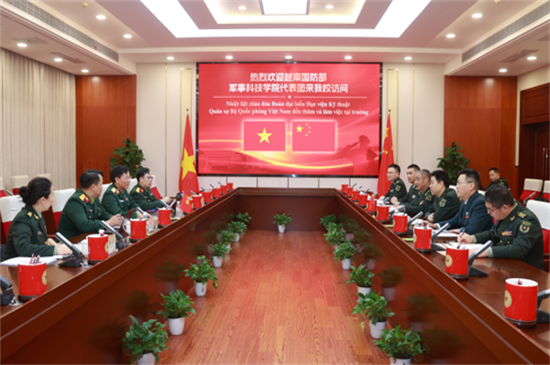 |
| The Academy visits and works with China's National University of Defence Technology in 2025 |
Entering the period of renovation and international integration, and based on thoroughly grasping the Party's viewpoints and guidelines on foreign relations and international integration, particularly Resolution No. 806-NQ/QUTW, dated 31 December 2013, of the Central Military Commission, entitled “On international integration and defence diplomacy through 2020 and beyond”, the Academy has issued numerous resolutions, directives, plans, programmes and projects on international integration and defence diplomacy. A key focus has been the implementation of overseas training and professional development programmes for cadres, tailored to different periods and achieving positive results. Notably, during this period, while maintaining its traditional and fruitful cooperative relations with major academies, universities and research institutes in the Russian Federation, Eastern European countries and Cuba, among others, the Academy expanded its cooperative relations with countries possessing advanced scientific and technological capabilities, including Japan, the Republic of Korea, Australia, India and several European countries. Thousands of cadres, lecturers and trainees have undertaken master and doctoral programmes and research internships overseas, bringing back new knowledge, as well as advanced teaching and research methods, for application at the Academy. Academic exchanges, co-supervision of doctoral candidates and joint implementation of international-level scientific research projects have also been intensified. Several advanced programmes, curricula and academic materials from leading universities worldwide have been selectively adopted, translated and integrated into the Academy's training programmes, making an important contribution to improving the quality of education and training and scientific research, as well as enhancing the Academy's standing and prestige within the Army's, national and international education and training systems.
Today, as globalisation and international integration deepen, science, technology, innovation and digital transformation have become central drivers determining the comprehensive strength and competitiveness of nations, and are of particular importance to Army building, the strengthening of national defence and the safeguarding of the Fatherland. For the Academy, further promoting international cooperation has therefore become increasingly pivotal and is identified as a means of mobilising and connecting knowledge and technological resources. This contributes to improving the quality of education and training and scientific research, developing the Academy into a research university and a leading centre for education, scientific research and innovation within the Army and the country, while enhancing its international standing.
To realise this goal, first and foremost, the Academy will focus on education and awareness-raising, build strong political determination, and generate new momentum and dynamism in international cooperation and defence diplomacy. This is a key task and solution of paramount importance for bringing into full play the combined strength of all components and forces, while ensuring that international cooperation develops in the right direction and with high effectiveness. Accordingly, the Academy will continue to thoroughly disseminate and implement Resolution No. 59-NQ/TW, dated 24 January 2025, of the Politburo (13th Party Central Committee) on international integration in the new situation; and Resolution No. 2662-NQ/QUTW, dated 26 February 2024, of the Central Military Commission on international integration and defence diplomacy through 2030 and beyond. These efforts are intended to ensure that all cadres and Party members, particularly Party committees and commanders at all levels, gain a deeper understanding of the position and role of international cooperation and defence diplomacy; thoroughly grasp the guiding viewpoints, development objectives through 2030, with a vision to 2045, and the key tasks and solutions associated with the requirements for developing the Academy into a leading research university of the Army, the country and the world. On this basis, a common understanding will be established that international cooperation constitutes a central political task, a key to and a driving force for the Academy's development. At the same time, the Academy will shift decisively towards proactive, substantive and effective cooperation, closely linking international cooperation with education and training and scientific research.
Building on the results achieved and lessons learned, the Academy will continue to study and propose improvements to the legal framework and internal regulations governing external relations, ensuring strict compliance with regulations of the State and the Ministry of National Defence while establishing an open and flexible mechanism to remove administrative bottlenecks and facilitate scientists' access to global research funds and partners. At the same time, importance will be attached to fostering the spirit of creativity and encouraging cadres and Party members, particularly those in leadership positions, to think boldly, act decisively and take responsibility in international cooperation. The results of this work will be used as a criterion for annual emulation and commendation.
 |
| Japan's Minister of Defence visits and works with the Academy in 2024 |
Second, the Academy will expand the scope of international cooperation, diversify its partners, and deepen and substantiate cooperation with strategic partners. The partner network serves as a channel for mobilising and transmitting knowledge, technological and financial resources. Shifting the focus from quantity to quality and from breadth to depth will enable the Academy to make the fullest use of the strengths of technological powers, thereby narrowing development gaps while saving research time and public funds. To this end, alongside maintaining and further deepening traditional relations with strategic partners in the Russian Federation and Eastern European countries, the Academy will continue to advance its “Eastward” and “Westward” outreach, establishing strategic partnerships with leading research institutes and universities in Japan, the Republic of Korea, Australia, India and Europe in key fields such as automation, artificial intelligence, semiconductors, quantum technology, new materials technology, and others.
The Academy will direct its functional agencies, particularly the Department of International Cooperation and Management of Military International Students and the Department of Military Science, to continue studying and completing the “Strategic Partner Map”. Partners will be clearly classified by level, including comprehensive strategic partners, project-based specialised partners and potential partners, thereby enabling appropriate policies for relations and cooperation to be formulated. At the same time, it will comprehensively review and assess signed memoranda of understanding (MOUs), resolutely filtering out and terminating those that are merely formal or have become “dormant”. New agreements must be closely aligned with its academic needs, with their implementation periodically assessed using key performance indicators (KPIs), such as the number of experts exchanged and joint scientific outputs. The Academy will also proactively advise and propose the establishment of high-level dialogue channels through defence attaché networks, science and technology counsellors at embassies, and other relevant channels. This will enable it to gain early access to government scholarships and non-commercial technology-transfer funding programmes serving education and training.
Third, building a corps of prestigious, highly qualified leading cadres, educators and scientists with the capacity to teach, conduct independent research and participate in international scientific forums. This is an important solution that directly enhances the Academy's standing and prestige, as well as the quality and effectiveness of its international cooperation. In the coming period, the Academy will continue to closely follow the Government's and Ministry of National Defence's programmes and projects on international training cooperation in order to send outstanding young cadres and lecturers abroad for master's and doctoral training and postdoctoral research, thereby building and developing a pool of experts, educators and leading scientists.
To effectively implement this policy, the Academy will continue to raise foreign-language proficiency standards for professional and leadership positions, making proficiency in English and Russian a prerequisite for the recruitment, appointment and planning of management cadres. It will establish a roadmap requiring young lecturers to acquire the ability to teach their specialised subjects in a foreign language. At the same time, the Academy will continue to maintain incentive and encouragement policies for scientists whose research is published in Q1 and Q2 journals indexed in the ISI/Scopus databases or who hold international patents with significant economic and defence value. Scholar-exchange programmes will be expanded, with foreign professors and military experts, particularly overseas Vietnamese scholars and intellectuals who have established themselves internationally, invited to deliver guest lectures, co-supervise doctoral candidates and lead core research projects at the Academy. Policies covering the entire process, from selection and dispatch for training to post-training reception, placement and employment, will be further supplemented and refined, ensuring that cadres and trainees return to long-term service and effectively apply the knowledge, experience and professional expertise acquired for the benefit of the Academy.
Fourth, closely linking education and training with research and development, and establishing internationally competitive research groups. This is the shortest route for the Academy to directly translate academic knowledge into technological solutions and concrete products serving Army building. In the coming period, the Academy will continue to make strong innovations in its approaches to international cooperation, moving from a mindset focused primarily on “receiving scholarships and acquiring knowledge” towards research cooperation based on equality, with results and intellectual property rights shared in accordance with regulations. As an immediate priority, the Academy will actively negotiate with partners to establish joint laboratories, research and development centres, and technology development and exploitation facilities, drawing on technologies and expertise from international partners while combining them with its own counterpart resources in infrastructure, personnel and research capabilities. The Academy will step up the planning and investment in interdisciplinary research groups of high capacity, granting their leaders the maximum possible autonomy in financial management and personnel organisation. It will also develop and consolidate the legal framework and internal procedures for intellectual property protection in international cooperation projects, ensuring national and Army interests when shared research outcomes are commercialised or transferred for use in economic and defence production processes.
Fifth, modernising technological infrastructure and developing a “Smart University” ecosystem. Infrastructure, particularly digital infrastructure, is the “launch pad” for achieving the objectives of international integration. A smart and modern working and learning environment on a par with those of the region and the world will not only attract international experts and students to work and study at the Academy, but also overcome barriers of space and time and connect the Academy with global knowledge. With this in mind, in the coming period, the Academy will continue to closely follow approved projects, plans and programmes on international cooperation and concentrate resources on developing infrastructure based on the smart-university model. A key priority will be the development of a modern digital academic ecosystem, with a focus on investing in, obtaining access rights to and interconnecting its library with the world's major academic databases, including Web of Science, Scopus, IEEE Xplore and ScienceDirect. The Academy will develop smart classroom complexes, interactive multimedia lecture theatres and online conference facilities integrated with military-grade secure transmission technologies, providing a foundation for organising annual international scientific conferences and cross-border thematic seminars. It will also make bold investments in simulation systems, virtual reality and mixed-reality technologies, enabling trainees to practise, disassemble and assemble, and operate advanced weapons and equipment supplied by foreign partners in virtual environments before the actual transfer of equipment. This will both ensure a vivid and immersive learning experience and save millions of US dollars in operating and equipment depreciation costs.
With the right strategic orientation and a solid foundation, the Military Technical Academy will continue to intensify the implementation of the above tasks and solutions for international cooperation, contributing to the successful fulfilment of its mission to train high-quality human resources, conduct scientific research and master strategic technologies, thereby meeting the requirements of Army building and national defence in the new situation.
Major General, Prof., PhD TRAN XUAN NAM, Deputy Director of the Academy