Legal dissemination and education serve as a bridge, bringing the guidelines and policies of the Party and the laws of the State to the public. Accordingly, alongside maintaining presence at sea and monitoring fishing grounds, Fisheries Surveillance Flotilla No. 2 focuses on enhancing the effectiveness of this vital task through scientific and practical measures. These efforts aim to raise fishermen's awareness and compliance with the law, thereby contributing to the stability of maritime activities and firmly safeguarding the security and sovereignty of the nation's southern seas, islands, and continental shelf.
In addition to duties such as patrolling, monitoring, detecting and handling legal violations, conducting specialised fisheries inspections, participating in disaster prevention and search-and-rescue operations, protecting fishing grounds, and supporting fishermen in seafood harvesting and maritime economic activities, Fisheries Surveillance Flotilla No. 2 plays a core role in disseminating legal information and guiding legal compliance among fishermen in coastal areas, spanning from Cu Lao Xanh (Gia Lai) to the northern bank of the Dinh An estuary (Vinh Long), including the Spratly Islands.
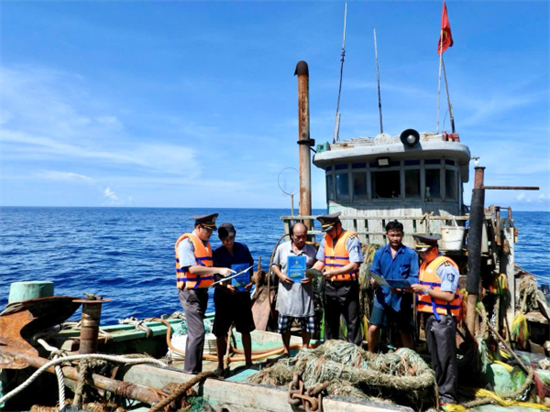 |
| Conducting legal dissemination offshore |
With great determination and effort, the Flotilla prioritises the dissemination of legal information and the encouragement of legal compliance among fishermen. These activities are conducted on a regular basis by means of diverse, creative methods that ensure substantive results. Notably, fishermen have developed an increasingly deeper understanding of international law, Party guidelines, Government decrees, and legal regulations concerning maritime economic activities in general and the fisheries sector, in particular. Cheating actions, such as the use of fake registration numbers on fishing vessels and the removal of vessel monitoring systems for transfer to other ships have decreased significantly; meanwhile, crimes involving drugs and human trafficking, smuggling, commercial fraud, and counterfeit goods are being progressively curbed. Especially, illegal, unreported, and unregulated (IUU) fishing activities are declining year by year, creating a stable environment for the sustainable development of the fisheries sector and resolutely clearing the shortcomings and limitations as recommended by the European Commission’s (EC) to lift the “IUU yellow card” warning.
To achieve these results, the Party Committee and Command of the Flotilla have implemented numerous synchronised, appropriate, and effective measures, focusing on the following ones:
First, the Flotilla promotes the role of Party committees, especially those of the ships in the dissemination of legal information. This measure is of critical importance as its forces operate across vast maritime areas, while the professional levels and capabilities of its troops are unequal, coupled with an ever-increasing need to raise fishermen's legal awareness and compliance. To ensure effectiveness, the Flotilla focused on thoroughly grasping conclusions, decrees, and directives concerning legal dissemination and the functions and duties of the Fisheries Surveillance Force. These efforts fostered a fundamental and comprehensive progress in the awareness and sense of responsibility among Party committees and officers at all levels regarding legal education, while ensuring unified, potent, and effective leadership and command during implementation.
On an annual basis, Party committees closely monitor the status of legal compliance and analyse the causes of violations by fishermen as a basis for formulating resolutions and collaborative programmes with objectives, targets, and contents that align with the unit's capabilities as well as the specific backgrounds and levels of awareness of different groups of fishermen. During implementation, the Flotilla prioritises coordination with local Party committees, authorities, the Fatherland Fronts, mass organisations, and mass media to develop and execute plans for raising awareness about sea and island issues, integrated with legal education for fishermen. It strengthens leadership, direction, supervision, and inspection across all stages, from formulating plans and programmes, making preparations in personnel, equipment, and materials, and conduct training and capacity building, to the practical application of various dissemination and educational methods. It attaches importance to conducting reviews to draw lessons, effectively address limitations and shortcomings, and identify more creative and efficient ways of implementation. As a result, efforts to disseminate information, educate, and encourage fishermen to comply with the law are implemented comprehensively and rigorously, both on land and at sea, thereby making a significant contribution to fostering a sense of legal compliance among fishermen and encouraging their participation in safeguarding sovereignty and maintaining a peaceful, stable maritime environment.
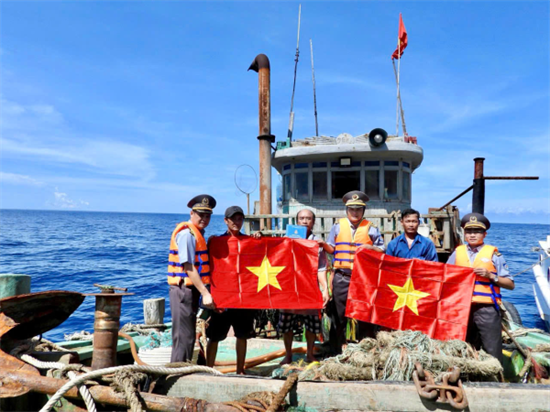 |
| Presenting national flags to fishermen |
Second, building a contingent of personnel serving concurrently as lecturers and disseminators which is both substantial in number and excellent in qualifications and skills, to meet the increasingly demanding requirements of the mission. This constitutes the core force determining the effectiveness of this work; ultimately, in any endeavor, the persons carrying out the tasks, are the most critical factor. Fully recognising this, the Flotilla employs comprehensive measures ranging from selection and training to deployment and remuneration policies tailored to the unit's specific mission characteristics and capabilities. Periodic reviews are conducted to streamline and strengthen the team towards “lean and high-quality” direction with priority being given to Party secretaries and deputy secretaries, political officers, Youth Union cadres, and staff members who possess strong political integrity, legal knowledge, and proficiency in mass mobilisation. In addition, prior to every deployment, vessels reinforce their propaganda teams, and provide assistance to fishermen, while also coordinating with competent authorities to execute their duties. Consequently, the Flotilla now consistently maintains a sufficient number of personnel to fulfill this vital mission.
To ensure this team possesses the necessary legal knowledge, dissemination skills, and the ability to flexibly apply various methods, the unit conducts regular reviews, categorisation, and assessments of its officers, staff, and fisheries surveillance personnel as a basis for continuous training and professional development, including knowledge of fisheries-related laws and regulations. The Flotilla frequently holds training sessions to enhance theoretical understanding and equip personnel with skills in drafting outlines and conducting oral propaganda. It also holds contests and competitions, creating a platform for personnel to gain practical experience, learn from their peers, assess their actual capabilities, and identify promising new talent. At the same time, practical activities are utilised to hone skills in handling real-world situations; time is allocated and legal reference materials are stocked on each vessel to encourage officers and staff to conduct self-study, research, and update their legal knowledge. What’s more, timely incentive and reward policies are implemented to motivate personnel and foster a strong sense of responsibility. As a result, the quality of this workforce has been steadily improved. Since the beginning of 2025, they have successfully drafted nearly 100 pieces of outreach content; conducted direct dissemination to over 1,000 fishing vessels and nearly 10,000 fishermen; distributed nearly 3,000 documents and leaflets; and communicated with over 20,000 fishermen across nearly 2,000 fishing vessels via radio.
Third, identifying key content areas and effectively combining various communication methods and approaches. Fishermen possess varying levels of knowledge and awareness; furthermore, the high-intensity nature of their work leaves them with limited time and opportunity to access legal information in a structured manner. Consequently, selecting concise, focused, and impactful content ensures the information is memorable, comprehensible, and feasible. To ensure effectiveness, the Flotilla directs its political agencies and vessel crews to tailor materials to specific audiences. Priority is given to fundamental aspects of the 1982 UN Convention on the Law of the Sea (UNCLOS), Law of the Sea of Vietnam, the Law on Fisheries, and the Law on Marine Environmental Protection; maritime delimitation and joint exploitation agreements between Vietnam and regional countries; Government Decree No. 246/2026/ND-CP, dated 29 June 2026, regarding administrative penalties in the fisheries sector; and Penal Code provisions concerning narcotics, human trafficking, smuggling, and commercial fraud. Particular emphasis is placed on Directive No. 45/CT-TTg, dated 13 December 2017, of the Prime Minister on urgent tasks and solutions to address the European Commission’s warning on combating illegal, unreported, and unregulated (IUU) fishing. Since the beginning of 2025, the Flotilla has compiled hundreds of documents, including legal handbooks offering specific guidance on lawful fishing operations; Q&A leaflets and brochures designed for quick comprehension; and broadcast content transmitted via ship-to-ship communication channels.
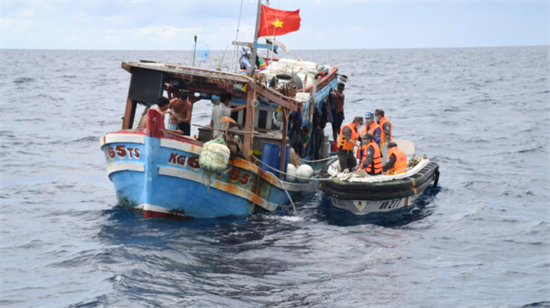 |
| Supporting fishermen operating offshore |
As shown in practice, laws and subordinate legal documents are often dry, academic, and difficult for most fishermen. Therefore, employing different communication methods tailored to specific audiences is crucial. Beyond simply distributing printed materials, the Flotilla utilises various approaches: dispatching personnel to fishing vessels for direct engagement with fishermen; broadcasting information via loudspeakers and communication channels from fisheries surveillance ships; opening mock trials that simulate violation cases to provide vivid, visual education; and installing billboards and slogans regarding anti-IUU fishing at fishing ports. Regarding foreign fishing vessels encroaching upon Vietnam's waters, the Flotilla persistently conducts outreach in foreign languages to foster understanding and compliance with both international and Vietnamese law. These efforts help fishermen fully understand anti-IUU regulations, the consequences of non-compliant fishing, and prohibited maritime economic activities; consequently, they are encouraged to voluntarily and strictly comply with international and Vietnamese laws as well as agreements with neighbouring coastal states, abandon outdated practices, and move toward sustainable fishing.
To ensure the effectiveness of legal dissemination and education for fishermen, the Flotilla has collaborated with local mass organisations, authorities, and relevant forces to conduct meaningful and practical community outreach activities. For the past two years, it has provided tons of essential supplies and food to offshore fishermen; presented over 2,000 national flags; distributed nearly 500 life jackets; and provided free medical examinations, treatment, medication, and first-aid kits to hundreds of fishermen; supported over 100 impoverished students and fishermen facing hardship in coastal communes; and participated in dozens of maritime search and rescue operations... truly serving as a pillar of support for fishermen to operate long days offshore, thereby contributing to the sustainable development of the local fishing industry and gradually lifting the “IUU yellow card” warning.
Building on these achievements, Fisheries Surveillance Flotilla No. 2 continues to play a core role by intensifying legal dissemination efforts and encourage fishermen to comply with the law, thereby contributing to the successful implementation of Vietnam’s maritime strategy and the firm protection of the security and sovereignty of the nation's seas, islands, and southern continental shelf.
DANG XUAN CHUONG, Flotilla Commander