
In response to the growing trend of digital transformation across all areas of social life, in recent years, Military School of Hanoi Capital Command has thoroughly grasped and realised resolutions, directives, plans, and guidance from higher echelons via solutions suited to the particularities of an education and training institution, thus achieving clear changes and positive results.
Notably, the School has promptly issued documents of leadership and direction over digital transformation; it has proactively proposed, received, and developed digital infrastructure, such as military data transmission network, Internet, LAN, document management software, command and control information system, and specialised professional software. Priority has been given to upgrading its training operation centre and building methodology rooms, smart classrooms, a digital library, and a virtual shooting range, with modern equipment. At the same time, the School has actively promoted the application of science and technology, innovation, and digital transformation across operational fields, focusing its leadership and direction over digital transformation in administrative reform and education and training. As a result, it has become a typical example in terms of digital transformation within Hanoi Capital Command as well as among the system of military schools at military region and corps levels, contributing to renewing its working processes and methods in a scientific way, improving technological efficiency, and creating huge changes in command, management, teaching, learning, and science research.
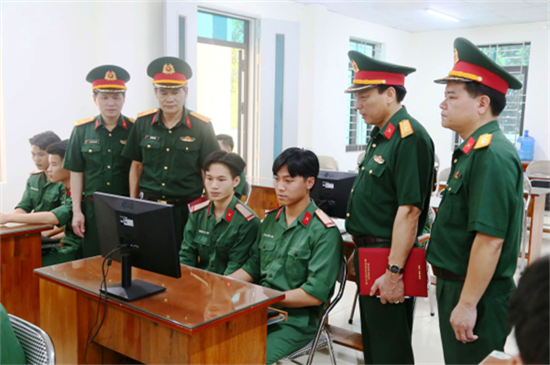 |
| The School's Board of Directors inspects a Digital Literacy class |
To achieve these good results, first of all, the School has strengthened the leadership and direction of all-level party committees and commands over digital transformation. This is the fundamental factor, playing a guiding and regulating role in all digital transformation activities of the School. Accordingly, the School’s Party Committee and Board of Directors have directed agencies, faculties, and units to thoroughly grasp higher-level resolutions, directives, and guidance on science and technology development, innovation, and digital transformation, especially Resolution 3488-NQ/QUTW, dated 29 January 2025, by the Central Military Commission on breakthroughs in science and technology development, innovation, and digital transformation in the Military and Resolution 42-NQ/ĐU, dated 10 September 2025, by the Party Committee of Hanoi Capital Command on leadership over digital transformation within Hanoi Capital Command for the period of 2025 - 2030. Fully recognising the necessity of digital transformation, the School Party Committee has released Resolution 42-NQ/ĐU, dated 27 September 2025, on leadership over digital transformation for the period of 2025 - 2030, with a view to facilitating leadership and direction over the building of a smart, modern School.
The School has well performed the work of tasks-related dissemination and fostered motivation and a sense of responsibility among all staff members. The School’s Steering Committee for science and technology development, innovation, digital transformation, and military administrative reform has given sound advice to the School’s Party Committee and Board of Directors on issuing operating regulations, specifying responsibilities of party committees, commands, and specialised cadres, and assigning each member to assist offices and units in specific fields of work. Party committees and commands of offices, faculties, and units have included digital transformation in their monthly, quarterly, and annual work plans, promoting the pioneering and exemplary role of cadres and party members in carrying out this important task, linking the targets and content of digital transformation with the “Determined to Win” Emulation Movement, taking digital transformation results as one of the criteria for annual commendation, assessment, and classification of party organisations and party members, widely implementing the “Digital Literacy” Movement, bringing into play the role of Advisory Teams for Digital Skills. As a result, the awareness, responsibility, and “digital mindset” of all cadres, teachers, cadets, non-commissioned officers, and soldiers have undergone a strong positive change; they have eliminated technological hesitation and conservative thinking in the process of digital transformation.
Second, the School has promoted the application of digital technology in management, leadership, and direction over education, training, and military administration, contributing to changing working methods from traditional to digital environments. The School has adopted a document management system and digital signatures across its offices, faculties, and units. Thousands of pages of documents have been digitalised; profiles and records used for cadet and training management, organisation of examinations and tests, issuance of certificates, and science research have been converted into a common digital database, thereby contributing to ensuring that leadership and direction information from the School’s Party Committee and Board of Directors could be transmitted quickly, accurately, with absolute security to each agency, faculty, and unit. The role of the training operation centre has been brought into play in real-time inspection and supervision via digital platforms, thus enabling the Board of Directors to monitor teaching and training progress at various locations. Digital tools have been integrated into personnel, weapon, equipment, logistics, and financial management to enhance transparency and save time. Notably, the School has given advice on building and initially completing smart classrooms, a digital library, and a virtual shooting range.
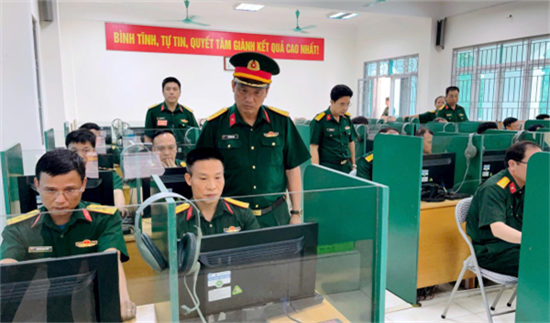 |
| Applying technology in the excellent teacher contest of 2025 |
In addition, the School has accelerated the digitalisation of programmes, plans, curricula, and teaching materials, while adopting computer-based tests and examinations to ensure objectivity and substance in assessing cadets’ learning outcomes. At present, 100% of the School’s (non-classified) documents and directives have been processed entirely online; military administrative procedures have been significantly shortened in time compared with traditional methods. The shared database system has initially proven effective in ensuring smooth transmission of information among offices, faculties, and units, and making cadet and training management more scientific and rigorous. Notably, the application of e-lectures and simulation software has become routine in faculties, with an increasing proportion of high-quality digitalised lectures, contributing to improving regular tests and graduation exercises.
Third, the School has built human resources to meet digital transformation requirements. Advocating that humans act as the centre and the decisive factor in the effectiveness of digital transformation, the School has focused on developing human resources in a systematic manner, under a specific road map. It has selected and trained cadres and employees with deep expertise in information technology (IT), information safety, and network administration to establish Advisory Teams for Digital Skills in offices, faculties, and units as the core force in giving advice on performing technical work, handling incidents, and ensuring smooth digital infrastructure systems. Dozens of refresher courses on IT application, modern teaching methods, and specialised education software have been organised for cadres and teachers. Teachers have been encouraged to apply digital technology in teaching; favourable conditions have been created for cadres and teachers to take part in in-depth training courses at major technology centres or prestigious schools in digital transformation.
At the same time, the School has paid special attention to building “digital culture” within the military pedagogical environment so as to form habits of sharing open learning resources, foster self-learning in cyberspace, and maintain a positive attitude towards technological changes among cadres, teachers, and cadets. The model of “Pair for Technology Progress”, whereby young cadres with strengths in technology could assist experienced teachers in making a transformation from traditional to modern teaching methods, has been encouraged. Offices and faculties have integrated digital transformation and cyber security into teaching programmes to help cadets develop their digital thinking, online resource utilisation skills, and information security awareness right at the School. Besides, collectives and individuals with technological initiatives and solutions effectively applied in practice have been commended. With the involvement of party committees and commands at all levels, 100% of the School’s teachers have been capable of designing e-lectures and interactive lectures and proficiently using smart equipment. Cadres and specialised employees have mastered management software and internal network systems.
Fourth, the School has mobilised resources to gradually upgrade digital infrastructure. Immediately after the Ministry of National Defence implemented the Project on building smart military schools capable of accessing the 4th industrial revolution, the School has mobilised resources to gradually modernise its equipment, IT infrastructure, internal networks, and shared classrooms, thereby laying a solid foundation for digital transformation in education and training. Emphasis has been placed on upgrading LAN and expanding military data transmission networks to offices, faculties, and units. The School has also made investment in firewall devices, anti-malware systems, and cyber security solutions to safeguard data security and prevent any leakage of military secrets.
To modernise its teaching equipment, the School has focused on building smart classrooms integrated with interactive boards and surveillance cameras. It has proactively coordinated with defence enterprises and other military academies and schools to learn from their experience and receive management software and modern simulation models, thus helping shorten timeframes and optimise investment costs. All invested items have been compatible and ready for synchronous connection with the Army-wide digital infrastructure. To date, the School has built one digital library with 50 Internet-connected computers, two methodology rooms equipped with 100-inch touch screens, receiving 61 new computers connected to the military data transmission network and 48 desktop computers serving the “Digital Literacy” Movement, equipping 100% of classrooms with projectors and interactive screens, providing 100% of teachers with network-connected computers. Since January 2026, the School has launched the “Web Portal of Hanoi Capital Command Military School” to carry out communication tasks and convey its functions, missions, and defence and security education work on the Internet.
The above achievements are only initial but extremely important, creating a precondition for Military School of Hanoi Capital Command to persistently, resolutely conduct digital transformation with the spirit of “new thinking, creative approaches, substantive results”, strive to become a leading unit in science and technology, innovation, and digital transformation among offices and units of Hanoi Capital Command, and realise the building of a smart, standardised, exemplary, modern School.
Sr. Col. DO HONG THAI
Commandant of the School