
The policy of deploying Army officers to commune-level Military Commands is a sound and correct decision, clearly reflecting the thinking of the Party and the State in continuously enhancing the quality of military and defence work from the grassroots level. For this policy to deliver sustainable and effective outcomes, the key issue lies in building a contingent of commune-level military cadres who possess sufficient political qualities, professional competence and prestige, fully capable of meeting the requirements of their tasks in the new situation.
Building an all-people national defence foundation and posture closely integrated with the people’s security posture and a firm “people’s heart-and-mind posture” is an objective requirement as well as a distinctive and creative feature of Vietnam’s military art. This is also an issue of strategic significance that is both urgent and fundamental in the long term, consistently reflecting the viewpoints of the Party, the State, the Central Military Commission and the Ministry of National Defence in the cause of national construction and defence.
Practice has shown that the system of local military organisations, including commune-level Military Commands, occupies a particularly important position and role. It serves as the core and leading force in advising local Party committees and authorities on leadership, direction and organisation of the implementation of military and defence tasks; in building the all-people national defence foundation and posture in close association with the people’s security posture; in strengthening the grassroots political system; and in combining socio-economic development with the consolidation of defence and security. At the same time, it is the key force in building the defensive zone posture, ready to successfully handle all defence and security situations at the local and grassroots levels, in both peacetime and wartime.
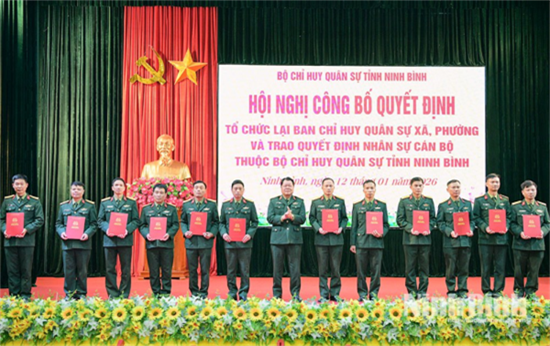 |
| Newly-appointed commune-level military commander of Ninh Binh province |
Under the conditions of implementing a two-tier local government model, many functions and tasks previously undertaken by district-level Military Commands have been transferred to commune-level Military Commands. These include national defence and security education; people’s air defence; civil defence; military recruitment and military admissions; the registration, management and training of reserve forces and the militia and self-defence forces; and the leading role in advising local Party committees and authorities on building defensive zones within their areas, as well as organising and deploying preparations for combat bases, logistics and technical facilities, evacuation areas, and clusters of combat villages and communes. This reality places very high demands on organisational structures and staffing, particularly on the quality of the contingent of commune-level military cadres.
The process of implementing military and defence work at the commune level following the adoption of the two-tier local government model (from July to December 2025) has brought to light several issues requiring close attention. These include the expansion of management areas; the limited staffing of commune-level Military Commands (with only three to five civil servants); uneven levels of professional qualifications and experience in local military and defence work among a proportion of cadres, which have yet to meet task requirements; and various shortcomings in advisory, command and operational capacities in training, force building, combat readiness, and coordination in maintaining security, order and social safety at the commune level, among others. Consequently, adjusting organisational staffing and deploying Army officers to commune-level Military Commands is an objective and pressing necessity.
On 31 December 2025, the Politburo and the Secretariat issued Conclusion No.228-KL/TW on the situation and performance of the political system and the two-tier local government apparatus, which affirmed the policy of deploying Army officers to commune-level Military Commands. In implementing this policy, the Central Military Commission formulated the Scheme on adjusting the organisational structure and staffing of Military Commands at the levels of communes, wards and special administrative units to meet task requirements in the new situation. This scheme was approved by the Politburo and the Secretariat under Conclusion No.234-KL/TW dated 10 January 2026. Subsequently, on 26 January 2026, the Government promulgated Resolution No.66.12/2026/NQ-CP on the organisation and operation of Military Commands of communes, wards and special administrative units under provincial and centrally governed municipal Military Commands, the Hanoi Capital Command and the Ho Chi Minh City Command. These documents constitute an important political and legal foundation, providing a solid framework for continuing to reorganise commune-level Military Commands in a manner truly consistent with the Party’s viewpoints and guidelines on all-people national defence and people’s war. They aim to build commune-level Military Commands that are regular, with balanced organisational structures, serving as the core force in building the all-people national defence posture in close association with the people’s security posture, and capable of meeting the requirements of safeguarding the Socialist Republic of Vietnam in the new situation.
In implementing the Conclusions of the Politburo and the Central Military Commission, the Ministry of National Defence has acted swiftly in leading and directing the coordinated implementation of a range of tasks and measures. These include formulating organisational and staffing structures for commune-level military agencies; selecting standing officers who fully meet the prescribed criteria and standards for transfer and appointment so as to fill 100% of the positions of Commanders of commune-level Military Commands, with priority given to those possessing strong capacity and experience in local military and defence work and holding advanced qualifications in political theory. At the same time, continued reviews have been conducted to consolidate and appropriately arrange sufficient numbers of officers and professional soldiers from existing pools of cadres and personnel of agencies and units; to recruit and confer officer and professional soldier ranks; and to call up reserve officers for active service, in respect of civil servants who have been appointed to the positions of Commander, Deputy Commander or staff officer within commune-level Military Commands and who express willingness and meet the required standards in political reliability, qualifications, professional expertise, health and appropriate age, in accordance with authorised organisational structures and staffing levels. After a short period, these cadres have rapidly grasped their task requirements and have begun to generate clear and positive changes in advisory work and in the organisation and implementation of local military and defence tasks, earning the trust and favourable assessments of Party committees, local authorities and the People.
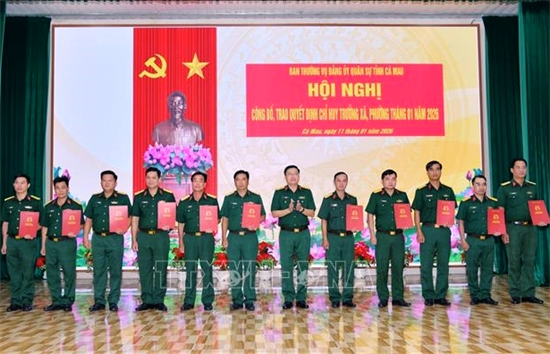 |
| Newly-appointed commune-level military commander of Ca Mau province |
To continue building a contingent of commune-level military cadres capable of effectively advising, directing and implementing local military and defence work, and of contributing to the development of a strong and modern all-people national defence, it is necessary to focus on effectively addressing the following fundamental issues:
First, strengthening leadership and direction over the building of the contingent of commune-level military cadres. This is a matter of principle and is decisive for the quality and effectiveness of the operations of commune-level military agencies. Party committees and Party organisations at all levels must fully recognise that the assignment of regular Army officers to the grassroots level is an objective requirement; thoroughly grasp and strictly implement Conclusion No.234-KL/TW and Resolution No.66.12/2026/NQ-CP; and promptly supplement leadership resolutions, as well as revise and refine regulations and rules on cadre work. In doing so, careful study and proper application must be made of the guiding documents issued by the Party, the Central Military Commission, the Ministry of National Defence and the General Political Department. Close coordination among relevant forces should be ensured in further consolidating commune-level military agencies in strict accordance with the Party’s lines and guidelines and the laws of the State, to select suitable cadres and enable them to best dedicate their capacities in the performance of their duties and responsibilities. Particular attention must be paid to recruitment, the conferment of officer and professional soldier ranks, and the calling-up of reserve officers for active service in respect of civil servants of commune-level Military Commands, ensuring strict adherence to procedures and the avoidance of any shortcomings. The building of the contingent of Party members should be closely linked with the building of the contingent of cadres, and the strengthening of Party committees and Party cells should go hand in hand with the development of the key leadership of commune-level Military Commands.
Second, effectively carrying out the selection, planning, training, further training, placement and utilisation of Army officers assigned to commune-level Military Commands in a coherent manner closely aligned with practical realities. The quality of the contingent depends first and foremost on the stages of selection, planning, training, further training, and placement and utilisation of cadres. It is therefore necessary to continue reviewing and refining standards and criteria for positions held by officers in commune-level Military Commands, ensuring adherence to principles while remaining suited to practical conditions and the specific characteristics of each locality, especially strategic areas, border regions, remote and isolated areas, and key areas of defence and security. Priority should be given to assigning officers with grassroots experience, strong prestige and mass mobilisation skills, a sound understanding of local customs and practices, and the ability to coordinate effectively with the grassroots political system. At the same time, long-term planning for the contingent of commune-level military cadres should be developed with vertical linkages across levels, closely combining immediate placement with the cultivation of successor cadres, thereby ensuring stability, continuity and development.
Comprehensive training and further training should be emphasised, with a focus on military and defence knowledge, advisory capacity, and the ability to organise and implement local military and defence work in close connection with grassroots realities for cadres of commune-level military agencies, particularly those newly selected from commune-level civil servants. In the immediate term, priority should be given to training cadres have yet to hold advanced qualifications in political theory but have been designated to participate in commune-level Party Committees and Standing Committees for the 2025-2030 term, as well as in commune-level People’s Councils for the 2026-2031 term. Further training and refresher courses should be provided to enhance their capacity to advise Party committees at all levels, higher-level commanders, and commune-level Party committees and authorities in the exercise of state management functions in national defence and local military affairs; to organise, build, manage, command and operate units and armed forces under their authority in a strong and combat-ready manner; to conduct combat operations and fulfil military and defence tasks at the commune level; and to build the all-people national defence foundation and posture in close association with the people’s security posture, develop defensive zones, and implement the Law on Civil Defence, among other responsibilities.
Third, continuing to improve mechanisms and policies to create strong motivation for commune-level military cadres to feel secure in their work and to commit themselves to long-term service at the grassroots level. Ongoing reviews and improvements should be made to regulations concerning regimes, policies, working conditions and living standards for cadres of commune-level military agencies, ensuring that they are commensurate with task requirements, the nature of the work and the working environment. Investment should be progressively made in upgrading infrastructure, offices and facilities, as well as equipment serving training and combat readiness; at the same time, due attention should be paid to policies on official housing, living conditions and healthcare, particularly for cadres serving in remote, border and island areas and other especially disadvantaged localities. Timely encouragement, recognition and commendation should be given to cadres with outstanding achievements, a spirit of innovation and creativity, and the courage to think and act boldly, who deliver high effectiveness in grassroots military and defence work. Solidarity and unity within Party committees and Party cells should be fostered; working relationships - especially between commune-level Military Commands and local departments, sectors and mass organisations - should be well managed; and difficulties and obstacles should be promptly addressed. This will help to shape a working environment that is democratic, disciplined, transparent and humane, thereby creating strong motivation for cadres to remain committed, strive and devote themselves wholeheartedly to their tasks.
Fourth, giving full play to the role and responsibility of commune-level military cadres in self-study, self-cultivation and the performance of their duties. Entering a new working environment marked by numerous challenges that demand strong political mettle, intellectual capacity and a high degree of adaptability, each cadre assigned to a commune-level military agency must clearly define their sense of responsibility; continuously cultivate and strengthen political steadfastness, moral integrity and lifestyle; remain firmly committed to the Party’s goals and ideals; and maintain absolute loyalty to the Fatherland, the Party, the State and the People. They must swiftly familiarise themselves with their duties, gain a firm grasp of local conditions and managed subjects, and flexibly apply professional knowledge to grassroots practice to fulfil their assigned responsibilities and tasks. At the same time, they must proactively engage in self-study and self-improvement to enhance their overall qualifications, particularly in local military and defence knowledge and in science and technology, to meet the increasingly demanding requirements of digital transformation at the local level.
Cadres who participate in commune-level Party Executive Committees, Standing Committees and People’s Councils need to be fully aware of their responsibilities and to actively and persistently improve their understanding of socio-economic affairs, law and state administration, among other fields, to ensure that their capacity matches their assigned roles. They must provide sound advice on, and strictly and conscientiously implement, the Law on Military Service, ensuring that no negative practices occur - especially for those serving in their own localities. Their ability to manage and handle working relationships with local departments, sectors and mass organisations should be enhanced, including coordination with commune-level public security forces in implementing Government Decree No.03/2019/NĐ-CP of 5 September 2019 on coordination between the Ministry of National Defence and the Ministry of Public Security in safeguarding national security, maintaining social order and safety, combating crime, and carrying out defence-related tasks. Through these efforts, they will contribute, together with Party committees and local authorities, to the leadership and direction of ever more comprehensive local development.
As the contingent of regular Army officers closest to the People and in frequent contact with them, each cadre of a commune-level military agency must consciously cultivate a scientific, methodical and grassroots-oriented working style, always respecting the People and serving them wholeheartedly. They must uphold principles, emphasise exemplary responsibility, match words with deeds, and resolutely oppose all manifestations of opportunism, pragmatism, evasion of responsibility or fear of difficulties. At all times, they should remain mindful of preserving and promoting the qualities and cultural values of the “Uncle Ho’s soldiers”. With a clear demonstration of high spirit and responsibility, they should not be complacent, dependent or satisfied with achieved results, but instead remain proactive in seeking new, appropriate and effective approaches; act as role models and pioneers in local movements; actively and proactively engage in communication and mobilisation of the People; and take the lead in countering erroneous and hostile viewpoints as well as outdated and harmful practices. They should uphold the spirit of self-examination and self-correction, seriously and respectfully receiving feedback from Party committees, local authorities, mass organisations, comrades and the People; promptly remedy shortcomings and weaknesses; and always remain a trusted pillar for the People, thereby contributing to the continued strengthening of the “people’s heart-and-mind posture”.
Finally, strengthening inspection, supervision, interim review, overall review and the drawing of lessons learned. The operation of commune-level Military Commands under the two-tier local government model is a new and unprecedented undertaking, requiring simultaneous implementation and experience-building. This is an objective necessity to make timely adjustments and improvements to organisational structures and operational methods. Through serious, scientific and timely inspection, supervision, interim review and overall review based on practical experience, it is possible to promptly identify difficulties, obstacles and shortcomings in organisational arrangements, staffing levels, leadership and command mechanisms, as well as in the management and utilisation of the contingent of commune-level military officers. At the same time, lessons learned can be distilled, and effective models and innovative, efficient practices suited to the characteristics of each locality can be identified and replicated.
Military agencies at all levels should proactively and closely coordinate with local Party committees and authorities in assessing the quality and effectiveness of the operations of commune-level Military Commands and their cadres, on the basis of results achieved in implementing assigned tasks, particularly key political tasks. Such assessments must be objective and comprehensive, with practical effectiveness serving as the primary yardstick, thereby clearly revealing the true capacity, sense of responsibility and level of contribution of each cadre. It is essential to resolutely overcome formalism, complacency and the pursuit of superficial achievements. Through this approach, it can be ensured that the contingent of commune-level military cadres truly fulfils its core role in building a strong all-people national defence, contributing to the maintenance of political stability, social order and safety from the grassroots level.
Building a contingent of commune-level military cadres capable of meeting task requirements in the new situation is a strategic and long-term issue of decisive significance for the effective fulfilment of military and defence tasks at the grassroots level. It makes an important contribution to building a strong and modern all-people national defence, and to firmly safeguarding the Fatherland early and from afar, beginning at the grassroots.
Senior Lieutenant General DO XUAN TUNG, Member of the Party Central Committee, Deputy Chief of the General Political Department of the Vietnam People’s Army