
Grasping and implementing the Party’s viewpoints on great national unity, economic - defence corps in the strategic Central Highlands in general, Corps 15 in particular, have been adopting effective measures to promote the role of ethnic minority people in socio-economic development associated with defence - security consolidation.
The Central Highlands holds a strategic position. It is home to many ethnic minority communities, where rich traditional cultural identities have been formed and preserved, with numerous unique tangible and intangible cultural heritages. This is also an area where hostile forces frequently carry out schemes and tactics of sabotage to undermine our great national unity.
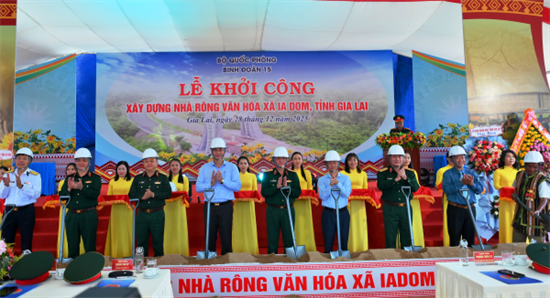 |
| Building a community house for ethnic minorities in Ia Dom commune |
Following the Party’s lines on socio-economic development associated with defence - security consolidation, over the years, Corps 15 has consistently pursued a policy of prioritising the recruitment of ethnic minority people, closely combining recruitment work for economic - defence zones and projects with the improvement of locals’ educational standards. At present, over 60% of cadres and employees in the Corps are ethnic minority people. In addition to directly fostering production models and economic development linked with defence and security, ethnic minority people in economic - defence units of the Corps also actively participate in building, proposing, supplementing, and refining solutions for socio-economic development associated with defence - security consolidation at grass-roots level; they serve as the core force in encouraging local communities to implement the Party’s lines and the State’s policies and laws, especially on combining economic development with defence and security as well as in combating wrong, hostile viewpoints. Over the years, the Corps has always taken the lead in building new production models, restructuring crops and livestock, developing infrastructure, ensuring social welfare, and caring for the people’s livelihoods. In the process, ethnic minority people have made effective contributions, and they are the beneficiaries of these achievements. This is vivid evidence affirming the correctness of our Party’s lines on combining socio-economic development with defence - security consolidation.
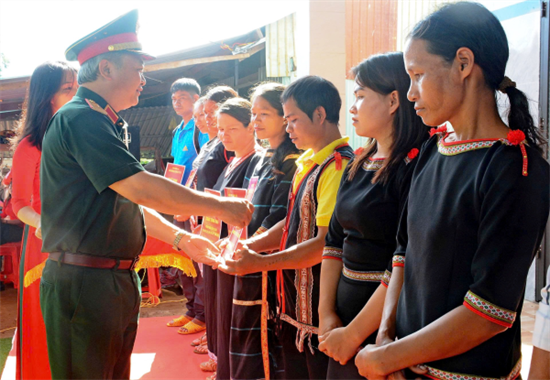 |
| Corps 15’s Command presents gifts to ethnic minorities |
In the coming time, in response to the increasingly high requirements of national construction and defence in the new era, on the basis of clarifying matters of principle, summarising practical experience, identifying causes, and accurately assessing influencing factors, Corps 15 will focus on effectively implementing several main solutions in order to further promote the role of ethnic minority people in socio-economic development associated with defence and security in the Central Highlands as follows.
First, raising awareness and a sense of responsibility among organisations and forces regarding the promotion of the role of ethnic minority people in socio-economic development and defence - security consolidation. Practice shows that wherever units and localities well perform education work to raise awareness and responsibility across the political system and among organisations and forces, the role of ethnic minority people is effectively promoted and their task performance is always high, and vice versa. Over the years, with great efforts, Corps 15 has always provided firm support for locals, both building a “protective rampart” for the Fatherland and acting as a “midwife” helping people escape poverty, stabilise their lives, and build strong political bases. However, compared with practical requirements, awareness of the role of ethnic minority people in socio-economic development associated with defence and security among some organisations and forces, including grass-roots cadres, remains insufficient. As a result, this resource has not been mobilised in a synchronous manner, or commensurate with its potential; meanwhile hostile forces have taken advantage of the situation to undermine our great national unity.
Therefore, to better fulfil this important task, Party organisations and key leaders, especially political cadres and political agencies at all levels throughout the Corps, must continue playing a core role in ideological orientation, raising awareness and responsibility among cadres, soldiers, and workers. To that end, due regard should be paid to regularly renewing content, methods, and forms of propagation, and promoting the role of cultural institutions and mass media to enhance propagation effectiveness. Forms of coordination should be diversified to encourage all forces, especially local Party committees, authorities, and enterprises, to actively take part in promoting the role of ethnic minority people in socio-economic development associated with defence - security consolidation.
Second, strengthening leadership and direction, effectively implementing solutions to promote the role of ethnic minority people in socio-economic development linked with defence and security. Thoroughly grasping and strictly implementing the Party’s viewpoints and lines and the State’s policies and laws on ethnic and religious affairs, based on practical survey results and careful analysis of the situation, especially the needs, capacities, and aspirations of ethnic minority people, Party committees and organisations at all levels must develop specialised resolutions on promoting the role of ethnic minority people in socio-economic development associated with defence and security. These resolutions should identify comprehensive leadership guidelines and breakthrough solutions with clear priorities, while action programmes and plans suited to the specific conditions of each unit and locality should be developed.
Promoting the role of ethnic minority people in economic development associated with defence - security consolidation is an inter-sectoral and multi-force task; hence, it is important to establish close, regular mechanisms for coordination among economic - defence units, local Party committees and authorities, political - social organisations, enterprises, and the people. These mechanisms should clearly define responsibilities, authorities, road maps, and methods, avoid overlaps or omissions, ensure the mobilisation of maximum resources, leverage the strengths of each component, and create synergy for production and economic development associated with defence - security consolidation in the area.
At the same time, Party committees and commands at all levels must establish mechanisms enabling ethnic minority people to give their opinions, reflect their aspirations, propose solutions, and directly take part in models of socio-economic development associated with defence and security, thereby not only enhancing democracy and consensus but also ensuring that leadership and direction measures will have vitality and long-term effectiveness. Inspection and supervision of the implementation of resolutions and programmes should be strengthened, while weaknesses and difficulties should be identified and removed to promptly adjust and supplement leadership and direction measures.
 |
| Handing over new houses constructed by the Corps to ethnic minorities |
Third, correctly identifying content and flexibly, creatively applying forms and measures to promote the role of ethnic minority people in socio-economic development associated with defence and security. With advantages in shared language, deep understanding of local natural, economic, cultural, and social conditions, broad practical experience in production, daily life, and cultural preservation, firm grasp of local customs, and community prestige, once fully equipped with knowledge, skills, political steadfastness, ethnic minority people within the Corps will become the core force in encouraging local communities to implement the Party’s lines and the State’s policies and laws. Thus, Party committees and commands at all levels must proactively renew forms and measures of education on traditions and revolutionary ethics, arouse patriotism, and bring into play the qualities of “Uncle Ho’s Soldiers” and the fine cultural values of ethnic minority people. They must synchronously, effectively perform Party and political work, and closely combine ideological work with organisational work and policy work for ethnic minority people in the Corps. They must improve the quality and effectiveness of mass mobilisation in ethnic minority areas and regularly, effectively implement policies for troops and military families as well as ethnic and religious policies.
To truly promote the role of ethnic minority people, it is not enough to just step up propagation; this work must be realised through practical activities; emphasis should be placed on encouraging and supporting communities to directly participate in models of socio-economic development associated with defence and security, such as industrial crop planting and exploitation, production forestry, medicinal plant cultivation, hi-tech agriculture, livestock breeding, household economy combined with cooperatives, and community tourism services linked with cultural preservation. When ethnic minority people play their role from planning and implementation to benefit sharing, they will raise their responsibility, promote their initiative and creativity, and build their long-term attachment to the Corps. Moreover, many models of agro-forestry production and forest conservation linked with community economic development can only succeed with the participation of local ethnic minority people. For that reason, economic - defence units must create mechanisms for people to give their opinions and provide policy feedback, thereby affirming their position as subjects rather than merely passive beneficiaries.
Furthermore, in the process, the Corps should flexibly, creatively apply forms and measures of propagation and closely combine propagation with direct support and the building of pilot models, thus encouraging the people to replicate good models and creative, appropriate approaches, promoting the voluntariness and creativity of local communities, overcoming limitations in resources and practical conditions.
Fourth, attracting, training, fostering, and effectively utilising ethnic minority people for socio-economic development associated with defence and security. This is not only an objective requirement contributing to building a workforce with professional competence, practical skills, and firm political qualities for the growing demands of socio-economic development associated with defence and security in strategic areas, but also a prerequisite for promoting the role of communities in the process of national industrialisation and modernisation. However, in fact, high-quality ethnic minority personnel remain seriously lacking. Fully aware of this, the Corps will synchronously adopt many comprehensive measures covering attraction, recruitment, training, utilisation, and remuneration. Priority will be given to encouraging and recruiting young people with great capacity, resolve, and aspiration for devotion to participate in economic - defence zone development projects.
At the same time, great value will be attached to professional development and skill training for ethnic minority people. Training models should be linked with practical production to help ethnic minority people master skills and develop their ability to handle complex situations related to defence and security. Ethnic minority people should be encouraged to take part in pilot projects and new models related to economic development. Great weight should be added to developing soft skills, including communication, teamwork, time management, and digital transformation. Knowledge should be regularly systematised and updated, especially in professional fields related to the rapidly changing models of production and economic development and digital transformation. The Corps will cooperate with reputable universities and vocational training schools to improve the quality and professionalism of training. At the same time, mechanisms for effective long-term utilisation and appropriate remuneration policies will be formulated and refined.
Fifth, mobilising the combined strength of organisations and forces to promote the role of ethnic minority people in socio-economic development associated with defence and security. Practice shows that although the Corps has implemented many models for production development and population stabilisation, it has not fully exploited social resources yet. Some agencies, local authorities, and mass organisations have not actively taken part in this process, thus leading to fragmented resources. Many enterprises have not shown real interest in economic - defence projects due to poor coordination mechanisms. Hence, organisations and forces, especially specialised forces within the Corps, must continue promoting their core role in firmly grasping the practical economic and social situation and customs of each ethnic minority group to develop plans properly. Priority should be given to building and perfecting mechanisms to enhance the participation of Party committees, authorities, enterprises, political - social organisations, and locals in this important work.
Close coordination among military units, local authorities, enterprises, and communities should be strengthened to form large-scale production zones, create stable employments, bring into play natural potential and advantages and the strengths of ethnic minority people, enhance the effectiveness of socio-economic development associated with defence - security consolidation, and contribute to building a Central Highlands region that is economically prosperous, politically stable, rapidly developed in culture and society, and strong in defence and security in the new era.
Maj. Gen. HOANG VAN SY
Commander of Corps 15