
Military Region 7 occupies a strategic position in terms of politics, economics, society, defence, security, and diplomacy; it is a major economic, cultural, social, scientific, and technological centre in the South and nationwide.
Thoroughly grasping the Party’s lines and viewpoints, in recent years, the Military Region’s armed forces have actively participated in carrying out propagation and mobilisation work among the people, raising the entire population’s awareness and sense of responsibility towards the cause of Fatherland construction and protection, taking part in building clean, strong party committees and authorities at all levels, assisting the people in socio-economic development, hunger eradication, poverty reduction, natural disaster and epidemic prevention and control. These activities have made practical contributions to cementing the people’s trust in the Party, State, Military, and socialist regime, bringing into play the strength of great national unity for maintaining political security and social order and safety, making all-people national defence, local defensive zones, and Military Region defence increasingly solid.
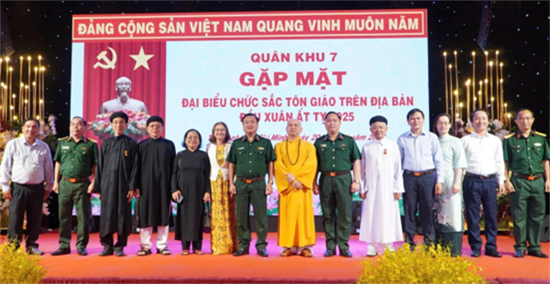 |
| A meeting with religious dignitaries held by the Military Region |
However, alongside those good results, the building of “people’s hearts and minds posture” by some offices and units at certain times and in certain places has not been truly proactive; forms and measures have yet to be flexible or creative, resulting in limited effectiveness. In the process, Military Region 7’s Party Committee and Command have drawn several valuable lessons on building “people’s hearts and minds posture” that should continue to be promoted in the time to come.
Given the increasingly high task requirements and the emergence of many new tasks, it is necessary to closely adhere to reality, combine practice with experience review, and gradually raise the quality and outcomes of conducting mass mobilisation and assisting the people in socio-economic development. This is an important aspect of party and political work, which is highly specialised and integrated, carried out in accordance with principles and regulations, and demands flexibility and adaptability to the characteristics of each locality. To achieve effectiveness, the Military Region’s Party Committee and Command have required offices and units to focus on educational work to raise awareness and a sense of responsibility among party committees, commands, cadres, and soldiers regarding mass mobilisation in the new situation. The educational process must be comprehensive, synchronised, and uniform, with clear focuses and especially issues directly related to the political tasks of offices and units and the characteristics of each locality; it must be conducted regularly via diverse forms and measures relevant to each target group. Doing so will bring about profound changes in the awareness and action of all-level party committees and commands, and enable cadres and soldiers to clearly recognise that mass mobilisation is a function and task of agencies and units, as well as a sentiment and political responsibility of each soldier towards the people; as a result, troops will be ready to go to the most difficult, arduous, and complex areas to assist the people and protect locals’ lives and property. At the same time, offices and units have strictly executed Regulation 718-QC/QUTW, dated 5 November 2021, by the Central Military Commission on mass mobilisation work of the Vietnam People’s Army (VPA), regularly reviewing, adjusting, and supplementing their own regulations, formulating resolutions and action plans in a close, effective manner, mobilising the synergy of organisations and forces in mass mobilisation work.
In the process, the Military Region’s Party Committee and Command have directed offices and units to step up the study and following of Uncle Ho’s mass mobilisation style of “respecting the people, staying close to the people, understanding the people, learning from the people, being responsible to the people”, closely adhering to the motto of “listening to what the people speak, speaking to make the people understand, act so as to earn the people’s trust”. They have renewed and diversified forms and methods of mass mobilisation, with a focus on helping the people eradicate hunger and reduce poverty, prevent and combat natural disasters and epidemics, and carry out search and rescue operations. Attention has been paid to effectively carrying out field marches combined with mass mobilisation and deploying task groups to reinforce grass-roots level. Coordination with local information, education, and mass mobilisation agencies and political - social organisations has been sustained in “Skilful Mass Mobilisation” emulation movement, the building of “Good Mass Mobilisation Units”, national target programs for economic, cultural, and social development and sustainable poverty reduction, and other movements and programs, such as “joining hands to build new-style rural areas”, “joining hands for the poor, leaving no one behind”, “soldiers’ Spring” and “Military - civilian Tet”.
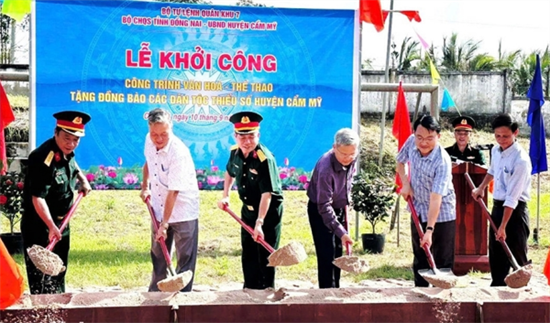 |
| Constructing culture and sport facilities for ethnic minorities of Cam My commune, Dong Nai province |
The Military Region has effectively maintained twinning activities with local agencies, units, and enterprises, and directed its affiliates to establish twinning relationships with 544 focal points. Thanks to creative, practical approaches, the Military Region’s armed forces have contributed to effectively performing socio-economic development tasks in association with defence and security, firmly maintaining political security and social order and safety, especially in key, remote, isolated, border areas, promoting socio-economic development, and improving the people’s living standards. Doing so has helped foil all sabotage plots and tactics of hostile forces and cement the people’s trust in the VPA and local party committees and authorities.
Special propagation work has been carried out effectively. This is an important component of the Party’s revolutionary mobilisation work and a part of party and political work of the armed forces, directly affecting the outcomes of local military and defence tasks. Hence, in recent years, Military Region 7’s Party Committee and Command have synchronously adopted various solutions to raise the quality of this important task. The Military Region has directed all-level party committees and commands to thoroughly grasp and strictly implement directives on special propagation work. In the process, the Military Region has required party committees, party organisations, political commissars, political officers, and commanders at all levels to uphold proactivity, actively study, forecast, analyse, and assess the situation as the basis for determining guidelines and solutions to improve the effectiveness of special propagation work appropriate to each area and target group. In terms of content, emphasis has been placed on clarifying the Party’s viewpoints and lines, the State’s policies and laws, and resolutions, directives, and guidance of the Central Military Commission and the Ministry of National Defence on military and defence work, especially the significance, role, importance, objectives, and requirements of building “people’s hearts and minds posture”. Priority has been given to rendering the people fully aware of hostile forces’ plots and tactics of “peaceful evolution” combined with subversion, partners and adversaries of the Vietnamese revolution, as well as reactionary groups and elements opposing the Party, State, and VPA. Units have flexibly applied diverse forms and methods of education and propagation, closely combining regular education with thematic education linked to political events of the country, Military Region, localities, and units, thereby arousing patriotism and national pride among all people, enhancing “immunity” against sabotage efforts of reactionary and hostile forces.
In recent times, the Military Region has had nearly 40 locations prone to becoming “hot spots”. However, the Military Region has directed its competent offices and units to coordinate with localities and relevant forces to firmly grasp the situation and promptly, effectively resolve complex cases; up to now, the number has been reduced by nine compared with the beginning of the term. At the same time, coordination with local public security forces under the Government’s Decree 03/2019/NĐ-CP, dated 5 September 2019, has been strengthened; forces have been deployed to patrol areas and encourage the people to denounce crimes (251 cases involving 348 suspects); propagation and mobilisation have been conducted to prevent free migration among 892 households, making contributions to ensuring defence and security and protecting national sovereignty.
Imbued with President Ho Chi Minh’s teachings on “maintaining freedom of belief and unity between religious followers and non-followers”, in recent years, Military Region 7 has attached importance to well performing ethnic and religious work via many meaningful activities, contributing to strengthening the great national unity bloc and building a firm “posture of people’s hearts and minds”. The Military Region’s Party Committee and Command have directed offices and units to coordinate with relevant forces to firmly grasp the situation, step up propagation and education efforts, and opportunely resolve ethnic and religious issues in the area. To effectively implement the National Target Program for socio-economic development in ethnic minority areas, units and localities of the Military Region have held 15 training courses on ethnic knowledge and ethnic languages for 1,903 cadres, soldiers, and local officials (including 2 Khmer language courses, 1 S’Tieng language course, and 12 courses on ethnic knowledge).
To promote the role of village elders, religious dignitaries, monks, and religious believers in building “people’s hearts and minds posture” and fostering inter-religious solidarity, the Military Region’s Party Committee and Command have intensified training in knowledge of defence and security for religious dignitaries and village elders (since 2020, 20 courses have been held for 3,908 religious dignitaries; 14 courses for 1,452 village elders and clan heads), contributing to raising awareness and a sense of responsibility among ethnic and religious communities regarding military and defence tasks and Fatherland protection. Additionally, the Military Region has well implemented the policy of “connection, friendliness, support for ethnic and religious compatriots”, organising 5 meetings with 483 delegates, paying visits, extending congratulations, and presenting gifts to religious dignitaries, village elders, and reputable individuals among ethnic and religious communities on major religious festivals and national holidays, constructing 186 culture and sport facilities at religious establishments and in ethnic minority areas, thus fostering the great national unity bloc - the foundation for building “people’s hearts and minds posture”.
Along with the above solutions, the Military Region’s Party Committee and Command has continued to direct offices and units to maintain coordination in developing a core political force consisting of reservists working in industrial parks and export processing zones, building strong local political systems and residential clusters adjacent to border militia posts, laying a foundation for forming an increasingly firm “posture of people’s hearts and minds” after the reorganisation of administrative units and the adoption of a two-tier local government model. Doing so will contribute to building and firmly protecting the Socialist Vietnamese Fatherland, enabling the entire country to confidently advance into a new era - the era of the nation’s rise.
Maj. Gen. PHAM ANH TUAN
Director of the Military Region’s Political Department