
In 2026, the global and regional situation is forecast to continue evolving rapidly and in a complex manner; non-traditional security challenges, high-tech crime, cyberattacks, information warfare, and the like are expected to increase in scale, nature, and sophistication, containing numerous unpredictable factors.
Domestically, the entire Military will focus on thoroughly grasping and implementing the Resolution of the 14th National Congress of the Party and the resolutions of Party congresses at all levels for the 2025–2030 term; continue building a revolutionary, regular, elite, and modern Military; and concurrently organise the synchronous implementation of the system of legal normative documents on military and national defence. This reality requires the work of legal dissemination and education to continue to undergo strong renewal, remain closely aligned with practical mission requirements, and enhance overall quality; while strengthening the prevention of violations and firmly maintaining order and discipline throughout the entire Military. To achieve these objectives, Party committees and commanders at all levels need to concentrate their leadership and direction on effectively implementing the following key focal areas:
First, to thoroughly grasp and uniformly implement the system of military and national defence law. The year 2026 marks a period in which numerous important laws, decrees, and circulars in the field of military and national defence come into effect, placing requirements on agencies and units to thoroughly study, firmly grasp their core contents, and organise their strict and uniform implementation throughout the entire Military. The focus is on the Law amending and supplementing a number of articles of 11 laws on military and national defence; the Law on Participation in United Nations Peacekeeping Operations; the Law on the State of Emergency; the Ordinance on the Management and Protection of the Ho Chi Minh Mausoleum Complex; and documents issued by the Government, the Prime Minister, and the Minister of National Defence concerning state management in the military and national defence sector. The process of dissemination must clarify new, amended, and supplemented provisions that are significant in establishing legal standards, delineating authority and responsibility, and ensuring uniformity in the organisation and execution of military and national defence tasks.
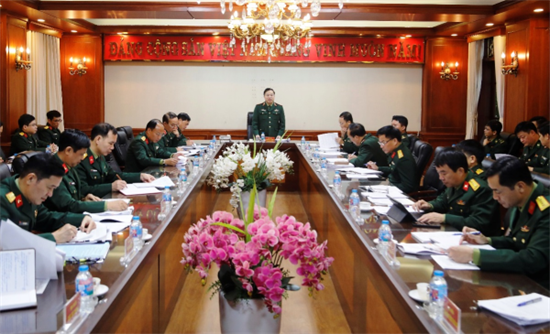 |
| Conference on coordination regulations between the Border Guard Command and the Military Regions |
Party committees, Party organisations, and commanders at all levels should closely adhere to the leadership, direction, and guidance of the Central Military Commission, the Ministry of National Defence, and the General Political Department; issue resolutions and action programmes of Party committees, as well as commanders’ work plans, to lead, direct, and implement legal dissemination and education; and integrate this work into political education, training, combat readiness, and the operation of grassroots cultural institutions. The implementation process must comply with Government Decree No. 28/2013/NĐ-CP of 4 April 2013, detailing a number of articles and measures for the implementation of the Law on Legal Dissemination and Education; Circular No. 42/2016/TT-BQP of 30 March 2016 of the Minister of National Defence regulating legal dissemination and education within the Ministry of National Defence; and Directive No. 103/CT-BQP of 28 November 2019 of the Minister of National Defence on continuing to strengthen the management and education of discipline observance and the assurance of safety in the Vietnam People’s Army. Through the thorough and coordinated implementation of these legal documents, positive changes will be fostered in the awareness and sense of law- and discipline-abiding among cadres and soldiers, ensuring that the law and discipline are respected and uniformly enforced throughout the entire Military.
Second, to innovate forms of legal dissemination and education in a substantive manner, closely linked with digital transformation and the building of a culture of law compliance within the Military. Legal dissemination and education should be organised through flexible and effective formats suited to the psychological characteristics, educational level, and working environment of soldiers. The selection of content must be focused and prioritised, avoiding dispersion and formalism; ensuring consistency with the Law on Legal Dissemination and Education and regulations of the Ministry of National Defence; and concentrating on core issues that directly regulate the conduct of cadres and soldiers in training, combat readiness, regularity building, discipline management, and safety assurance. Particular attention should be paid to regulations concerning the use of social media, the protection of state secrets, information security, and the prevention of violations in the digital environment and in professional relations and daily life. The content of legal dissemination and education should be closely linked with practical situations and typical cases in order to enhance persuasiveness and the capacity for retention among cadres and soldiers.
In terms of form, traditional and modern approaches should be closely combined, with greater emphasis on visualisation and dialogue, and with the effectiveness of reception by cadres and soldiers serving as the principal benchmark. In particular, agencies and units should continue to thoroughly grasp and strictly implement Plan No. 4396/KH-BQP dated 4 November 2021 of the Ministry of National Defence on the development of e-Government towards digital government within the Ministry of National Defence for the 2021–2025 period, with orientation to 2030, and Plan No. 3015/KH-BQP dated 30 May 2025 on the implementation of the Prime Minister’s Decision No. 766/QĐ-TTg of 15 April 2025 approving the Scheme on digital transformation in legal dissemination and education for the 2025–2030 period. The focus is on consolidating and improving the “Digital Law” system and digital libraries within the Military; developing thematic videos and visual graphics; intensifying communication through mass media and digital platforms; expanding the organisation of legal knowledge competitions; and replicating effective models of legal dissemination and education. Through these measures, a healthy and coherent legal environment will be gradually formed, providing a foundation for enhancing the quality of law and discipline observance among cadres and soldiers and the effectiveness of state management in military and national defence.
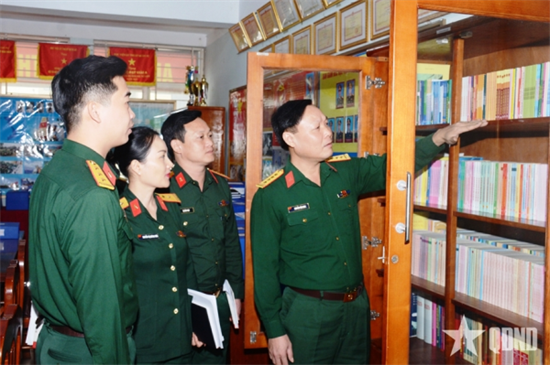 |
| The Military Youth Board checks legal education at the Military Technical Academy |
Third, to link legal dissemination and education with regularity building, discipline management, and the prevention of violations throughout the entire Military. This is a cross-cutting requirement aimed at ensuring that the law and military discipline truly become self-conscious standards of conduct for every service member. Agencies and units need to integrate legal dissemination and education with strengthened efforts to thoroughly grasp and strictly implement Directive No. 79/CT-BQP dated 22 July 2022 of the Minister of National Defence on building comprehensively strong units that are “exemplary and typical”, together with regulations on safety assurance and the prevention and control of fires and explosions, natural disasters, and epidemics. On that basis, these requirements should be concretised into regulations, plans, and work contents appropriate to the mission characteristics, organisational structure, and practical conditions of each unit. Legal dissemination and education must be closely integrated with the process of regularity building and discipline management, especially in daily unit activities, training, combat readiness, logistics and technical work, occupational safety, and the Determined to Win Emulation Movement. Agencies and units should proactively review and identify fields, periods, and target groups that pose high potential risks to safety and are prone to violations of law and discipline, in order to select appropriate contents for legal dissemination and education; with emphasis on clearly clarifying regulations on the conduct of service members and employees what they “must do, are permitted to do, and must not do” in the performance of their duties. It is necessary to thoroughly grasp and strictly implement the Regulations on the management of service members’ ideological work, daily routines, and grassroots-level democratic dialogue. The role and responsibility of Party committees, commanders, and the contingent of cadres at all levels should be brought into full play in leadership, direction, and troop management; with proactive forecasting and assessment of factors affecting the ideology of service members, particularly under conditions of diverse tasks and complex working environments. On that basis, each service member should be equipped with essential legal knowledge linked to skills of self-control over conduct, enhancing the capacity for early identification of risks of violations, and forming sustainable habits of voluntary compliance with the law and military discipline. At the same time, inspection, supervision, interim reviews, and final evaluations of law and discipline observance within the Military should be intensified; and effective coordination among legal affairs bodies, political agencies, criminal investigation bodies, and the military procuracy should be promoted, with the synchronous implementation of preventive measures from an early stage and at a distance, in order to minimise violations of state law and military discipline.
Fourth, to enhance the quality of operations of councils for the coordination of legal dissemination and education at all levels, their standing bodies, and the contingent of legal reporters, propagandists, and legal officers engaged in legal dissemination and education. Accordingly, councils for the coordination of legal dissemination and education at all levels need to fully bring into play their central advisory role, formulate plans closely aligned with task requirements, strengthen coordination mechanisms, and clearly define the responsibilities of each member in conjunction with prescribed regimes of inspection, evaluation, and reporting. The contingent of legal reporters, propagandists, and officers engaged in legal dissemination and education must be regularly consolidated in sufficient numbers, possess firm political integrity, have a thorough grasp of relevant legal knowledge, demonstrate pedagogical skills, and exemplify the exemplary bearing and conduct of military personnel.
Agencies and units should intensify the organisation of in-depth training on methods of legal dissemination and education, as well as on the capacity to analyse and handle legal situations; and regularly update new legal documents, particularly regulations in the military and national defence domain. Military academies and schools need to supplement and comprehensively update legal content in their training curricula, and conduct substantive inspection and assessment. At the same time, it is necessary to study and refine appropriate and specific incentive mechanisms and preferential policies for personnel engaged in legal dissemination and education, thereby creating motivation and favourable conditions for this contingent to fulfil their tasks effectively.
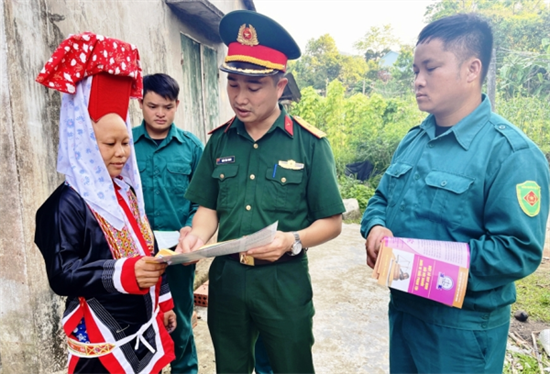 |
| Quang Ninh provincial armed forces conduct legal dissemination for the locals |
Fifth, to strengthen coordination between military units and agencies, organisations, and local authorities in legal dissemination and education, while proactively combating and refuting erroneous and hostile viewpoints. Agencies and units within the Military should closely coordinate with judicial bodies, the Public Security forces, the Viet Nam Fatherland Front, and local authorities in strict accordance with the Law on Legal Dissemination and Education and specialised laws, such as the Law on Military Service; the Law on the Viet Nam Border Guard; the Law on Forces Participating in the Protection of Security and Order at the Grassroots Level; and the Law on National Defence and Security Education, among others. The focus should be on unifying awareness, sharing information, providing professional support, and organising specific coordination models suited to the characteristics of each locality.
The content of coordination should concentrate on key issues such as disseminating laws on borders and seas and islands; preventing and combating crime and legal violations; protecting state secrets; and continuing to effectively implement the Scheme on “Promoting the role of the Viet Nam People’s Army forces in legal dissemination and education and mobilising the People to comply with the law at the grassroots level for the 2021–2027 period”; while effectively carrying out mass mobilisation work and building a firm “people’s heart-and-mind posture” in areas where units are stationed. Units performing specialised tasks along border lines, maritime areas, and islands need to proactively advise on practical solutions and promptly address newly emerging issues. Concurrently, the role of specialised forces should be brought into play to resolutely combat and refute erroneous and hostile viewpoints, firmly safeguarding the Party’s ideological foundation. The integration of legal dissemination and education with ideological struggle must be conducted proactively, in the correct orientation, ensuring prevention early and from a far.
In its role as the standing body of the Council for the Coordination of Legal Dissemination and Education of the Ministry of National Defence, the Department of Legal Affairs will continue to advise the Central Military Commission, the Ministry of National Defence, and the General Political Department in leading and directing the entire Military to renew the content, forms, and methods of legal dissemination and education; improve the quality of personnel; strengthen inter-agency coordination; and build a safe and exemplary legal environment.
Major General NGUYEN VIET DUNG, Director General of the Department of Legal Affairs, Ministry of National Defence