
The most prominent features of the global political and military landscape in 2025 are the irreversible trend towards multipolarity of the world order and intense competition among major powers. Besides, worrying developments from the conflicts of Russia-Ukraine, Israel-Iran, India-Pakistan, etc., and the risk of US military intervention in Venezuela are posing significant challenges to global security and stability.
The irreversible trend towards multipolarity of the world
According to world political and military analysts, since the end of the Cold War, the unipolar world order has been referred as the “liberal world order” or the “rules-based world order” by the U.S leaders in their official political documents. However, in recent years, it is facing the risk of a collapse due to the U.S power decline and the comprehensive and powerful rise of China, Russia, India, as well as international institutions, such as the BRICS, the Shanghai Cooperation Organisation (SCO), etc., This has gradually formed a multipolar world which was acknowledged by Russian President Vladimir Putin when he addressed at the Valdai Forum in Sochi, Russia, in October 2025 that: the trend towards a multipolar world order is inevitable and irreversible.
Especially, the overwhelming victory of Republican candidate Donald Trump and his inauguration as President of the United States on 20 January 2025 has accelerated the demise of the unipolar world order. In his speech to the U.S. Senate Committee on Foreign Relations, U.S. Secretary of State Marco Rubio stated that the idea that the post-Cold War liberal world order would last forever was not just a fantasy but a dangerous delusion. His statement made it clear that many were wrong to believe that, to serve national interests, the U.S. needs to maintain a liberal world order in which nations abandon their national identities to join the global community of citizens. Marco also argued that the era of the U.S hegemony has ended and that there should be a multipolar international relations system, in which the U.S. must compete with several emerging powers. Meanwhile, U.S. President Donald Trump has adopted a new approach to China and Russia, and required more security responsibilities from NATO allies; imposed unprecedentedly harsh tariffs on countries, regardless of whether they are allies or key partners. Therefore, many analysts believe that the second term of US President Donald Trump could mark the end of the unipolar world order.
 |
| U.S President Donald Trump in his inauguration speech in January 2025 (Photo: AP) |
The increasingly fierce strategic competition between big powers
According to international experts, the biggest disagreement between the US and Russia currently revolves around ways to end the Russia-Ukraine conflict. While the administration of former US President Joe Biden considers Russia's Special Military Operations in Ukraine an “act of aggression” imposed over 20,000 sanctions on Russia, President Donald Trump holds a different view, arguing that one of the reasons Russia launched its Special Military Operations was Ukraine's pursuit of NATO membership. Therefore, the Trump administration does not support NATO's admission of Ukraine.
To improve relations with Russia and seek to “diverge” the Russia-China relations, US President Donald Trump proactively made eight telephone calls with Russian President Vladimir Putin. The two countries held a summit in Alaska on 15 August 2025, and planned a second one in Budapest (Hungary). These two summits not only discuss how to end the Russia-Ukraine conflict but also improve relations between the two countries to serve their interests. However, according to experts, although US-Russia relations show many positive signs, there are still significant divergences that are difficult to resolve in the short term, and an increasingly severe competition is very likely the case.
Meanwhile, US foreign policy towards China during President Donald Trump's second term follows his first one which considered China a “strategic rival” and triggered a trade war with Beijing, and adopted the Indo-Pacific strategy to contain China's influence in the region. During his second term, President Donald Trump maintained high import tariffs on all Chinese goods, citing the need to “protect American manufacturing”, withdrawing the United States supply chains from China, and reducing the dependence on Beijing, encouraging American firms to move their high-tech production lines from China back to the US, and launching a “chip war” to prevent China’s access to advanced semiconductor technology, etc.
In addition, the US increased its military presence in the region through alliances with the Philippines, Japan, and Australia, etc. Although President Trump and Chinese President Xi Jinping reached a temporary agreement on rare earth minerals and tariff reductions on the sidelines of the APEC Summit in South Korea in October 2025, public opinion generally believes this is merely a “truce” when Washington has yet to complete the construction of rare earth refining plants, and tensions could escalate at any time.
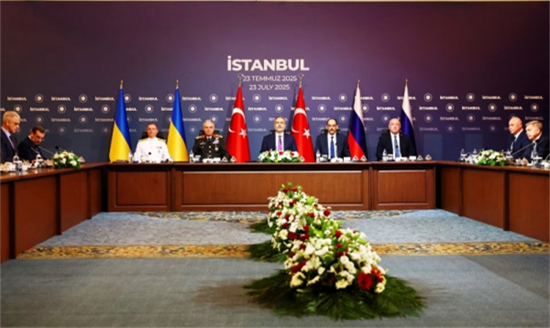 |
| Peace talk between Russia and Ukraine in Istanbul, Turkey on 23 July (Photo: Reuters) |
Flashpoints continue
Besides the ongoing Russia-Ukraine conflict, the world also saw the outbreak of other new flashpoints in 2025. On 13 June 2025, Israel – the U.S closest ally in the Middle East – launched a surprise attack on Iranian nuclear facilities, missile sites, and military commanders to halt Tehran's nuclear and ballistic missile programmes. In response, Iran launched hundreds of missiles and drones into Israeli targets. The 12-day war between Israel and Iran, with the involvement of the US through a lightning air raid onto Iranian nuclear facilities, marked a major shift in the strategic landscape of the Middle East. This was also the first time the two Middle Eastern powers confronted each other in a lightning war. Compared to the previous Middle Eastern wars, this conflict between Israel and Iran is limited in scale and nature, but its repercussions are expected to impact the strategic landscape of the Middle East for many years to come. In military domain, it further affirms Israel's superior advantage, especially with the support of its ally, the United States. However, in terms of politics, the war will deepen the irreconcilable contradictions between the Jewish state and Iran. At the same time, it warns us about the increasingly common use of force to resolve disagreements in the Middle East and around the world.
Also in the Middle East, as of 18 October 2025, the Israel-Hamas conflict has caused approximately 68,000 Palestinian dead and 170,000 other injured. Most of the 2.2 million residents in Gaza were made homeless, and hundreds of thousands of Palestinians are facing starvation, etc. Under international pressure, on 29 September 2025, US President Donald Trump proposed a 20-point initiative to end this bloody war, calling the two sides to cease all military operations and release all hostages within 72 hours of a ceasefire agreement. The plan also stipulated the deployment of international forces to monitor the agreement, Israel's withdrawal of troops from Gaza, the demilitarisation of the Gaza Strip, and the establishment of a peace council chaired by President Trump to oversee the reconstruction of Gaza, among other terms. On 17 November 2025, the United Nations Security Council adopted the resolution drafted by the US, supporting President Trump's 20-point plan to end the conflict in the Gaza Strip and allowing the deployment of an international stabilisation force in the Mediterranean region. Hamas rejected the new mechanism, while the Palestinian Authority supported its implementation. This is also a matter of concern for Israel because it outlines a path towards the future establishment of a Palestinian state. Therefore, according to political analysts, the practical implementation of this resolution will face many difficulties in the future.
The year 2025 also witnessed a conflict between two nuclear powers in South Asia. On 7 May 2025, India launched an air strike coded Operation Sindoor, targeting facilities of a terrorist group in Pakistan which was condemned for the 22 April attack in Pahalgam, Indian-administered Kashmir, killing 26 people. Pakistan returned with mortar fire, missiles, and UAVs. This conflict was one of the most serious escalations between these two South Asian nations since 2019 and may escalate to a nuclear conflict. As having strategic interests in the region, the United States acted as a mediator, using intelligence, economic, and diplomatic measures to force the two parties to end the conflict. As a result, only a few days later, the two countries agreed to sign a ceasefire agreement, which is considered the most effective one between India and Pakistan since 2003.
In South America, Venezuela is facing the risk of armed conflict with the United States. For years, the US has always expected for a regime change in this country. During his first term, US President Donald Trump recognised Juan Guaido – the opposition candidate in the Venezuelan presidential election in January 2019 - as the “legitimate president” and stated that the US military intervention in Venezuela might be possible “to protect the legitimate president Juan Guaido”. International opinion holds that during his second term, US President Donald Trump may decide to militarily intervene in Venezuela under the pretext that this Latin American country is “nursing the drug cartels”. However, according to analysts, the US is actually pursuing the ambition of a regime change and the establishment of a Washington-controlled government in Caracas to gain access to this South American nation's largest oil reserves. Currently, the US has deployed a large naval fleet and marine force off the coast of Venezuela, ready for military intervention.
Given these concerns, the international community hopes that there will be more positive changes in the global political and military landscape in 2026. However, this depends on many factors, especially the actions of major powers and the possibility of ending the current conflicts.
LE THE MAU