
Sixty years ago, during Hiep Duc - Dong Duong Operation, our forces, through a distinctive art of organising and employing combat units, dealt successive “critical, heavy” blows against the enemy’s elite formations operating in the adjacent zone between mountainous and coastal lowland areas of Military Region 5. The success of the Operation marked a new development in the overall strategic offensive posture and gave strong impetus to the movement among our armed forces and people to “seek out to fight American troops, seek out to destroy puppet troops”.
Entering 1965, a series of defeats on the battlefields had pushed the US “Special War” strategy to the brink of complete collapse. However, driven by the ambition to regain military superiority and secure a decisive victory, US imperialism “recklessly” embarked upon a new and extremely dangerous stage of escalation, seeking to pursue its objectives through the military strategy of “Local War”. Accordingly, large numbers of troops - including forces from several satellite states - were deployed directly into combat in South Vietnam. In Military Region 5, US forces employed a number of battle-hardened units equipped with modern weapons, equipment, and combat means to reinforce key positions at Phu Bai, Da Nang, Chu Lai, Quy Nhon and Cam Ranh, among others, with the aim of establishing firm strongholds and conducting “search and destroy” operations. However, following their severe defeat in the Siege of Plei Me, enemy forces were encircled by our troops, placed in a state of isolation and strategic passivity, and forced to withdraw and concentrate within bases, sub-sectors, and district headquarters. In order to form a “hard defensive shell” and provide defence in depth for these key bases, across the adjacent zone between the mountainous and lowland areas of Hiep Duc and Dong Duong, as well as the districts of Que Son, Thang Binh, Tam Ky, and Tien Phuoc in Quang Nam province, the enemy deployed several elite and highly capable units together with security forces, militia, and commando elements, ready to counter and block our offensive operations.
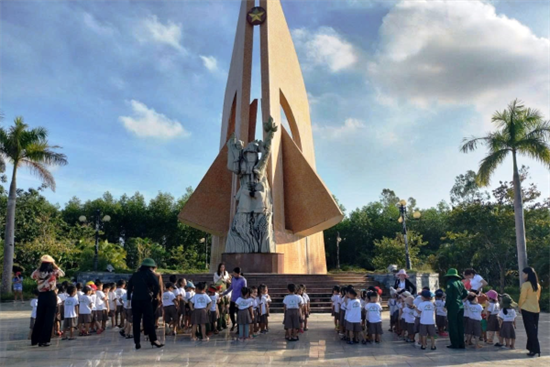 |
| Pupils visit Dong Duong Victory Monument |
On our side, building upon the momentum of victory achieved in the Siege of Plei Me and taking advantage of the enemy’s confusion and disorientation, Military Region 5’s Party Committee and Command decided to launch Hiep Duc - Dong Duong Operation, attacking the adjacent zone between the mountainous and lowland areas with the aim of destroying a significant portion of main enemy forces, creating favourable conditions to intensify guerrilla warfare activities, forming “belts of destruction” against US forces, expanding the liberated areas, training and strengthening our forces in preparation for larger operations. Thoroughly implementing the guiding principle of “fighting the enemy primarily outside fortifications, ensuring certain success, conducting continuous attacks, and dealing decisive blows from the very first engagement, closely combining combat operations of main-force units with political struggle, enemy proselytisation, and popular uprisings to eliminate puppet elements, break enemy control over local population, seize territory, and expand liberated areas”, together with high combat determination and a distinctive military art, after more than one month of continuous offensive, our Infantry Division 2 and associated units achieved outstanding feats, inflicting heavy losses on numerous elite enemy units. The success of the Operation provided many valuable lessons on the art of campaign-level combat, particularly on combat against US forces, including the art of force organisation and employment.
First, implementing appropriate force organisation and employment to assault and besiege enemy strongpoints, and later destroy enemy relief forces. In order to “lure” the enemy into the “trap” we set up in the Hiep Duc - Dong Duong area, the Operation Command and its staff were required to appropriately organise and employ forces for various tasks including assaulting and besieging enemy strongpoints and destroying enemy reinforcements. If excessive forces were committed to assaulting and besieging targets, then when the enemy launched relief and breakout operations, our forces would not have sufficient strength to destroy the relief units, thus failing to achieve the primary objective of the Operation; conversely, if the forces assigned to assaulting and besieging targets were not strong enough to create constant and sufficient pressure, it would not be possible to successfully “bait” enemy reinforcements.
The practical conduct of the Operation shows that, when besieging Viet An strongpoint, the Operation Command employed only Infantry Battalion 60 together with three guerrilla platoons, while the main strength was concentrated on destroying enemy reinforcements, including three infantry battalions (40, 90, and 70) and the Operation’s fire-support units. This represented a particularly notable feature in the organisation and employment of forces of the Operation, as Viet An was a relatively isolated strongpoint located along the vital route linking Hiep Duc and Dong Duong, situated between three mountains (Lac Son, Liet Kiem, and Chop Chai). Consequently, it was sufficient to deploy a moderate force to seize favourable surrounding terrain, deploy firepower effectively, and cut lines of communications to isolate Viet An from Hiep Duc and Dong Duong, thereby quickly placing this important strongpoint under complete encirclement, denying the ability to break out or withdraw of the enemy force inside. With a suitably sized force, but making full use of advantageous terrain and establishing a lethal and clever disposition for assaulting and besieging the target, our forces “locked down” the enemy at Viet An for twelve consecutive days. At the same time, we maintained a sufficiently strong force, deployed in a pre-arranged formation, ready to destroy the enemy’s relief and breakout forces. As anticipated, unwilling to lose “Viet An node”, the enemy hastily organised one Saigon combat group to conduct a relief operation, only to fall into the ambush we had prepared in advance and be promptly defeated by units of Infantry Division 2; the enemy remnants were forced to withdraw and regroup at Dong Duong, creating favourable conditions for us to fight the key decisive engagement of the Operation and secure victory.
Second, opportunely initiating force adjustment to “avoid the enemy’s strengths and strike at its weaknesses”. In this Operation, thanks to creative and sharp thinking in the study, assessment, and overall evaluation of the situation - particularly the art of “knowing the enemy and knowing ourselves” - the Operation Command promptly adjusted its main forces, avoiding direct confrontation with US troops when they were at their strongest, and waiting for an opportunity to deliver a “decisive blow” against their flanks and rear, where they were vulnerable. Accordingly, when US forces deployed four Marine battalions by air assaults into the areas of An Ly, Chau Xuan, Hill 51, Gia Hoi and An Trang, we decided to divide our main forces into two groups: a northern group (Infantry Regiment 21 and supporting battalions of the Division) and a southern group (Infantry Regiment 1), in order to avoid direct engagement with US forces in the central area, while awaiting an opportunity to strike US troops as they withdrew towards Tam Ky after failing to “search and destroy” our main forces. This was a correct decision by the Operation Command, as the enemy had committed large forces equipped with modern weaponry, supported by powerful artillery and air firepower, including B-52 strategic bombers, to strike key areas in order to secure their landing zones. On our side, after two consecutive offensive phases, our units had suffered casualties and required time to replenish and consolidate their forces, as well as to prepare for decisive engagements. A comparison of forces at this stage clearly showed that we were weaker than the enemy; if direct confrontation had been pursued, our casualties would have been heavy, our combat performance would have been low, and our set objectives would have been difficult to achieve. On the basis of accurate situational assessment, the Operation Command divided its forces into two groups and waited until US troops became fatigued, careless and complacent, withdrawing along narrow, single routes, before suddenly delivering “thunderous” blows against their formations. This was a prudent choice, reflecting the Operation Command’s art of creating and seizing opportunities and of “understanding the enemy in order to defeat the enemy”. Thanks to this timely adjustment, and the establishment of a clever, effective battle disposition, when intelligence was received that US troops would manoeuvre via Cam Khe towards Tam Ky after a large-scale “search and destroy” operation that had returned “empty-handed”, the Operation Command ordered Infantry Regiment 1 to conduct a mobile ambush, killing hundreds of US soldiers - delivering critical and punishing blows at an unexpected moment and securing victory.
Third, bringing into full play the combined strength of the three-category armed forces in combat. This represented a creative application closely aligned with battlefield realities, giving full expression to the art of people’s war and generating combined combat power. Accordingly, in order to inflict heavy losses on elite enemy battalions equipped with modern weapons and protected by strong defensive positions, our side concentrated the main forces of Infantry Division 2 together with Quang Nam provincial local troops, forming powerful “fists” that repeatedly delivered decisive blows against the enemy, thereby creating favourable conditions and opportunities to promote guerrilla warfare and mass uprisings to smash local puppet administrations and reactionary collaborators. In the first phase of the Operation, Battalions 60 and 90, together with local forces of Que Son district, focused on destroying enemy forces at Tranh Hill, Son Hill and Nui Lon, gaining control of the administrative area of Hiep Duc district. This victory opened opportunities to intensify guerrilla warfare and mass uprisings, sweep up and capture remaining enemy elements in hiding, force the surrender of Tu La civil-guard post, eliminate enemy spy networks, dismantle communal puppet administrations, and expand the liberated areas.
In coordination with the main axis of attack conducted by the main-force units, along a secondary axis, prior to the opening of the Operation, Battalion 72 of Quang Nam provincial local forces and guerrillas launched an attack to destroy two enemy civil-guard companies. This sudden blow attracted the enemy’s attention, forcing them to expose numerous weaknesses and creating favourable conditions for the main-force units on the primary axis to retain the element of surprise, concentrate their strength, and achieve a decisive victory. Building on these favourable developments, a local company of Thang Binh district attacked the district headquarters, destroying one civil-guard platoon and dismantling twelve strategic hamlets, while guerrilla forces in various localities eliminated collaborators and destroyed the enemy’s logistics and technical facilities, and so forth. Thus, by establishing a widespread, interlocking battle posture, local forces and guerrillas across the area caused puppet troops and administrations to become increasingly “disintegrated”, suffering attrition and severe weakening, with their areas of control shrinking, their capacity for coordination, cooperation, and mutual support between US forces and puppet troops and authorities limited, and their overall combat power steadily declining, ultimately leading to defeat.
The victory of Hiep Duc - Dong Duong Operation created a new shift in our strategic offensive posture in the area of Military Region 5. The lessons learned regarding the art of organising and employing forces in operational combat should continue to be studied and flexibly, creatively applied in the (potential) war to defend the Fatherland.
Sr. Col. NGUYEN HOAI NAM, MA
Military Medical Academy