
Stationed in the Central Coast and Central Highlands - one of the regions that are most severely affected by diverse types of natural disasters nationwide, over the years, the armed forces of Military Region 5 have always promoted their core, pioneering role in responding to natural disasters, becoming a firm, reliable fulcrum for local Party committees, authorities, and citizens in the region.
With terrain sloping gradually from west to east, Truong Son mountain range stretching across the western side, steep eastern slopes, and numerous mountain ranges extending out towards the sea, the Central Coast and Central Highlands region has complex weather, climate, and hydrological conditions and frequently endures many types of natural disasters, such as storms, floods, earthquakes, droughts, tornadoes, and landslides.
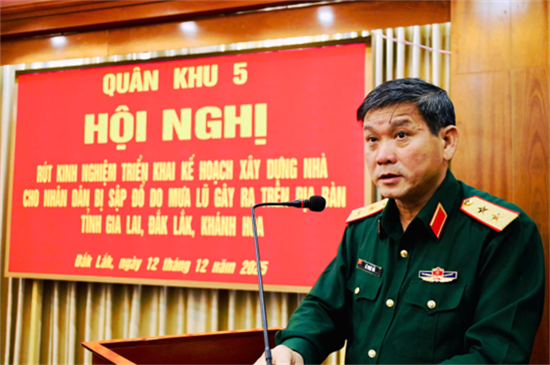 |
| A conference by Military Region 5 to draw lessons on implementing Quang Trung Campaign |
In recent years, due to the impacts of climate change, natural disasters have taken place more frequently, with greater intensity, causing more severe damage. On average, this region is struck by 3 - 4 storms each year and experiences 2 - 3 heavy rainfall episodes leading to serious flash floods, inundation, and landslides, leaving many areas isolated and cut off, forcing thousands of households to evacuate, causing severe hardship to the people’s lives. In 2025 alone, several extremely strong storms made landfall, bringing historic rainfall and flooding across localities within the Military Region, such as Storm No.12 (October 2025), with prolonged heavy rain causing widespread flooding in lowland areas and severe landslides in mountainous areas of Da Nang and Quang Ngai. In mid-November 2025, while the damage caused by Typhoon Kalmaegi (Storm No.13) had yet to be fully addressed, locals in the provinces of Gia Lai, Dak Lak, and Khanh Hoa were faced with a historic flood, resulting in 125 people being killed or missing and property damage estimated at VND 15 trillion.
Fully aware of the situation, over the years, alongside effectively carrying out training and combat readiness tasks, the armed forces of Military Region 5 have attached great importance to natural disaster prevention and control and search and rescue, regarding this as a “combat mission in peacetime” and a “command from the heart”, closely working with local Party committees and authorities, promoting the synergy of organisations and forces in the area to well perform this vital mission. Accordingly, leadership, command, and management of disaster response and search and rescue have been maintained in a disciplined, effective manner. The Military Region Party Committee Standing Board has directed all affiliated Party committees and organisations as well as provincial-level military Party committees to proactively develop resolutions on this important work in accordance with their practical conditions and task requirements, delegate specific responsibilities, and strictly conduct inspection and supervision. The Military Region Command has issued a lot of directives, regulations, plans, and guiding documents to direct and manage disaster response and search and rescue in accordance with the characteristics of each area, while actively coordinating with provincial-level Party committees in leading, directing, and guiding the implementation process uniformly, effectively. Civil defence commands at all levels and search and rescue teams have been regularly consolidated, thus ensuring a unified, close, smooth command and control system. Offices and units have well carried out the work of propagation and education to raise their troops’ awareness, responsibility, political steadfastness, and resolve. In fact, when receiving orders, regardless of the destructive power of nature, cadres and soldiers promptly appeared at key locations, proactively overcoming difficulties and dangers, maintaining coordination to effectively handle situations.
Besides, the Military Region has actively renewed and improved training work, and practised its disaster response projects. Emphasis has been placed on improving forces’ capabilities in organisation and command and their skills and procedures for handling incidents and disasters as well as conducting search and rescue operations. Due attention has been paid to specialised training to enhance the capacity of military medical teams, humanitarian assistance and disaster relief units, and technical personnel in using equipment. To improve the task performance of agencies, localities, and units, the Military Region has attached significance to organising exercises on response to serious disaster scenarios, such as super storms, widespread heavy floods, landslides, and dyke breaches. Localities have flexibly integrated disaster prevention and control and search and rescue into defensive zone exercises, thus practically improving the leadership, direction, and command capabilities of Party committees and authorities as well as forces’ coordination, equipment utilisation, and political resolve.
 |
| Inspecting the construction of houses for locals during Quang Trung Campaign |
Upholding the spirit that “wherever the people need, troops will be there; wherever difficulties arise, troops will be present”, with the “direct, practical, effective” leadership and command mechanism, offices and units have made all necessary preparations and maintained coordination with local authorities and other forces to take the initiative in responding to disasters, minimising damage, and helping the people quickly stabilise their lives. Accordingly, when serious landslides occurred in Tra Leng commune, Nam Tra My district, Quang Nam province (October 2020), and at Da Nang city cemetery (October 2022), the Military Region mobilised all available resources, with sufficient forces and equipment to assist the people in quickly responding to the disasters and minimising loss of life and property.
Especially during the complex developments of the recent historic floods and storms, the Military Region strictly maintained duty regulations, closely monitoring weather conditions and actual developments, organising multiple working delegations to directly command disaster response and recovery efforts in the field, at the heart of storms, and within isolated areas. In coordination with local authorities, 17,085 households with 65,120 people affected by or facing risks from storms, floods, and landslides were relocated to safe areas. Units deployed more than 8,000 personnel and nearly 150 vehicles of all types, surmounting all dangers and hardships to engage in disaster response and search for missing persons, ensuring absolute safety and effectiveness in the process. Goods were transported by land, while essential supplies were delivered in coordination with air force units for the people within isolated areas.
After the storms and floods, offices and units actively assisted local authorities and people in recovery efforts, organising clean-up and repair of over 11,000 houses, protecting 100 metres of sea dykes, cleaning 645 schools, 134 hospitals and medical stations, and 499 offices and public works. In coordination with Military Hospital 175, Hospital 87 of the General Department of Logistics and Technology, and Southern Military Preventive Medicine Institute, 33 medical teams and 6 epidemic prevention teams were deployed to conduct search and rescue, medical examination, medicine distribution, and disease prevention for localities. Tens of thousands of free meals were prepared and distributed to locals; in cooperation with individuals, organisations, and enterprises, tens of tons of relief goods were transported to the people in disaster-hit areas. In “Quang Trung Campaign” launched by the Prime Minister, the Military Region organised and deployed 80 construction teams, maintaining coordination with local authorities and forces to build 402 new houses and repair 334 houses, helping the people quickly stabilise their lives. With great affection and responsibility for the people, those efforts have shown profound humanitarian significance, contributing to spreading the virtues of “Uncle Ho’s Soldiers” - Military Region 5’s soldiers in the new era.
In the coming time, the Military Region’s area will continue to be affected by climate change, with the increasingly complex, abnormal, unpredictable developments of natural disasters. Storms, floods, droughts, and extreme natural disasters tend to increase in number, intensity, and frequency. Hence, the armed forces of the Military Region will focus on synchronously, effectively implementing several key tasks and solutions as follows.
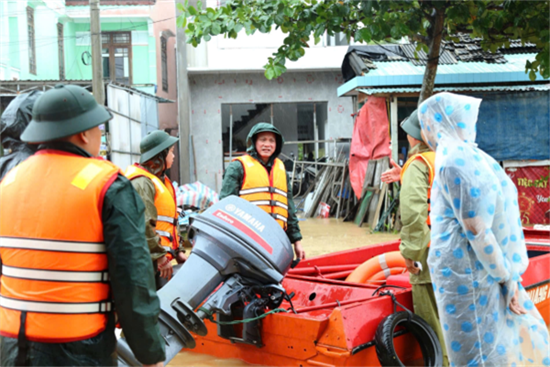 |
| Search and rescue forces during the historic flood in Da Nang |
First, strengthening leadership and direction to promptly, effectively respond to natural disasters in the area. Party committees and commands at all levels will continue thoroughly grasping and effectively implementing superior directives on disaster response, concretising those documents into resolutions and action plans relevant to reality, ensuring unity in awareness, taking resolute action, readily handling any abnormal disaster situations. Leadership, command, and management work will be resolutely, proactively, effectively carried out early and from afar, right at grass-roots level, and in accordance with situational developments.
In the medium term, Party committees and commands at all levels will focus their leadership and direction on successfully completing “Quang Trung Campaign”. Forces will uphold a sense of proactivity, discipline, and responsibility, surmount all difficulties and challenges, and closely coordinate with local Party committees, authorities, other forces, and project boards to build and repair houses, and help the people stabilise their lives “at lightning speed”.
Second, urgently reviewing and completing response projects and inter-sectoral and inter-force coordination mechanisms for disaster response. Based on data from the recent historic floods and storms, as well as superior directives and their task requirements, offices and units will proactively review, update, and perfect the system of disaster response plans according to risk levels, while building plans to handle extreme disaster scenarios, such as super storms, flash floods, landslides, dam breaches. Inspection and assessment of the current status of disaster prevention works will be conducted to identify key areas and develop appropriate protection plans and scenarios. Duty regimes for search and rescue at all levels will be maintained strictly; weather developments will be proactively monitored; plans will be regularly updated to ensure readiness. Mechanisms for command and control, particularly unified command from the Military Region to its affiliates, and close coordination with local Party committees, authorities, and other forces in disaster response and search and rescue will be closely maintained.
Offices and units will closely coordinate with sectors and localities to thoroughly grasp geographical characteristics, population distribution, livelihoods, and occupational features for providing early warnings of risks. Military agencies at all levels will effectively advise local Party committees and authorities on consolidating and improving all-level civil defence commands, building mechanisms, policies, and operational regulations, delegating responsibilities, and enhancing all-level cadres’ command and management capacity.
Third, focusing on substantive training and exercises and improving on-site command, management, and action capacity. Units will seriously maintain disaster prevention, incident response, and search and rescue training, practise plans for response to reservoir and dyke incidents, population evacuation, rescue, and disaster consequence settlement. They will closely combine training with exercises and enhance their forces’ command, coordination, and response capacity under all conditions. Emphasis will be placed on organising continuous multi-force, multi-area exercises integrated with practical training in responding to complex incidents, such as forest fires, dam breaches, maritime search and rescue, population evacuation in dangerous areas, thereby promptly drawing lessons, adjusting plans and maps for disaster prevention and response in line with reality, enhancing forces’ mobility, coordination, and effectiveness.
Fourth, raising public awareness, making all-round preparations, consolidating logistics and technical capacity and specialised equipment to meet mission requirements. From practical lessons learned in responding to the recent historic floods and storms, propagation activities to raise public awareness and disaster prevention personnel’s capacity must be intensified. Via mass mobilisation, offices and units will strengthen dissemination of knowledge and skills on disaster prevention and control. This includes identifying disaster risks and response solutions for each community, especially those in high-risk, remote, mountainous areas. The militia and self-defence forces will be taken as the core to build, consolidate, and multiply disaster response teams at commune and village levels, tasked with proactively responding to natural disasters from the earliest moments, especially in key areas.
Party committees and commands at all levels will thoroughly grasp and strictly realise “four-on-the-spot” and “three-readiness” principles, while taking prevention as the main focus. The organisational structure of mobile forces at all levels will continue to be consolidated; synchronised investment in specialised equipment will be made to meet task requirements. Field logistics bases will be proactively established; essential supplies will be stored on the spot; support capacity will be enhanced in mission execution. The role of regional depot systems will be promoted to build a flexible logistics posture closely aligned with the area, ready to effectively respond to all situations.
Practice from the recent historic floods and storms shows that in order to meet the increasingly high requirements of disaster response, the armed forces of the Military Region should continuously renew their leadership thinking and remain resolute in their action. The achieved results demonstrate the early and from-afar defence thinking of Military Region 5’s Party Committee Standing Board and Command, which places the people at the centre and upholds the viewpoint that national defence must be closely linked with people’s livelihoods while security must be associated with sustainable stability. This is not only an immediate requirement, but also a long-term strategy to firmly protect the area and build strong, modern all-people national defence right in peacetime.
Lt. Gen. LE NGOC HAI
Commander of Military Region 5