
In recent years, under the impact of climate change, weather conditions across our country have become increasingly complex and extreme, causing severe losses in human life and property for the State and the people. Against that backdrop, officers and soldiers of the Vietnam People’s Army (VPA) have consistently upheld their role as the core force and a firm, reliable pillar for the people in natural disaster prevention and control and search and rescue, thereby further spreading the glorious image of “Uncle Ho’s Soldiers”, being highly appreciated by the Party, State, and people.
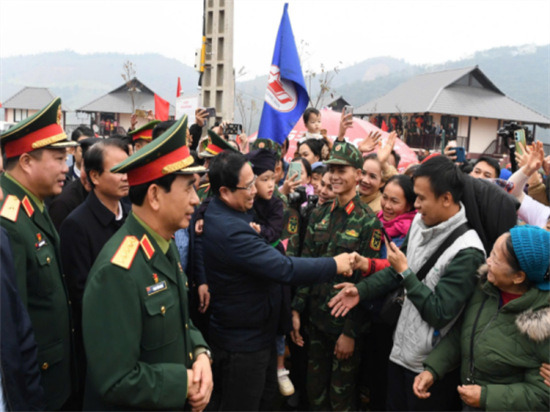 |
| Prime Minister Pham Minh Chinh joins the people in the Inauguration Ceremony of the Project to build a new residential area within Lang Nu village, Phuc Khanh commune, Lao Cai province, in December 2024 |
Vietnam is a country with diverse, complex terrain; on average, each year Vietnam is directly affected by 12 to 14 storms and tropical depressions, as well as heavy rainfall leading to major floods, widespread inundation, and landslides. Alongside these phenomena are drought and saltwater intrusion, all of which are highly unpredictable.
Extreme weather phenomena have caused severe losses in human life and property, damaged the nation’s infrastructure, and seriously affected socio-economic development activities. The year 2025 recorded many abnormal weather events; by the end of November 2025, there had been 15 storms and 6 tropical depressions occurring in the East Sea, making it the year with the highest number of storms and tropical depressions since observational records began (in 1961), and resulting in serious damage nationwide.
Against that backdrop, the VPA has consistently taken the lead, clearly demonstrating its political responsibility to the Party, State, and people, becoming a firm and reliable pillar for the people in disaster response. Imbued with President Ho Chi Minh’s teachings: “When storms and floods occur, combating storms and floods must be given top priority”; “Our army is the people’s army, meaning it is composed of the people’s own sons and daughters… protecting the people’s freedom and happiness”, the Central Military Commission (CMC), the Ministry of National Defence (MND), and party committees and commands at all levels across the VPA have always attached great importance to exercising leadership and direction over disaster prevention and response, as well as search and rescue operations, identifying these tasks as the Military’s “combat missions in peacetime”.
With a well-organised system, strict discipline, high mobility, and rich practical experience, agencies and units have proactively developed disaster prevention and response plans for each risk level, prepared forces, equipment, and technical supplies in accordance with the “four on-the-spot” and “three readiness” mottos, and intensified training and rehearsals of manoeuvre and search-and-rescue plans under different types of terrain and climatic conditions. They have focused on grasping and seriously implementing resolutions, directives, and urgent instructions from higher authorities, regularly monitoring local conditions and climate and weather developments, proactively coordinating with other forces and the people, authorities at all levels, sectors, party committees, and local governments to effectively implement response measures and mitigate the consequences of natural disasters.
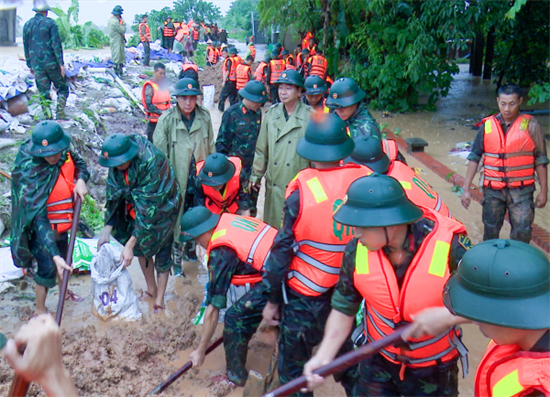 |
| Troops of Military Region 1 settle the consequences of Storm No.11 within Thai Nguyen province (October 2025) |
Following the directions of the CMC and the Minister of National Defence: “The Military must proactively go to the people, not wait for the people in need to seek out the Military… The Military will do its utmost for the people…”, adhering to the principle that “helping the people is an order from the heart”, between 2021 and 2025, agencies and units across the entire VPA mobilised more than 1.5 million personnel and over 64,000 vehicles to assist the people in responding to storms and floods. Nearly 12,000 people and almost 1,300 vehicles were rescued; more than 12 million people with over 2.4 million vehicles were alerted and mobilised; fire fighting operations were conducted for nearly 4,000 houses and over 6,000 hectares of forest; nearly 275,000 households were assisted in relocating to safe shelters. From the end of September 2025 to the present, successive prolonged heavy rains have caused flooding, flash floods, and landslides, resulting in serious losses of life and property. The VPA has participated in assisting the people and local authorities in overcoming the consequences by searching for the missing, supplying and transporting relief goods, spraying disinfectants and carrying out decontamination, cleaning the environment and water sources, repairing and cleaning houses, medical facilities, schools, public offices, and transport routes, harvesting crops, and repairing dykes, reservoirs, and dams, among other tasks. At the same time, the CMC and MND have provided support amounting to nearly VND 12.3 billion to families and relatives of officers and soldiers affected by natural disasters.
In particular, in response to “Quang Trung Campaign” to swiftly rebuild and repair homes for families whose houses were damaged by recent natural disasters in the Central region and the Central Highlands, party committees and commands of agencies and units stationed in provinces and cities from Ha Tinh to Lam Dong have closely coordinated with local party committees, authorities, departments, and mass organisations. They have mobilised more than 125,000 personnel and over 5,000 vehicles of all types to assist the people in constructing and repairing more than 600 houses that collapsed or were swept away by floods. With the highest sense of responsibility and working day and night, military units are determined to complete the construction of new houses for households whose homes were completely destroyed or severely damaged before 20 January 2026 (striving to finish 10 days ahead of the deadline set by the Government), thereby ensuring that all people who lost their homes due to natural disasters have accommodation and can enjoy the 2026 Tet holiday (Lunar New Year) in safe homes, in line with the objectives set by the Campaign.
With the determination to “endure the scorching sun, overcome the rain, and never yield to storms”, units have closely combined disaster prevention and response with mass mobilisation, coordinating with party committees, authorities, Vietnam Fatherland Front, and political - social organisations to encourage the people to proactively prevent and respond to natural disasters, acquire response skills, and maintain environmental hygiene after floods. These efforts have contributed to building an increasingly firm “people’s hearts and minds posture” and further enhancing the noble image of “Uncle Ho’s Soldiers”. The timely presence of military units in difficult, complex situations and the images of thousands of officers and soldiers braving hardship and danger, wading through floodwaters to evacuate people from hazardous areas to safety, overcoming rough seas and strong winds to deliver food and essential supplies, and conducting search and rescue operations to save lives have provided motivation and served as a firm and reliable support for the people to surmount hardship and loss and gradually stabilise their lives.
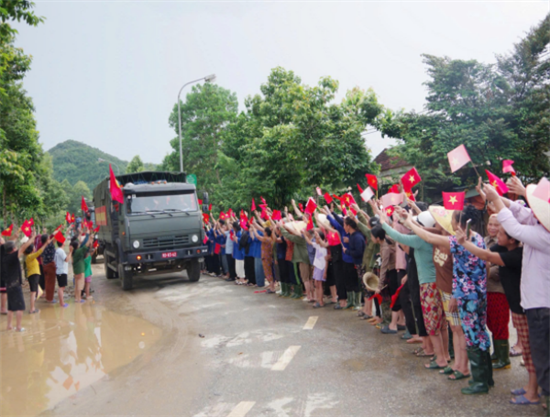 |
| Locals of Nghe An province wave farewell to troops after fulfilment of Storm No.3 response task (July 2025) |
In the coming period, weather trends are forecast to become increasingly extreme and unpredictable due to the impacts of climate change; accordingly, disaster prevention and response and search and rescue operations will face many difficulties. Upholding the tradition and noble virtues of “Uncle Ho’s Soldiers” in the new situation, officers and soldiers across the entire VPA will continue to regard assisting the people in natural disaster prevention and control as a political responsibility, an “order from the heart”, and the Military’s “combat mission in peacetime”. In this regard, priority will be given to effectively implementing the following key tasks.
First, strengthening education and fostering a high level of commitment among officers and soldiers with regard to disaster prevention and response and search and rescue. Accordingly, party committees and commands at all levels need to intensify political education so that their subordinate officers and soldiers thoroughly understand and strictly implement the Party’s viewpoints and lines, the State’s policies and laws, and the directions of the CMC and MND relating to disaster prevention and response and search and rescue operations; they should actively disseminate and publicise information on the risks and consequences caused by natural disasters, storms, and floods. On that basis, units and agencies must clearly identify disaster prevention and response and search and rescue as important political tasks and an expression of the affection, responsibility, and noble commitment of military personnel towards the people. In addition, the VPA must build strong commitment and resolve among officers and soldiers so that they are always the vanguard and core force, promptly present in the most difficult, dangerous places, ready to sacrifice to protect the lives and property of the State and the people, with the spirit that “human life comes first and foremost” and “wherever there are difficulties and dangers, there are soldiers”. There must be no manifestations of subjectivism, complacency, or reluctance to endure hardship and sacrifice among military members.
Second, enhancing leadership and direction over the task of assisting the people in disaster prevention and response. Party committees and commands of agencies and units must continue to uphold their sense of responsibility, regularly exercise their leadership and direction over the monitoring and close grasp of the situation, make accurate forecasts, and proactively develop plans and projects to respond to developments of natural disasters in their areas. They must also effectively implement the principle of “taking prevention as the key, giving proactive, swift, effective response”, ensure thorough preparation of resources to deal with disaster situations, strictly maintain regimes for combat readiness and flood and storm prevention, guarantee sufficient forces and means to adopt preventive measures for agencies and units and to rapidly manoeuvre to participate in disaster response and recovery operations. When disasters occur, military units must closely follow direction from the higher-up, proactively review and adjust disaster prevention and response plans to suit local characteristics and specific situations, and be ready to manoeuvre quickly and reach the scene as early as possible to rescue the people and protect the lives and property of the State and the people. At the same time, units need to pay attention to reviewing and updating information on families of officers and soldiers in affected areas who suffer losses due to natural disasters, propose solutions in accordance with decentralised authority, and promptly encourage troops to overcome difficulties, stabilise their lives, and successfully fulfil their assigned tasks.
Third, continuing to effectively organise field training marches combined with mass mobilisation to assist the people in settling the consequences of natural disasters. This is identified as a key component of fulfilling the VPA’s function as an “army ready for work”, contributing to strengthening military - civilian solidarity and building an increasingly firm “people’s hearts and minds posture”. When carrying out this important task, units need to stay close to grass-roots levels and localities, especially remote, isolated, border, and island areas where difficulties remain significant, closely combine propagation work aimed at encouraging the people to abide by the Party’s lines and the State’s policies and laws with participation in assisting the people in economic development, poverty reduction, new-style rural and civilised urban area building, and natural disaster prevention and response.
Fourth, intensifying the dissemination and replication of “skilful mass mobilisation” models and exemplars in disaster prevention and response. Units need to closely coordinate with press and media agencies, both within and outside the VPA, to step up communication and reporting, through articles, pieces of news, and images on troops’ participation in assisting the people in disaster prevention and response, thereby spreading the noble virtues and image of “Uncle Ho’s Soldiers” in their task performance. In addition, military units must promptly draw lessons and encourage, reward, and replicate collectives and individuals with outstanding achievements. Furthermore, military leaderships at all levels must fully bring into play the role of organisations and forces in resolutely combating and thwarting schemes and tactics that seek to exploit disaster situations to sabotage the Party, State, and VPA.
Natural disasters in Vietnam are becoming increasingly complex and unpredictable, with ever more devastating consequences, threatening the safety and lives of the people and affecting military and defence tasks. In all circumstances, officers and soldiers of the VPA remain the core, vanguard force and a firm, reliable pillar for the people in disaster prevention and control, continuing to uphold the noble virtues of “Uncle Ho’s Soldiers” in the new era.
Maj. Gen. BE HAI TRIEU
Director of the Department of Mass Mobilisation