
Thoroughly grasping and implementing the strategic guidelines of the Party, the Central Military Commission, and the Ministry of National Defence on restructuring local military forces in the “lean, compact, and strong” direction, the Military Region 3 Party Committee and Command have resolutely and synchronously deployed a wide range of measures and achieved encouraging initial results. These outcomes have laid a firm foundation for building the Military Region’s armed forces “revolutionary, regular, elite, and modern,” enabling the successful fulfilment of assigned tasks and further embellishing the tradition of “unity, proactiveness, creativity, sacrifice, and victory” in the new era.
By profoundly internalising the Party’s military and defence line - most notably the Politburo’s Resolution No.05-NQ/TW dated 17 January 2022 on the organisation of the Vietnam People’s Army for the period 2021-2030 and beyond; the Central Military Commission’s Resolution No.866-NQ/QUTW dated 14 June 2025; and the Ministry of National Defence’s Plan No.3433/KH-BQP dated 14 June 2025 on implementing the reorganisation of local military structures in a “lean, compact, and strong” manner to meet mission requirements in the new context – the Military Region 3 (MR3) Party Committee and Command have proactively conducted in-depth studies, maintained a firm grasp of the situation, and promptly concretised these directives through resolutions, programmes, and plans. At the same time, they have led and directed military party committees and provincial and municipal military commands to advise provincial and municipal party committees and people’s committees on organising dissemination and developing implementation plans with clearly defined roadmaps, phases, and completion timelines, closely aligned with local realities and the specific characteristics of each type of agency and unit.
Concurrently, the MR3 Party Committee and Command have focused on leading and directing the consolidation of steering committees and defensive area councils; reviewing, adjusting, and supplementing operational documents and combat plans for the protection of agencies and units in line with the two-tier local government model and newly defined administrative boundaries. They have reviewed personnel planning and appointments for area defence command staff, while coordinating the consolidation of commune-level military commands in accordance with established criteria, ensuring quality and effective fulfilment of mission requirements. Notably, the Military Region has proactively researched and successfully directed two pilot exercises for the Area Defence Command No.3 - Dong A (Ninh Binh Provincial Military Command) and the Border Guard Command under the Hung Yen Provincial Military Command. These exercises incorporated numerous novel and unprecedented elements and were duly recognised and highly commended by the leadership of the Ministry of National Defence and the General Staff.
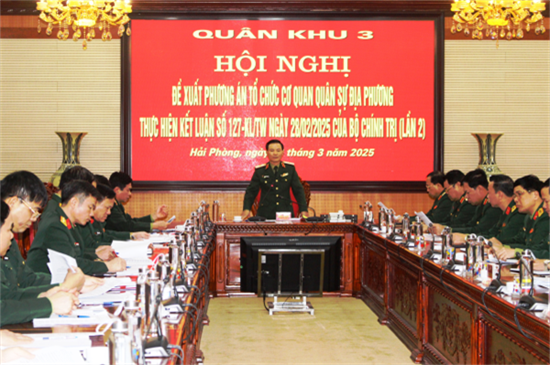 |
| Conference on the restructuring of local military agencies |
With strong political resolve and scientifically grounded solutions, the Military Region has to date largely completed the reorganisation and restructuring of local military agencies in accordance with the approved plan. Following the reorganisation, the structure among agencies, units, departments, and force components has become balanced and synchronised; operations have been brought into a stable and orderly routine; and coordination, advisory, command, and leadership activities in the execution of local military and defence tasks have been maintained without interruption, ensuring that no operational gaps have arisen. The overall quality and combat strength of local armed forces have continued to improve, enabling timely and effective handling of defence, security, and civil defence contingencies, thereby meeting mission requirements in the new situation.
In the years ahead, the cause of building the Army, strengthening national defence, and safeguarding the Fatherland will pose higher and more demanding requirements for the Military Region’s armed forces. To meet these demands in the new phase, alongside resolute and comprehensive leadership and direction across all areas of work, MR3 Party Committee and Command have determined to continue making breakthroughs in building strong local military agencies, ensuring that they truly serve as the core force in advising, directing, and organising the implementation of military and defence tasks at the local and grassroots levels.
In pursuit of this objective, the Military Region will, first and foremost, continue to thoroughly grasp and effectively implement the resolutions, conclusions, and plans of the Party, the Central Military Commission, and the Ministry of National Defence concerning the organisation of local military forces, with particular emphasis on Resolution No.866-NQ/QUTW of the Central Military Commission and Plan No. 3433/KH-BQP of the Ministry of National Defence. On that basis, it will direct party committees and commanders of agencies, units, and localities to review, supplement, and concretise the goals, requirements, and targets set out in resolutions, programmes, and leadership and implementation plans. At the same time, it will proactively coordinate with functional departments and sectors to advise and propose to provincial and municipal party committees guidelines and solutions for leading and directing the consolidation, strengthening, and enhancement of leadership capacity and combat effectiveness of military party committees and cells at all levels, in close conjunction with the consolidation of the cadre contingent in line with the two-tier local government model.
Relevant agencies - most notably the General Staff Department and the Political Department - will take the lead, in coordination with functional agencies of the Ministry of National Defence and with localities and units, in conducting a comprehensive review of the system of legal normative documents related to defence and military affairs, promptly updating and supplementing new provisions and repealing regulations that are no longer appropriate. Priority will be given to revising and supplementing regulations on leadership over key areas of work, working regulations, and coordination mechanisms among agencies, units, and forces in the execution of military and defence tasks, as well as in defensive operations, to ensure unity, synchronisation, and effectiveness. Concurrently, they will advise and propose to higher authorities the promulgation of regulations clearly defining the functions, tasks, powers, and responsibilities of area defence commands, Border Guard commands, border guard posts, and commune-level military commands, thereby creating a firm legal framework for effective inter-force coordination, avoiding overlap or omissions in the conduct of military and defence work at the local and grassroots levels.
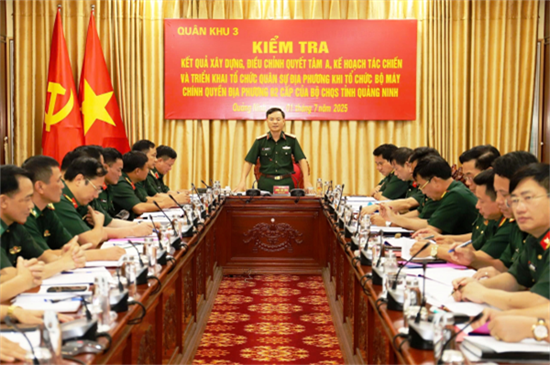 |
| Reviewing the result of running new local military agencies associated with the two-tier local govervent model in Quang Ninh province |
Secondly, continued efforts will be made to accelerate the consolidation of organisational structures and forces, and to build a contingent of local military cadres commensurate with task requirements. This constitutes both a mission and a foremost solution, serving as the decisive factor in determining the combat strength of agencies and units. Building on achieved results, the Military Region will continue to thoroughly implement and strictly enforce the new organisational and personnel establishment promulgated by the General Staff. With regard to local military agencies, proactive adjustments and force realignments will be undertaken, prioritising manpower for units assigned combat readiness missions and for key, border, and island areas. At the same time, the effectiveness of coordination between the Military Region Party Committee and provincial and municipal party committees, as well as with the Border Guard Party Committee and High Command, will be enhanced in leading and directing the building of strong local military party organisations in political, ideological, and organisational terms, endowed with comprehensive leadership capacity, and capable of effectively advising on and implementing military, defence, and border protection tasks under new conditions.
In parallel with organisational consolidation, the Military Region will intensify leadership and direction in building a contingent of local military cadres, particularly those serving in area defence commands and commune-level military commands, who possess firm political resolve, strong professional competence, scientific working methods and styles, and the capacity to handle complex issues arising at the grassroots level. Accordingly, alongside reviewing, assessing, and assigning cadres in line with their capabilities and strengths, the Military Region will advise on the selection of fundamentally trained cadres with practical experience to further consolidate commune-level military commands, ensuring sufficiency in numbers and improvement in quality. It will also coordinate with localities to accelerate the implementation of the project on training commune, ward, and special administrative unit military cadres to college and university level in grassroots military studies. Plans will be developed, and guidance provided to provincial and municipal military commands to advise local party committees and authorities on allocating budgets for advanced training in political theory for 100% of commanders of commune-level military commands. Moreover, cadres of area defence commands will be reinforced to directly provide professional guidance and support to commune-level military commands, particularly in new task areas, thereby enhancing the quality of military party cell activities and the overall effectiveness of military commands at the commune, ward, and special administrative unit levels.
Thirdly, the innovation and enhancement of the quality of training and combat readiness will be intensified. Closely adhering to the direction and guidance of the General Staff on military and defence work - particularly drawing on the outcomes and experience gained from the two pilot exercises - the Staff Department will continue to conduct research and advise on the development of plans, content, and programmes for training and refresher courses tailored to different target groups. It will further supplement and refine management and command-and-control mechanisms, together with leadership, command, and operational regulations, in order to enhance coordination and cooperation among forces, including main-force units, local forces, and the militia and self-defence force, under conditions of the two-tier local government model and the new organisational arrangements for local military agencies. Defensive operations exercises will be organised for area defence commands and commune-level military commands in accordance with approved plans, with improved quality and closer alignment with operational intent.
Party committees and commanders of local military agencies at all levels will proactively review and supplement targets and measures in programmes and plans implementing Resolution No.396-NQ/ĐU dated 22 March 2023 of the Military Region Party Committee on improving training quality for the period 2023-2030 and beyond. Emphasis will be placed on in-depth research and accurate situational assessment, particularly with regard to the adversary’s plots, tactics, and new weapons and equipment, as well as the characteristics of the operational environment and our own force organisation, weapons, and equipment, so as to adjust, supplement, standardise, and refine training and exercise content, programmes, and scenarios for all target groups. Training will focus on enabling standing forces and the militia and self-defence force to master and proficiently employ weapons and equipment in their authorised tables of organisation, supporting tools, and improvised weapons, thereby enhancing their capacity for independent combat readiness and coordinated action with other forces to effectively handle contingencies, maintain local stability, and participate in disaster prevention, search and rescue, and relief operations at the local level.
Concurrently, the Military Region will focus on directing local military agencies at all levels to develop, revise, supplement, and complete the system of operational documents and civil defence plans, while ensuring adequate provision of materiel, weapons, equipment, and supporting tools. Close coordination will be maintained with local party committees and authorities to review, adjust, and supplement the development of the Military Region’s defensive posture and provincial- and municipal-level defence zone projects in accordance with newly defined administrative boundaries. Greater emphasis will be placed on organising drills and exercises for the Military Region’s defensive posture, defence zones, sectoral defensive support exercises, and civil defence exercises, among others. Through these activities, operational plans and contingencies will be promptly adjusted and refined to better reflect the realities of each sector, locality, agency, and unit.
Finally, resources will be proactively mobilised to ensure funding and infrastructure commensurate with the operational requirements of local military agencies in the new era. In practice, immediately following establishment decisions, localities have actively mobilised all available resources to provide initial support for newly formed units. However, training grounds, firing ranges, barracks, and storage facilities serving training and daily life in a number of agencies and units - particularly newly established units or those relocated to new garrisons - have yet to fully meet operational requirements. To address this situation, in the coming period, in close alignment with the Master Site Planning and the Medium-Term Public Investment Plan for 2026-2030, the Military Region will actively mobilise resources to effectively implement approved projects and schemes for the construction of barracks, depots, training grounds, and exercise areas serving training and manoeuvres, while ensuring the efficient and lawful management and use of defence land. It will continue to direct provincial and municipal military commands to advise local party committees and authorities on reviewing and allocating resources for consolidating and upgrading headquarters facilities and working equipment for commune-level military commands; reviewing and adjusting defence land-use planning in conjunction with provincial and municipal socio-economic development strategies; and planning the mobilisation of resources for building and effectively operating the militia and self-defence force, the reserve force, and permanent militia combat posts in border areas. At the same time, defence potential will be strengthened through the review, consolidation, supplementation, and expansion of defensive works within the overall defensive posture.
Strong emphasis will be placed on accelerating the application of information technology, digital transformation, and administrative reform in the defence and military domain, particularly at the commune-level military agencies. Priority will be given to building a national digital database on military service, the militia and self-defence force, and the reserve force, with secure data connectivity and sharing with the national population database. Greater use will be made of automated command-and-control software and 3D digital mapping in exercises and defensive operations, while enhancing information technology and digital transformation competencies among cadres and personnel, treating these capabilities as mandatory criteria in annual cadre performance assessments.
Alongside the above tasks and solutions, MR3 will continue to thoroughly disseminate and strictly implement higher-level documents, directives, and guidance on building comprehensively strong units that are “exemplary and typical.” Inspection, supervision, and guidance will be intensified in order to promptly address difficulties and obstacles, particularly issues arising in the course of operating the new organisational model. This will help ensure organisational stability, ideological unity, and the development of strong local military agencies with enhanced operational effectiveness, in line with the two-tier local government model and capable of meeting the requirements and tasks of safeguarding the Fatherland in the new situation.
Lieutenant General LUONG VAN KIEM, Commander of Military Region 3