
Signal Brigade 21 is tasked with ensuring communications for the Border Guard Force (BGF) Command to exercise leadership, direction, and command over subordinate agencies and units. In the execution of its missions, the Brigade has faced numerous difficulties due to the dispersed deployment in many areas, a wide variety of tasks, and high operational requirements.
Fully aware of those challenges, over the years, the Brigade has directed its affiliates to resolutely, synchronously implement various solutions aimed at building “exemplarily, typically” comprehensively strong unit, considering this a decisive factor in raising its overall quality and ensuring seamless, reliable communications for assigned missions. From its recorded results, the Brigade has drawn several lessons as follows.
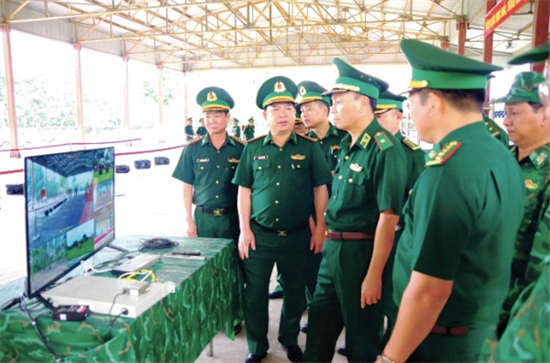 |
| BGF Command inspects the Brigade’s communications support work |
First, focus on building a politically strong Brigade, ensuring that cadres and soldiers are always ready to undertake and successfully accomplish all assigned tasks, especially under high-intensity operating conditions requiring the maintenance of “lifeline” of communications in any circumstances. The Brigade has directed its affiliates to well perform political and ideological education work, with emphasis on implementing Directive 2423-CT/QUTW, dated 09 November 2023, by the Central Military Commission Standing Board, on “renewing and improving political education in the new period” to render cadres and soldiers fully aware of their task requirements, regulations on security and discipline in communications, the necessity of building “exemplarily, typically” comprehensively strong unit, and the criteria stipulated in Directive 79/CT-BQP, dated 22 July 2022, by Minister of National Defence on the building of “exemplarily, typically” comprehensively strong units.
To that end, the Brigade has flexibly, creatively applied diverse forms and methods of education suited to the educational level and cognitive capacity of each target group, while closely combining basic education with mission-oriented education. It has directed its affiliates to strictly implement the Grass-roots Democracy Regulations, provide information and ideological orientation for troops in the face of complicated issues, especially for those working in isolated stations, promote the exemplary role of cadres and party members in building confidence and professional pride among troops, and well implement policy work for troops and their families so as to enable them to keep their mind on their job. Since 2023, the ideological situation of cadres and soldiers has always remained stable; over 85% of troops have achieved merit or distinction in annual political education tests. Besides, the Brigade has focused on consolidating Party committees and Party organisations at all levels, building a pool of cadres with sufficient qualities and capabilities, especially for independent stations and mobile signal detachments performing their tasks in border, remote, isolated areas. It has strictly observed regulations and principles in Party activities, promoting collective democracy and individual accountability, closely managing and educating cadres and party members, developing “four-good Party cells and four-good grass-roots Party organisations”, improving inspection and supervision work, promptly detecting and rectifying weaknesses, thus building pure, strong Party organisations at all levels as the basis for the Brigade to enhance its overall quality and successfully fulfil all assigned missions.
Second, proactively renewing and improving training and combat readiness. The Brigade has thoroughly grasped and strictly implemented resolutions, directives, and guidance from higher echelons on training and combat readiness; its Party Committee has concretised those documents into Resolution 48-NQ/ĐU, dated 24 March 2023, on raising the quality of training for the period of 2023 - 2030 and beyond. Based on those documents, the Brigade has comprehensively implemented all training programs, with a focus on thorough preparation in terms of personnel, plan, and facility. It has regularly, closely coordinated with competent agencies of the Signal Corps Command to assign cadres to refresher courses and to receive technology transfer in the operation and exploitation of modern equipment systems, such as campaign-level mobile television transmission systems, Vsat Scorpion, live broadcast cameras, Softswitch AG-144 exchanges, Cisco C2800L, Router N560-7, thereby laying a foundation for its own refresher courses and “professional standardisation” prior to formal training. Currently, 100% of cadres have been capable of training work at their levels; over 80% of them have been rated good or excellent.
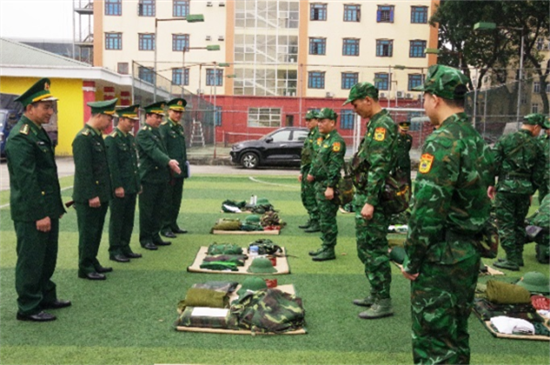 |
| Brigade Command inspects its affiliates’ combat readiness work |
In the training process, the Brigade has adhered closely to the motto of “basics, practicality, solidity”, organising synchronised, intensive training relevant to its tasks and the areas of responsibility, closely combining basic training with professional group training, aligning face-to-face training with network-based training. Cadres at all levels have been trained in operational staff work, training staff work, and signal management, command, and control. For detachments, training has been closely aligned with communications support situations and projects to achieve the goal of being “proficient in traditional communications, highly skilled in mobile communications, capable of mastering hi-tech communications”; emphasis has been placed on skilful use of all assigned technical systems as well as mastery and effective exploitation of new, modern equipment. To improve the quality of training, the Brigade has directed its affiliates to use simulation devices and laboratories in specialised training, closely integrate theory with direct guidance on equipment systems, and intensify the training of skills and techniques. After each subject and phase, it has organised inspections, re-inspections, and contests in a serious, substantive manner. It has closely integrated training with the execution of its routine communications support missions. As a result, its affiliates have completed all training plans; for many consecutive years, its professional work has been highly rated by the BGF’s Staff Department.
In parallel with efforts to raise training quality, the Brigade has seriously maintained communications duty regimes, “staying close to the equipment and stations anytime and anywhere”, especially within the general station at the BGF Command, strictly ensuring professional discipline and information security regulations during duty shifts, closely managing duty shifts, thus preventing leaked, lost, or wrong information. Due to its personnel shortages, it has adopted the policy of “concurrent assignment”, reallocating forces and means, giving priority to units performing combat readiness duty and important contingency tasks. It has proposed adjustments to communications networks in line with changes in the organisational structure of provincial-level border guard commands, thereby maintaining the “lifeline” of communications in all situations.
Third, making breakthroughs in discipline management and the building of standardised, exemplary agencies and units. With a large number of professional service members working in dispersed locations far from direct management and command, facing risks of violation of discipline, the Brigade has intensified education and dissemination to raise troops’ awareness of the State’s law, the Military’s discipline, and the Signal Sector’s regulations, clarifying the causes and consequences of violations, thus creating firm changes from awareness to action. At the same time, it has designed, promulgated, and strictly enforced a system of regulations and guidance. It has directed its affiliates to regularly, closely manage personnel during days off and rest hours, resolutely handle violations to create deterrence, absolutely avoid covering up or concealing shortcomings, and promptly provide information on law and discipline across the Military and within themselves as the basis for drawing lessons and encouraging cadres and soldiers to heighten a sense of responsibility and self-discipline in task performance. In recent years, the Brigade has seen a positive change in troop observance of law and discipline; the rate of violations requiring disciplinary action has been below 0.2%; it has ensured absolute safety in all aspects.
The Brigade has regularly mobilised all resources to build and improve its barracks, promoting the emulation movement of “building and managing regular, green, clean, beautiful barracks”, raising the quality of regularity building, maintaining daily, weekly routines, closely combining regularity building with the building of a cultural environment to foster troops’ love for their units. It has taken many measures to promote the “Digital Literacy” Movement and the building of e-Government within the Ministry of National Defence, accelerating the application of information technology in unit management, command, and control, guaranteeing a high rate of document transmission and receipt via networks and digital signature use.
Fourth, providing full, timely logistics and technical support for missions. In this regard, the Brigade has regularly reviewed, adjusted, and perfected the system of logistics and technical documents for combat readiness, closely, scientifically developing routine support plans aligned with its task requirements. It has directed its affiliates to fully utilise available land, intensify crop/animal husbandry to improve the quality of meals for troops, focus on medical examination and treatment and epidemic prevention and control, and ensure full, timely logistics standards for regular, irregular, and combat readiness tasks. Consequently, on a yearly basis, its healthy manpower rate consistently exceeds 99%.
To ensure the stability, accuracy, and solidity of communications while most of the equipment and technical systems have been used for many years, the Brigade has strengthened education and propagation work to foster a sense of “good maintenance, durable use, safety, and thrift” among all troops, strictly maintaining “Technical Hour” and “Technical Day”, raising the effectiveness of maintenance and repair at all levels. It has frequently conducted inspection, maintenance, and servicing of stations, cable routes, and equipment, promptly responding to communications incidents, preventing interruptions, especially in remote and isolated areas and during natural disasters. It has well implemented the Campaign on “managing and exploiting weapons and technical equipment effectively, sustainably, safely, economically and ensuring traffic safety”. As a result, the technical condition of its equipment and technical systems has always been maintained in accordance with regulations.
Fully aware of its functions and tasks, Signal Brigade 21 will continue striving to build itself into an “exemplarily, typically” comprehensively strong unit, enhancing the stability and robustness of communications networks, providing “timely, accurate, confidential, safe” communications for both regular and irregular missions, contributing to firmly safeguarding national sovereignty and border security in all situations.
Sr. Col. KHUAT DUY TIEN
Commander of the Brigade