Promoting the qualities of “Uncle Ho’s Soldiers” in building a firm “People’s heart and mind posture” is both a responsibility and an important measure enabling the Army to fulfil its function as an “army for work”, thereby contributing to safeguarding the Fatherland firmly “from an early stage and from afar” in the new situation. This article discusses several fundamental issues of both immediate and long-term strategic significance.
Our Military originated from the People and fights for the People. In fulfilling its function as an army for work, officers and soldiers have, over the years, upheld the noble qualities of “Uncle Ho’s Soldiers”, proactively conducting communication and mobilisation activities to raise public awareness and responsibility for national construction and defence; helping build clean and strong Party committees and authorities at all levels; and effectively undertaking mass mobilisation, assisting communities with socio-economic development, poverty reduction, disaster prevention and recovery, and disease control. These efforts have strengthened public confidence in the Party, the State, the Military and the socialist system, promoted great national unity, and helped establish a firm “people’s heart and mind posture”.
Nevertheless, some agencies and units have yet to demonstrate these qualities clearly in this important work, and their results have remained limited. To improve performance in the coming period, the author proposes the effective implementation of the following principal measures.
First and foremost, to promote the qualities of “Uncle Ho’s Soldiers” in information and communication activities, bringing about substantial improvements in the awareness and responsibility of local Party committees, authorities and the People in building a firm “people’s heart and mind posture”. Practice shows that these qualities embody the finest values of the nation’s traditional culture, the Army’s revolutionary nature and its determination to fight and win. They have been cultivated by successive generations of servicemen and recognised and honoured by the People, giving them considerable persuasive and moral influence. When cadres and soldiers engage in public communication, People are consequently more inclined to trust and listen to them, voluntarily comply with the Party’s guidelines and the State’s policies and laws, understand the methods and intentions of hostile forces, and recognise their own responsibilities for national construction and defence.
 |
| Lam Dong armed forces conduct search and rescue |
Moreover, the knowledge, exemplary conduct and strong sense of responsibility displayed by military personnel in advising on and implementing policies can help local Party committees and authorities better appreciate their own roles in leading and organising the development of a firm “People’s heart and mind posture”. Practical measures include renewing leadership methods, maintaining close contact with grassroots communities, understanding People’s concerns and promptly addressing pressing livelihood issues. In this way, the foundation of public support can be strengthened at local and grassroots levels.
To achieve strong results, Party committees and commanders throughout the Military should intensify political, ideological, and ethical and lifestyle education, especially for personnel engaged in communication work, in conjunction with studying and practising Ho Chi Minh’s thought, ethics, methods and style. Every cadre and soldier must internalise the maxim “think with the mind, observe with the eyes, listen with the ears, travel on foot, speak with the mouth and work with the hands”, and genuinely remain close to grassroots communities, understand and respect the People, and act responsibly towards them. Only then will communication carry authority and inspire public trust and action. Communication methods should also be diversified and substantially renewed to suit different regions and audiences. Alongside direct communication, units should promote vivid visual and cultural approaches, including grassroots cultural teams, sketches, songs and dances reflecting local traditions. Twinning activities, field deployments for mass mobilisation and the “Effective Mass Mobilisation” emulation movement should be strengthened so that practical assistance to the People is combined with communication. Agencies and units should also apply science and technology, make effective use of social media, and develop Zalo groups and online pages to maintain contact, deliver timely information and counter misleading or hostile narratives, ensuring that authoritative information reaches the public and provides a “soft shield” against harmful online content.
Promoting the qualities of “Uncle Ho’s Soldiers” in helping build clean and strong local political systems is both an urgent and a long-term requirement. It contributes to implementing the Party’s resolutions on building and rectifying the Party and political system, particularly under the two-tier local government model. Some personnel in local military agencies still lack practical experience and knowledge, limiting their contributions to grassroots political development. Party committees should therefore strengthen training in administrative reform procedures, political theory, state and economic management, legal affairs, and issues directly related to local economic, political, cultural and social conditions, languages, psychology, customs, practices and beliefs. Personnel also need stronger advisory and coordination skills to work with political-system organisations in resolving emerging socio-political issues.
Promoting the qualities of “Uncle Ho’s Soldiers” requires military cadres to show greater initiative and the courage to think and act when researching and proposing to local Party committees and authorities measures for economic, cultural and social development in conjunction with national defence, security and foreign affairs. Priority should be given to building the posture and potential of local defensive zones; working proactively with local authorities to establish a firm “People’s heart and mind posture” linked to the People’s security posture; safeguarding the Party’s ideological foundation and countering disruptive activities by hostile and reactionary elements; and developing effective coordination regulations between stationed units and local Party committees and authorities to strengthen the areas in which they operate.
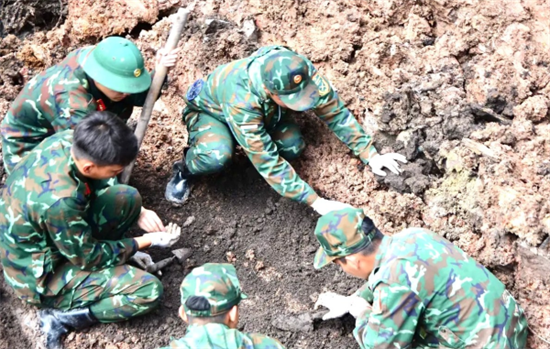 |
| Troops of Military Region 7 search and collect martyrs' remains in Le Thi Rieng Park, Ho Chi Minh city |
In practice, military agencies and units, including those in Military Region 7, have proactively advised local Party committees and authorities on local defence and military affairs in conjunction with strengthening grassroots political systems. They have effectively implemented the project to develop residential clusters adjacent to militia posts and border guard stations and checkpoints. To date, the Military Region has established 60 residential sites comprising 879 houses and two kindergartens, and worked with local authorities to establish and consolidate Party committees in all commune-level military Party cells. These efforts have helped strengthen local political systems, improve their regularity and effectiveness, enhance grassroots leadership and management capacity, develop politically steadfast local cadres, maintain security and public order, and deepen military-civilian solidarity. People can thus confidently remain in their communities, protect their villages, and voluntarily serve as the “eyes” and “ears” of national defence and security, providing a foundation for a firm “People’s heart and mind posture” and strong defensive zones.
Experience has demonstrated that when servicemen actively engage in mass mobilisation and provide practical assistance with economic and cultural development and poverty reduction, the qualities of “Uncle Ho’s Soldiers” spread more widely and deeply. This encourages the People to recognise and fulfil their responsibilities in strengthening national defence and security and building a firm “People’s heart and mind posture”. To further improve effectiveness, Party committees and commanders should strengthen leadership and implement Conclusion No.43-KL/TW, dated 7 January 2019, of the Secretariat on continued implementation of Resolution No.25-NQ/TW, dated 3 June 2013, of the 11th Party Central Committee on “Strengthening and renewing Party leadership over mass mobilisation in the new situation”, and Regulation No.718-QC/QUTW, dated 5 November 2021, of the Central Military Commission on “Mass mobilisation work in the Vietnam People’s Army”. They should proactively review and adapt implementation to local conditions, develop appropriate and rigorous resolutions and plans, and mobilise the combined strength of organisations and forces engaged in mass mobilisation.
Only when the awareness of cadres and soldiers is translated into practical action can the noble qualities of “Uncle Ho’s Soldiers” truly shine in the hearts of the People. Agencies and units throughout the Army should therefore practise President Ho Chi Minh’s mass mobilisation style: “respect the People, remain close to them, understand them, learn from them and act responsibly towards them”. Priority should be given to “Repaying the Debt of Gratitude”, “The Military Joins Hands to Build New Rural Areas and Civilised Urban Areas”, and “Joining Hands for the Poor - Leaving No One Behind”, thereby further enhancing the image of “Uncle Ho’s Soldiers” in the new era. For example, over the past five years the armed forces of Military Region 7 have built and donated thousands of gratitude houses, comradeship houses and great-unity houses. Under the movement to eliminate temporary and dilapidated housing, they repaired and donated 510 homes, exceeding the Ministry of National Defence’s assigned target by 70. They also helped construct rural roads, bridges and schools, provided medical examinations, health advice and free medicines, and presented gifts to local people.
Furthermore, the policy of “Building Friendly Bonds and Supporting Ethnic Minority and Religious Communities”, a distinctive feature of Military Region 7’s ethnic and religious affairs work, has helped reinforce solidarity between the Military and the People and between religious and non-religious communities. More than 600 vehicles and over 15,300 deployments of officers, soldiers and militia personnel were mobilised to build and repair 41 homes for residents of D’Ran Commune, Lam Dong Province, ahead of the schedule of the “Quang Trung Campaign”. The Military Region also launched an intensive “Fight the Pandemic, Save the People” campaign involving more than 100,000 officers, soldiers, militia and self-defence members and reservists, together with 47,000 vehicle deployments, to combat the COVID-19 pandemic and assist the public, contributing to recovery and reinforcing confidence in the Party and the Military. Notably, under the “500-Day Campaign to Accelerate the Search, Recovery and Identification of Fallen Soldiers’ Remains”, by 20 October 2026 the Military Region had recovered 1,539 sets of remains, exceeding the Campaign’s overall target, and completed 100 per cent of remains sampling nine months ahead of schedule. These achievements have further enhanced the image of Military Region 7’s armed forces in the hearts of the People.
Preserving and promoting the qualities of “Uncle Ho’s Soldiers” in the heroic Vietnam People’s Army’s contribution to building a firm “People’s heart and mind posture”, through innovative and effective measures, is of exceptional importance. It creates a strong political and spiritual foundation for safeguarding the Fatherland “from an early stage and from afar” and enabling the country to advance confidently into a new era of national development.
Major General PHAM ANH TUAN, Chief Political Officer of Military Region 7