Combining economic development with strengthening national defence and security has been the Party’s consistent, overarching viewpoint throughout the cause of building and defending the Fatherland. Over 40 years of renovation, the Party’s theoretical thinking on this relationship has been continually supplemented and developed in its connotation, scope, methods and implementation mechanisms, making important contributions to orienting the country towards rapid and sustainable development, consolidating national defence and security potential and strength, and firmly safeguarding the Fatherland in the new situation.
The Party’s thinking on combining economic development with strengthening national defence and security has become increasingly proactive, comprehensive and synchronised
Building the nation hand in hand with safeguarding it is the law of existence and development of the Vietnamese nation. In the current era, that law is chiefly manifested in the relationship between building and defending the Fatherland, and between national development and the strengthening of national defence and security. The 14th National Congress of the Party carried this understanding further when it stressed the requirement to “...closely and effectively combine national defence and security with economic, cultural, social, and foreign affairs development to leverage Vietnam’s soft power, contributing to generating a new posture and strength for the nation”. This new step of development is demonstrated through the following key aspects:
First, the requirement for combination, which was initially a matter of principle, has gradually developed into a requirement for close and effective combination, and from a general guideline to a requirement that runs through the entire process of formulating and implementing the national development strategy. From the very first years of renovation, the Party identified the combination of the economy with national defence, and of national defence with the economy, as a fundamental and long-term orientation. It had to be reflected in economic zoning plans, the distribution of labour and productive forces, the building of economic-technical sectors and the development of local economies, thereby forming a unified strategic deployment across the country and in each area. The 7th National Congress of the Party continued to place socio-economic development, the maintenance of security and order, and the consolidation of all-people national defence within a single unified strategy. The 8th National Congress broadened the concept from combining the economy with national defence to combining the economy with national defence and security. The 9th National Congress placed this combination within the guideline on socio-economic development and regarded it as a resource that creates the comprehensive strength to protect the Fatherland. The 10th, 11th, 12th and 13th National Congresses continued to concretise it in terms of areas, fields, master plans and plans, and extended it to culture, society and foreign affairs.
On that basis, the 14th National Congress placed the requirement of close and effective combination within a broader whole. The notable point is not a change in the essence of the principle of combination, but rather the elevation of the quality, level and real effectiveness of that combination. National defence and security can no longer be viewed as supplementary requirements added after economic strategies, master plans, programmes and projects have already been formed. They must be factored in right from the process of defining objectives, choosing development options, arranging the spatial layout, and allocating resources. Conversely, building national defence and security potential must also pay close attention to resource utilisation efficiency, dual-use capabilities, and appropriate contributions to socio-economic development.
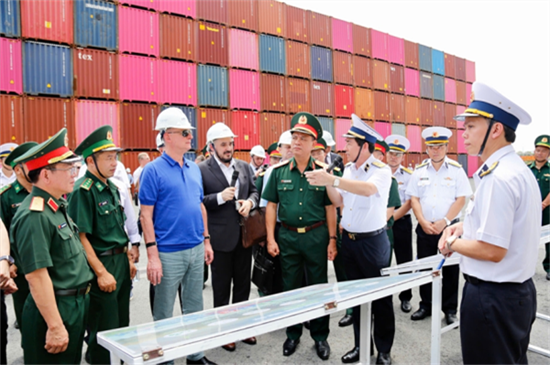 |
| The Sai Gon New Port has performed its defence and economic tasks very successfully (Photo: qdnd.vn) |
Second, the primary relationship between the economy and national defence has developed into an overall relationship between the economy, culture, society and foreign affairs on the one hand and national defence and security on the other, thereby leveraging the national comprehensive strength. In the early stages of renovation, the content of the combination focused mainly on economic development coupled with building national defence potential, distributing productive forces, developing infrastructure, constructing economic-defence zones, and building key areas. As renovation and international integration advanced, the scope of the combination steadily expanded. At the 12th National Congress, the Party placed the economy, culture and society in a close combined relationship with national defence and security; the 13th National Congress continued to emphasise the requirement of combining the economy, culture, society and foreign affairs with national defence and security, and vice versa. The 14th National Congress developed this approach further by placing national defence and security in a close relationship with economic, cultural, social and foreign affairs development, aiming to leverage Vietnam’s soft power and generate a new posture and strength for the nation. This shows that, under new conditions, the potential for protecting the Fatherland is formed from the comprehensive strength of many fields. Within this, military, national defence and security strength is organically bound up with economic, scientific, technological, cultural and human potential, social stability, governance capacity and foreign affairs, together with the country’s international standing and prestige.
Third, awareness of the two-way interactive relationship between economic development and the strengthening of national defence and security has become increasingly comprehensive. A developed economy is an important material foundation for strengthening national defence and security potential. Concurrently, strong national defence and security protect independence, sovereignty, unity, territorial integrity, and the achievements of development, directly contributing to maintaining a stable socio-political environment and ensuring safety for production, business, investment and other activities. The 14th National Congress emphasises the requirement to “...closely and harmoniously link economic, cultural and social development and environmental protection with the consolidation of national defence and security”, while also affirming the need to “maintain and consolidate a peaceful environment for building and developing the country”. A peaceful, stable and safe environment has become an important national advantage in attracting investment, technology and talent and in expanding international cooperation. Therefore, close and effective combination must be understood as ensuring each step of economic development contributes to expanding national defence and security potential, while each step of consolidating national defence and security helps create a more favourable environment, conditions, and space for socio-economic development.
Fourth, the combination of economic development with the strengthening of national defence and security is increasingly tied directly to the requirement of enhancing strategic autonomy and the resilience of the economy. Against the backdrop of escalating strategic competition among major powers, complex developments in local conflicts, fierce trade and technological competition, risks of supply chain disruptions, and increasingly evident non-traditional security challenges, economic and security issues increasingly intertwine and convert into one another. Overdependence on a single external market, supply source, technology, or infrastructure system can rapidly transform an economic issue into a national security challenge. Therefore, the effectiveness of combining the economy with national defence and security cannot be evaluated solely by the volume of economic resources that can be mobilised when necessary; instead, it must be manifested in the autonomy, resilience, and adaptability of the economy in the face of major volatility.
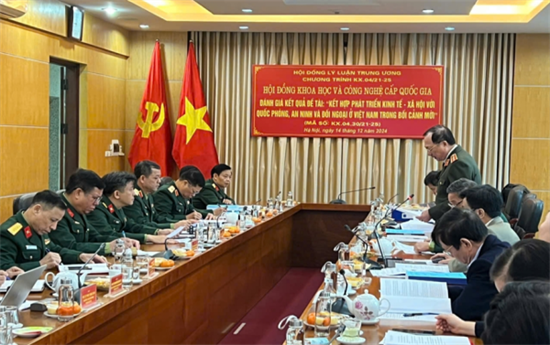 |
| Evaluating the results of the Project "Combining social-economic development with defence, security and foreign affairs in Vietnam in the new context" (Photo: qdnd.vn) |
Fifth, the scope of combination has been expanded from traditional strategic areas to new spaces of development and protection. Borders, seas, islands, remote and isolated areas, and key areas for national defence and security have always been exceptionally important spaces in combining the economy with national defence and security. However, the rapid advance of science, technology, innovation and digital transformation is giving rise to new spaces of development, which are also spaces that need to be protected, such as cyberspace, national data, digital infrastructure, telecommunications, digital platforms, core technologies, technology supply chains and others. In this context, national defence and security requirements must be embedded right within the process of building the digital economy, digital society, digital government, digital infrastructure, and databases; while simultaneously leveraging the scientific and technological potential of national defence and security to serve socio-economic development.
Sixth, the thinking on the national defence and security industry continues to evolve towards being autonomous, self-reliant, self-strengthening, dual-use and modern, and increasingly closely tied to the national industry. Since the 10th National Congress, the Party has advocated for building the national defence industry within the national industrial system, with selective investment towards modernisation to serve both national defence and people’s livelihoods. Through practical development, this thinking has been increasingly perfected.
The Law on Defence and Security Industry and Industrial Mobilisation defines the national defence and security industry as an important component and a specialised sector of the national industry, constituting a fundamental component of the actual strength and potential of national defence and security. The 14th National Congress continues to set the goal of “building a proactive, self-reliant, self-strengthening, dual-use and modern defence and security industry”. The national defence and security industry not only meets the requirements and tasks of defending the Fatherland, but also promotes innovation and technology mastery and enhances the competitiveness of the national industry, making an important contribution to socio-economic development.
Seventh, the emphasis has shifted from handling emerging issues to proactively identifying and preventing risks to national defence and security right within the development process. Under conditions of deep and extensive integration, an economic development decision — if not fully considered from a national defence and security perspective — could create long-term dependence or even affect the country’s strategic interests. Close and effective combination therefore demands that national defence and security requirements be considered early and from afar, in the very process of formulating and implementing development policy. Strategies, master plans, programmes and major projects, especially those involving strategic infrastructure, energy, telecommunications, data, key technologies, and border, maritime and island areas, need to be fully evaluated regarding their national defence and security impacts. This is an advance from a mindset of primarily rectifying consequences to one of proactively managing risks, ensuring rapid and sustainable development that is at once safe and autonomous and does not create points of dependence that could have long-term effects on national defence and security.
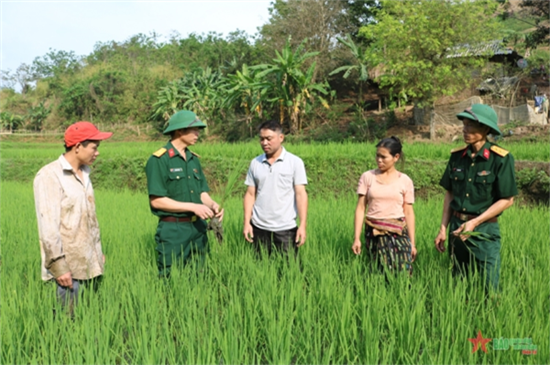 |
| Cadres of Defence and Economic Corps 5 of Military Region 4 instruct the locals on rice cultivation (Photo: qdnd.vn) |
Realising the Party’s thinking on combining economic development with strengthening national defence and security in the new era
First, it is necessary to overcome the mindset of isolating economic development from the consolidation of national defence and security, or only focusing on combination within a few specific areas and specialised fields. We must be deeply aware that economic development creates the material foundation, resources and a new posture for the cause of defending the Fatherland; conversely, strong national defence and security constitute an important condition for ensuring a peaceful and stable environment, enabling the country to develop rapidly and sustainably. On that basis, Party committees, authorities, ministries, sectors and localities must identify the requirement for combining economic development with the strengthening of national defence and security as a theme running through the planning and implementation of their tasks. They must perfect inter-sectoral coordination mechanisms; integrate national defence and security requirements right from the drafting stage of master plans, programmes, and projects; strengthen the appraisal, inspection, and supervision of strategic projects and areas; and proactively identify and handle shortcomings and emerging risks in practice. At the same time, the responsibility of the head of each organisation must be linked with the implementation outcomes, and treated as one of the criteria for evaluating the effectiveness of leadership, management and socio-economic development.
Second, continue to perfect institutions, ensuring that the requirement for close and effective combination is implemented synchronously across development strategies, master plans, plans, programmes, and projects. Accordingly, national defence and security requirements should be integrated from the stage of formulating strategies, master plans, plans, policies and selecting projects; at the same time, criteria for assessing economic, social and technological effectiveness and dual-use capability should be added for suitable national defence and security programmes and projects. Along with that, it is essential to perfect coordination mechanisms, with responsibilities clearly delineated among ministries, sectors, localities, and relevant forces; thereby overcoming departmentalism and the pursuit of isolated goals by individual sectors and fields, which reduces the overall effectiveness of the combination.
Third, prioritise resources for sectors, fields, and infrastructure with high dual-use capabilities, simultaneously driving economic development, reinforcing national defence and security potential, and enhancing strategic autonomy. The focus is placed on fields capable of generating dual effects, such as energy, strategic transportation, logistics, telecommunications, digital infrastructure, data, foundational industries, high technology, and the national defence and security industry. Concurrently, efforts must be stepped up to advance two-way technology research, development, and transfer between the national defence and security sector and the civilian sector, focusing on mastering foundational, core and strategic technologies. This is both a requirement for building modern national defence and security and a means of enhancing technological autonomy and the quality of economic growth.
Fourth, closely combine the development of traditional strategic areas with building the capacity to protect new strategic spaces. Under new conditions, the protection of national sovereignty and national and ethnic interests is steadily expanding: alongside land, sea, islands and airspace, there are now cyberspace, digital space and technology space, all changing rapidly. For borders, seas, islands, remote and isolated areas and other key areas, we must continue to link investment in infrastructure and production, job creation, and the improvement of education, health care and the people’s living standards with the strengthening of national defence and security. Economic development must go hand in hand with the distribution and stabilisation of the population, generating sustainable livelihoods, consolidating the grassroots political system, and building a solid people’s hearts posture. At the same time, we should enhance the capacity to ensure cybersecurity, data security, economic security, energy security, financial security, and supply chain security, while protecting digital infrastructure systems and critical national infrastructure.
Fifth, constantly improve the capacity for organising implementation, taking actual effectiveness as the primary measure of the combination. Combining economic development with strengthening national defence and security is an inter-sectoral, cross-field and inter-regional task that involves multiple levels and various stakeholders. Accordingly, it is essential to build a contingent of cadres with comprehensive thinking and the competence to handle inter-sectoral issues. At the same time, we should gradually build a system of specific criteria for assessing the effectiveness of the combination, such as the degree of dual-use capability of infrastructure, the capacity to guarantee economic and supply chain security, the level of technological autonomy, the resilience of the economy, the socio-economic development efficiency within strategic areas, the ability to mobilise resources during contingencies, and the degree of safety of new development spaces.
Over 40 years of renovation, the Party’s theoretical thinking on combining economic development with strengthening national defence and security has been continually supplemented and developed. At its core, every step of economic development must contribute to consolidating the potential and strength for defending the Fatherland; and every step of strengthening national defence and security must, in turn, create more favourable conditions for the country to develop rapidly and sustainably.
That is the substantive requirement for realising the viewpoint of closely and effectively combining economic development with strengthening national defence and security in the new era of development.
Assoc. Prof., Dr VU VAN HA, Former Deputy Editor-in-Chief of the Communist Review