In response to rapid advances in science and technology, particularly in biotechnology, pharmaceutical sciences and precision medicine, the Military Institute of Pharmaceutical and Medical Equipment Testing and Research, under the Military Medical Department, has been implementing a comprehensive range of measures to develop the Institute towards greater modernisation and specialisation. These efforts contribute to modernising the Military Medical Sector and ensuring the successful fulfilment of all assigned tasks.
The Military Institute of Pharmaceutical and Medical Equipment Testing and Research, formerly known as the Military Medical Pharmaceutical Supply and Manufacturing Institute, was established on 22 November 1956.
Over 70 years of development, successive generations of the Institute's personnel have upheld the spirit of self-reliance and resilience, demonstrated professional competence and intellectual capability, proactively overcome difficulties, and successfully fulfilled their assigned tasks. The Institute has gradually affirmed its role as the Military Medical Sector's final line of defence in pharmaceutical and medical equipment testing and research. The Institute had the honour of participating in the Advisory Group and successfully carrying out the special research mission on preserving President Ho Chi Minh's body in 1969. It was also one of the units that successfully conducted research into extracting pure artemisinin from the sweet wormwood plant (Artemisia annua) for malaria treatment, an achievement recognised with the Ho Chi Minh Prize in 2003. In recognition of these outstanding achievements, the Institute was awarded the Third-class Fatherland Protection Order in 2016, along with numerous other prestigious honours.
In recent years, rapid advances in science and technology, particularly in biotechnology, pharmaceutical sciences, precision medicine, artificial intelligence and smart medical devices, have driven the development of new medicines, advanced dosage forms and modern medical equipment. However, these advances have also brought new challenges for the Institute in carrying out its duties, particularly the proliferation of counterfeit medicines and substandard medicines and medical devices produced using increasingly sophisticated counterfeiting techniques. Meanwhile, certain conditions necessary for the Institute's operations remain limited. These include, in particular, the availability of highly qualified personnel, infrastructure and technical equipment. Although investment in these areas has received due attention, some aspects have yet to keep pace with operational requirements and the rapid development of science and technology. Against this backdrop, the Party Committee and the Institute's commanders have focused their leadership and direction on implementing a comprehensive range of measures to develop the Institute towards greater modernisation and specialisation, thereby meeting the requirements of its assigned tasks.
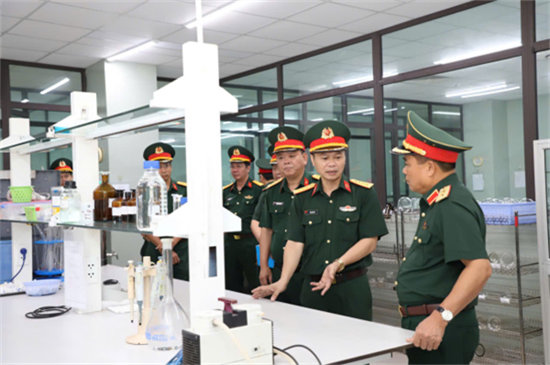 |
| Leader of the General Department of Logistics and Technique checks the lab of the Institute |
Renewing leadership thinking, raising awareness and strengthening determination to build a modernised and specialised Institute
In implementing and concretising the resolutions, directives and guidelines issued by higher authorities, the Institute developed a Plan for technical and professional development for the 2023–2025 period, with a vision to 2030, and submitted it to higher authorities for approval. The Plan clearly defines objectives, roadmaps, key priorities and breakthrough areas for each field of work. Its main priorities include developing a workforce with specialised expertise and the capacity to operate and master modern equipment; accelerating investment in equipment modernisation; and expanding cooperation in scientific research and technology transfer. These efforts aim to lay the foundations for enhancing professional capabilities and gradually modernising the Institute's operations.
Based on the established objectives, the Institute has directed its departments and specialised divisions to translate them into work plans tailored to their respective functions and assigned tasks, with clearly defined activities, responsibilities and implementation schedules. At the same time, it has stepped up educational activities to raise the awareness and sense of responsibility of its personnel, particularly Party committees and commanders at all levels, regarding the distinctive role and importance of the Institute's areas of operation, as well as the urgent need to build a modernised and specialised Institute to improve the performance of its political tasks and the quality of healthcare and health protection for military personnel and the People. The Institute also encourages innovative thinking and promotes initiative, creativity and the willingness to think boldly, act decisively and take responsibility. It resolutely addresses the reluctance to embrace innovation, adopt and master new technologies. In addition, it has strengthened inspection, interim reviews and final assessments to identify and resolve difficulties and obstacles promptly, thereby bringing about coordinated changes in both awareness and action and fostering a strong sense of responsibility and creative initiative among all personnel in performing their duties.
Developing high-quality human resources to meet immediate and long-term mission requirements
The specific nature of the Institute's tasks requires its personnel not only to possess sound professional knowledge and proficiency in technical procedures, but also to be capable of adopting and mastering advanced and specialised methods and techniques in pharmaceutical and medical equipment testing and research. Fully aware of these requirements, the Institute has focused on developing its technical workforce, particularly leading experts, towards the standard of professional excellence, strong political resolve and high ethical standards, while ensuring continuity and meeting long-term mission requirements. Based on a comprehensive review and assessment of workforce quality, the Institute has proactively developed personnel planning, talent pipelines, and training and professional development plans for each specialised field. It has also gradually standardised qualifications, competencies and practical skills to meet the requirements of individual positions. Alongside these efforts, the Institute has broadened its recruitment pool and prioritised attracting highly qualified personnel, particularly those with specialised training from reputable institutions such as Hanoi University of Pharmacy, the Vietnam Military Medical University and the Military Technical Academy.
In parallel, the Institute has actively renewed its training and retraining programmes, placing greater emphasis on practical training and on-the-job professional development through actual task performance. It has created opportunities for personnel to participate in scientific research projects, research assignments, pilot production and the development of new techniques. Experienced personnel are encouraged to play a greater role in providing professional guidance and passing on their expertise to younger generations.
Furthermore, the Institute has strengthened coordination with the National Institute of Drug Quality Control, the Directorate for Standards, Metrology and Quality, and other relevant organisations to organise technical development training and improve personnel's skills in operating and using next-generation and high-tech equipment. It has also established incentive mechanisms to encourage personnel to pursue self-directed learning and professional development, thereby enhancing their qualifications and practical expertise.
One of the Institute's notable achievements has been its willingness to appoint young personnel to challenging and important positions and assign them demanding tasks to strengthen their professional competence and resolve, while developing a pool of successors for future management and command positions. It has also sought to create a favourable, equitable working environment offering ample opportunities for professional development, while ensuring appropriate welfare policies and support for military families so that personnel can remain confident in their work and dedicated to their duties. To date, the Institute has developed a well-structured, highly qualified workforce, with over 80% of its officers holding postgraduate qualifications. This provides an important foundation for enhancing its testing and research capabilities and gradually mastering advanced and specialised techniques.
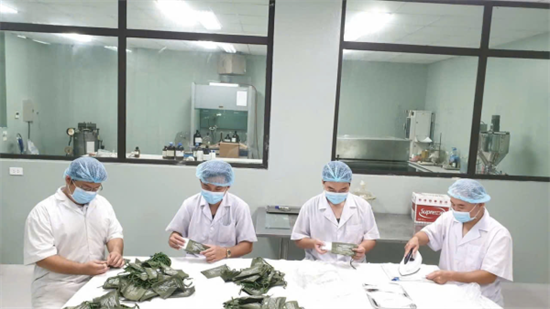 |
| Producing medical equipment |
Modernising technical infrastructure in tandem with promoting initiatives and technical innovation
Against the backdrop of rapid advances in medical and pharmaceutical sciences and technology, analytical, testing and inspection methods are becoming increasingly sophisticated, while requirements for accuracy, reliability and turnaround time are growing ever more stringent. Fully aware of these demands, the Institute's Party Committee and commanders have proactively advised and proposed to higher authorities investment policies and plans with clearly defined priorities and focus areas. These efforts combine the modernisation of technical infrastructure with accelerated digital transformation to ensure the efficient use of available resources. In recent years, the Institute has focused on reviewing and assessing the current state of its laboratory systems, specialised equipment, technical support conditions and capacity to meet professional standards. This has enabled it to identify priority areas for investment and upgrading, equipment requiring replacement or supplementation, and fields in which new capabilities need to be developed.
With a view to anticipating and keeping pace with scientific and technological advances, the Institute has advised higher authorities to concentrate resources on investing in and modernising equipment and technical facilities, while comprehensively upgrading its infrastructure. Priority has been given to analytical and testing systems for medicines, chemicals and medicinal materials; enhancing its capacity to inspect and calibrate medical equipment; and improving technical conditions for research, testing and product quality assessment. At the same time, the Institute has focused on renovating and upgrading its laboratory, inspection and testing facilities, thereby gradually enhancing its capacity to fulfil assigned tasks.
Alongside the modernisation of infrastructure and equipment, the Institute has stepped up scientific research and promoted initiatives and technical improvements. Priority has been given to research projects in military medicine, as well as the development and production of products serving military medical support requirements.
Over the past five years, the Institute has undertaken or continued to implement five Ministry of National Defence-level research projects, six sector-level research projects, seven military standards, and dozens of specialised studies and institution-level research projects.
Notable examples include research into the development of new products for the prevention and emergency treatment of sunstroke and heatstroke in support of Mission A801; and research into medicines for preventing and treating injuries caused by chemical weapons, such as medication against CS riot-control agents, antidotes for systemic cyanide poisoning, and atropine sulphate auto-injectors for emergency treatment of nerve agent poisoning. In addition, through its participation in the Military Youth Creative Innovation Awards, the Institute received three third prizes and two consolation prizes. At the Hanoi Regional Youth Creative Technical Competition in the Health Sector, it won First prize.
Expanding cooperation in scientific research and technology transfer, combining internal capabilities with external resources
To meet increasingly demanding requirements in pharmaceutical testing and research and the inspection of medical equipment, the Institute has proactively expanded cooperation with research institutes, the Vietnam Military Medical University, Hanoi University of Pharmacy, the Military Technical Academy and other institutions. This cooperation enables the Institute to access new knowledge and gradually master advanced techniques and technologies.
Cooperation focuses on key professional areas, addressing existing limitations and capability gaps while leveraging the respective strengths of each partner. Particular emphasis is placed on joint research and the development of testing methods; enhancing the capacity to assess medicine quality and inspect medical equipment; and researching the application of new technologies in specialised analysis and data processing. Through these partnerships, the Institute has gradually acquired, built upon and further developed research findings and technological documentation. Knowledge and technology transfer are closely integrated with personnel training and professional development, thereby strengthening research capacity to address practical challenges.
Alongside these measures, the Institute has stepped up efforts to maintain and improve the quality of testing and calibration in accordance with national and international quality management standards and systems, including GLP, ISO/IEC 17025, ISO 9001 and ISO/IEC 17011. It has actively researched and updated advanced analytical methods, developed new testing and inspection procedures, and advanced techniques in accordance with the standards of the Vietnamese Pharmacopoeia and international pharmacopoeias. The Institute has also established and standardised new reference substances and reference standards to ensure increasingly high standards of testing and inspection quality and meet practical requirements.
Building on its proud traditions and the achievements and experience accumulated over 70 years of development, the Military Institute of Pharmaceutical and Medical Equipment Testing and Research will continue to implement these measures in a coordinated manner, further developing itself into an increasingly modernised and specialised institution. In doing so, it will successfully fulfil its assigned tasks and contribute to improving the quality of military medical support, meeting the requirements of Military building in the new situation.
Senior Colonel, Ph.D. TO MINH HUNG, Director