
Established in April 2020 on the basis of the merger of three units under Naval Region 2, the Technical Support Centre is tasked with upgrading, preserving, maintaining, repairing, storing, and synchronising weapons and technical equipment; upgrading specialised ammunition; receiving and distributing weapons, ammunition, and technical materiel for naval forces in the southern region; and maintaining logistical and technical reserves for the Navy and the Ministry of National Defence, among other responsibilities.
In recent years, the Centre has maintained operations across more than 90 depots and stations. However, it has faced numerous challenges, including a limited and unevenly qualified technical workforce, aging and non-synchronised equipment, and difficult family circumstances affecting a number of cadres and personnel. Confronted with these realities, alongside comprehensively implementing all aspects of its work, the Centre has placed particular emphasis on leading and directing the development of “regular, exemplary and safe” depots and stations, achieving many positive results. In 2025, the Centre successfully fulfilled its role as a pilot model for Naval Region 2 in this field, thereby laying a firm foundation for building a comprehensively strong, “exemplary and typical” unit, maintaining a clean and strong Party Committee, and successfully accomplishing all assigned tasks.
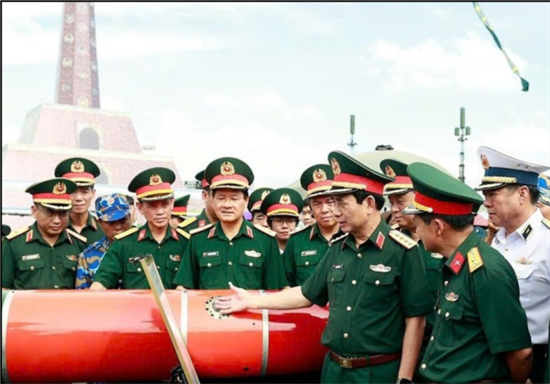 |
| General Phan Van Giang, Minister of National Defence, checks one of the product of the Centre |
The leadership and direction exercised by party committees and commanders at all levels constitute the overarching and decisive factor in ensuring the effectiveness of building “regular, exemplary and safe” depots and stations. Fully aware of this, and on the basis of thoroughly grasping Resolution No.1712-NQ/ĐU dated 5 December 2024 of the Naval Region Party Committee on leadership in carrying out tasks in 2025, the Centre Party Committee issued a specialised resolution and developed a pilot implementation plan on building “regular, exemplary and safe” depots and stations for the Region. At the same time, it issued a decision establishing a Steering Committee and promulgated operating regulations and working plans, thereby ensuring focused, unified leadership, direction, and organisation of implementation. The Steering Committee closely adhered to Regulation No.1678/QyĐ-BTL dated 2 April 2025 of the Naval Region 2 Command on the Criteria for building “regular, exemplary and safe” depots and stations in order to develop a set of criteria tailored to the Centre’s specific tasks and characteristics. The Logistics-Technical Department studied and formulated a master plan, while directing individual depots and stations to develop detailed implementation plans, clearly defining content and tasks at each level. Dedicated working groups were established to provide regular guidance, supervision, and inspection, ensuring that all criteria were implemented effectively and that established objectives and requirements were achieved.
To enhance awareness and motivate cadres, technical personnel, and soldiers to overcome difficulties, the Centre intensified education, dissemination, and communication efforts regarding the pilot mission and the criteria for building “regular, exemplary and safe” depots and stations. Concurrently, peak emulation campaigns and focused drives were launched, mobilising the collective strength of the entire unit towards the fulfilment of the identified targets and objectives. As a result, the awareness of cadres, personnel, and soldiers regarding the position and significance of building “regular, exemplary and safe” depots and stations has been significantly enhanced; they have developed proper motivation, a strong sense of responsibility, professional working methods, and strict discipline. These factors have played a decisive role in improving productivity and safety performance in the Centre’s task execution.
Building standardised technical order and discipline is an objective and indispensable requirement, forming a solid foundation for successfully accomplishing all assigned tasks. Accordingly, the Centre strictly implements Guideline No.90/HD-TCK dated 8 January 2016 of the Technical General Department on “Building regular technical zones, operational- and strategic-level depots for weapons, technical equipment and technical materiel”. It has proactively developed a comprehensive system of regulations, rules, and operating procedures for technical zones, depots, and stations. The Centre requires all cadres, technical personnel, and soldiers to strictly observe working hours, regulations governing access to technical areas, approved work plans, and standards of military bearing, conduct, forms of address, and salutation. In particular, all activities within technical zones must strictly adhere to prescribed schedules, whistle and signal systems, and the orders of commanders; personnel are not permitted to leave their assigned posts without authorisation.
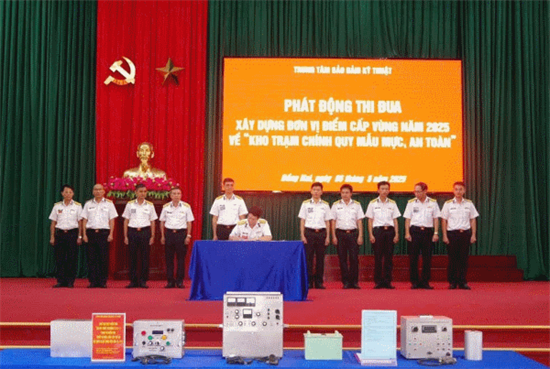 |
| Signing emulation movement |
In recent years, the Centre has paid close attention to overall barracks planning and has mobilised resources to upgrade technical areas, depots, and stations. New signage systems, including directional boards, speed limit signs, and internal traffic signage, have been installed and supplemented. Standardised identification plates, internal regulations, and fire prevention and firefighting instructions have been uniformly implemented. Water reservoirs, sand pits, safety corridors, and blast-mitigation structures have been constructed in accordance with established standards. To date, 100% of outer and inner perimeter zones adjoining technical areas and other high-risk locations are equipped with adequate warning signs; depots, stations, functional buildings, and vehicle garages are fully marked with facility identification signs. Firefighting systems, equipment, and tools are fully provided and maintained in synchronised operational condition, with fire hydrants kept at high readiness pressure, ensuring immediate and effective response in emergency situations. Within depots and stations, the Centre has implemented systematic spatial planning and functional zoning, complete with layout diagrams and equipment arrangement charts, ensuring orderly, scientific organisation that facilitates inspection, management, preservation, and maintenance.
Strict compliance with procedures governing upgrading, management, receipt, issuance, transfer, preservation, maintenance, repair, liquidation, and disposal of weapons and technical equipment constitutes a fundamental principle and core content of depot and technical support operations. For the Centre, this requirement is particularly critical given its responsibilities in upgrading specialised ammunition - including missiles, torpedoes, naval mines, rocket-assisted munitions, depth charges, and other ordnance - and in preserving and repairing a wide range of weapons, ammunition, and materials with inherently high safety risks. Accordingly, the Centre requires all agencies, depots, and stations to ensure that receipt, issuance, recovery, and transfer operations are supported by complete documentation, orders, files, and handover records duly verified by competent authorities. At the same time, stringent requirements are imposed on classification, grouping, and quality grading of weapons and equipment in strict accordance with the Regulations on Technical Work and Regulation No.5151/QyĐ-HQ dated 20 April 2022 of the Naval Service on “Quality management, acceptance, and inspection of technical equipment within the Navy”. Technical preservation, maintenance, and repair regimes and procedures are rigorously maintained in line with the established decentralisation framework.
During preservation and maintenance activities, units strictly comply with the procedures, regulations, and technical instructions issued by manufacturers, specialised technical branches, and higher-level technical authorities. Upon completion of maintenance, all documentation is consolidated and fully recorded in logbooks and equipment registration records. Any defects identified and repair actions undertaken are duly entered into equipment files and technical records in accordance with regulations. The quantity, type, and synchronised quality status of technical equipment are closely monitored and managed. The Centre requires strict adherence to regulations governing the handling of Category-5 ammunition in accordance with guidance issued by technical authorities at all levels and by the ordnance branch. In 2025, the Centre successfully received and distributed hundreds of tonnes of materiel, and transferred and reorganised thousands of tonnes of ammunition, weapons, and technical supplies, ensuring safety and adherence to planned schedules. It also conducted emergency and routine handling of over 40 tonnes of Category-5 and high-risk Category-5 ammunition, exceeding annual targets by nearly 76%, while strictly observing established procedures, technical rules, and ensuring absolute safety.
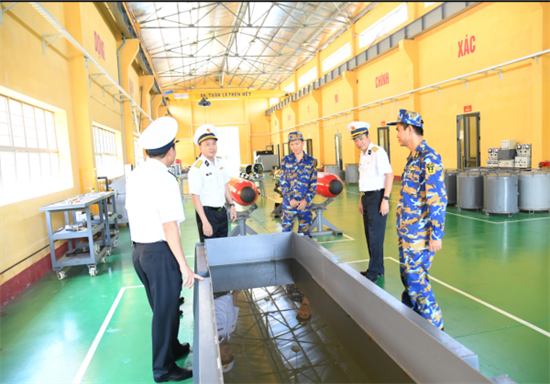 |
| Leader of Naval Region 2 visits Torpedo Station 93 |
Given the hazardous nature of the working environment and the high inherent risk of fire and explosion, safety assurance is always placed as the Centre’s top priority. To this end, alongside strengthening education and fostering vigilance, professionalism, and meticulousness among cadres, personnel, and soldiers, the Centre has invested in and installed comprehensive safety equipment, including 100% automatic fire suppression systems. Fire alarm systems in all depots are regularly inspected to ensure high reliability for timely detection and response to fire and explosion incidents. The Centre has also invested in specialised equipment and machinery for the dismantling of Category-5 ammunition. During dismantling and disposal operations, strict compliance with internal regulations, operational procedures, and safety rules within designated functional areas is closely supervised.
To prevent and promptly address potential incidents, the Centre has reinforced the electrical system in technical areas; installed surveillance cameras and electrical safety devices that meet industrial safety and aesthetic standards; and ensured their regular maintenance. Periodic inspections of electrical safety are conducted in conjunction with occupational safety and fire prevention inspections, enabling timely rectification of potential hazards. Additionally, the Centre has invested in constructing blast-mitigation barriers and lightning protection systems; regularly measuring grounding resistance to effectively prevent fire and explosion incidents during storms and heavy rainfall. Commanders at all levels have strengthened oversight of operational activities; organised guard duties and patrols to promptly detect and rectify potential unsafe practices; and regularly conducted drills on depot and station protection plans, including fire and explosion prevention scenarios. All activities related to issuance, receipt, technical support, relocation of equipment and ammunition are conducted scientifically in strict accordance with technological processes and regulations on labour protection, safety, and industrial hygiene, particularly when handling weapons and ammunition.
The decisive factor determining the effectiveness of building “regular, exemplary and safe” depots and stations lies in the competence of the technical cadres and personnel. Accordingly, in recent years, the Centre has proactively coordinated with higher-level authorities to synchronously implement comprehensive measures in the areas of political education, organisational consolidation, and personnel policy in order to strengthen and enhance the quality of its human resources. In addition to fostering firm political steadfastness, sound professional ethics, and a disciplined, scientific working style among cadres and personnel, the Centre has reviewed and reassigned technical staff in accordance with their specialised training. At the same time, diverse forms of training and professional development have been implemented, with emphasis placed on on-site training and self-improvement. Training content focuses on equipping personnel with knowledge, skills, and practical experience in management, preservation, and maintenance, particularly new technologies and technical methods related to specialised ammunition and advanced technical equipment support. Given the large number of depots and stations under its management, the Party Committee and Command of the Centre attach great importance to personnel and task management in accordance with established regulations, internal rules, and clearly defined responsibilities. Decentralisation and delegation of authority are strengthened in parallel with the clarification of accountability for individual depots and stations. Concurrently, the Centre actively promotes emulation movements and fosters exemplary collectives and individuals, thereby creating a ripple effect and encouraging broader replication throughout the unit. Proper attention is also given to implementing policies and welfare regimes to ensure that cadres and personnel feel secure in their duties and remain committed to the unit.
The achievements attained in building “regular, exemplary and safe” depots and stations have laid a solid foundation for the Technical Support Centre to consistently accomplish its assigned missions with excellence, contributing to the building of Naval Region 2 as a “revolutionary, regular, elite, and modern” force, firmly safeguarding the sacred maritime sovereignty and islands of the Fatherland under all circumstances.
Senior Colonel BUI QUOC KIEN, Commander