
Implementing the Party and State's policy on defence and security education, over the years, the Centre for Defence and security education of Hung Vuong University has implemented many innovative solutions, suitable to the practical situation, creating comprehensive changes and achieving encouraging results, affirming its role as one of the leading institutions in the Northwest region.
Since 2021 to date, the Centre has conducted national defence and security education for over 60,000 students, in which 100% of them meet the requirements, including over 98.7% good or excellent grades which has been highly appreciated by partner universities. In addition, it has coordinated with high schools to carry out education for tens of thousands of students through the programme of “Military lifestyle and skills”, contributing to fostering patriotism, national history and traditions, and national defence and security awareness among young generations.
Currently, the Centre has been endowed with new tasks with very high goals and requirements while it is experiencing a shortage in staff and facilities. Against this backdrop, the Centre keeps insisting on a number of tasks and solutions to maintain and improve the quality of defence and security education.
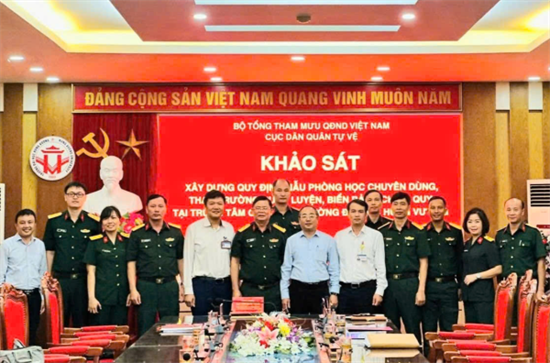 |
| The Department of Militia and Self-defence forces work with the Centre |
Innovating thinking, raising awareness, and enhancing the responsibility of stakeholders
The Centre continues to promote the studying and implementation of resolutions and directives, focusing on Directive No. 12-CT/TW, dated 03 May 2007 of the Politburo (10th term) on “Strengthening the Party's leadership over defence and security education in the new situation”, the Law on Defence and security education, and guiding documents through various flexible and suitable methods. Party committees, cadres, and lecturers should concentrate on studying and firmly grasping the position and role of the subject. They should neither underrate the subject nor hold subjective, simplistic, and formalistic mentality in teaching. For students, the Centre continues to promote education and orientation to ensure learners fully understand the position, significance, and content of the subject as not only a mandatory condition for completing the curriculum, but also an environment for cultivating political fortitude, sense of discipline, basic military skills, and civic responsibility.
To make this work highly effective, it applies different forms of propaganda and education, such as through banners, slogans, group activities, seminars, exchanges, etc. Effectively utilise digital platforms such as websites, forums, social networks, etc., to increase the volume and content of propaganda, enabling students to access information quickly, conveniently, and easily. At the same time, it strengthens inspection and supervision to promptly detect and correct manifestations of misunderstanding, underestimating the subject, and reluctance to study; resolutely combat disciplinary violations, contributing to raising awareness and responsibility among faculty, staff, and students, improving their attitudes for learning and training significantly.
Building the teaching staff sufficient in quantity and standardised in quality
The quality of the teaching staff is a key issue that directly determines the quality of education and training. Currently, its teaching staff is recruited from various sources with uneven levels of qualifications, abilities, and experience, and also insufficient in number. To overcome this issue, the Centre continues to advise the School on planning and consolidating the teaching staff in a streamlined, high-quality, and rationally structured manner, with continuity and sustainable development. At the same time, it pays attention to building, training, and standardising their political qualities, educational qualifications, pedagogical skills, and practical experience. Accordingly, along with directing relevant agencies to review, evaluate, and classify the teaching staff according to specific criteria, and develop recruitment and training plans tailored to each man and position, the Centre coordinates with relevant agencies to recruit capable and experienced military officers from Military Region 2 to serve as lecturers. It also advises on selecting lecturers from other disciplines who have necessary qualities and abilities to study second degrees in defence and security education, aiming to build a stable and reliable teaching staff.
Simultaneously, the Centre promotes comprehensive training and improvement of the lecturers' political quality, professional qualifications, pedagogical skills, and practical experience. At the same time, it encourages the teaching staff to self-study and improve their professional skills; actively apply modern teaching methods and tools; promote scientific research, compile materials and textbooks, and improve teaching aids to directly serve teaching. It strives that by 2030, 100% of the teaching staff hold bachelor degrees with over 30% of them getting master's degrees and over 4% of them being doctors.
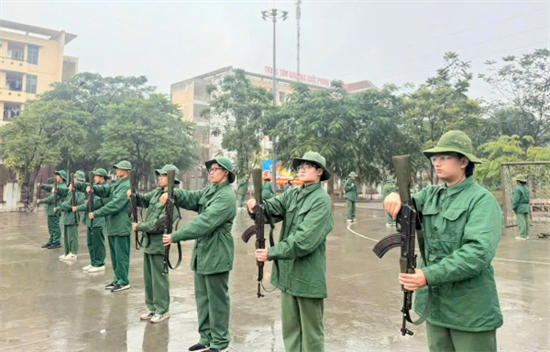 |
| Students practice drill |
Innovating the content, form, and methods of teaching and learning towards practicality and effectiveness
To improve the quality of teaching and learning and overcome the rigidity of the subject, the Centre continues to promote innovation in content, diverse forms and methods, modernise its means, and focus on the quality and effectiveness. The goal is to transform the training process into a process of self-training and self-improvement of students. Adhering to the curriculum and guidelines of the Central Council for defence and security education and the Ministry of Education and Training, the Centre continues to review, update, and supplement new issues regarding the Party's viewpoints and policies, the State's laws and regulations; and the socio-economic, defence, and security situations into the curricular. At the same time, it strengthens the exploitation of documents, images, documentaries, and practical examples to build lively, visual, and practical lectures, making it comprehensible and appliable.
In terms of methodology, there will be a major shift from “knowledge transmission” to “capacity building” approach. Lecturer’s main role is to guide, raise the problems, provide materials, instruct group discussions and paper writing, etc. For theoretical topics, emphasis is placed on designing open lectures, flexibly combining presentations, illustrations, and prompts for discussion to encourgae self-learning, self-research, and independent thinking of students. For practical contents, especially difficult ones, such as: infantry combat techniques, drill regulations, firing, grenade throwing, etc., visual training is enhanced through demonstrations, team demonstrations, and video clips, ensuring learners are “solid in theory, proficient in skills, and skillful in movements”. Moreover, the Centre continues to include extracurricular activities, such as: visits to historical sites, like the Hung King Temple and the Museum of Military Region 2; guest talks with historical figures; experiencing Military units, etc., in order to enrich students’ knowledge, foster their national pride and proper motivation for learning.
Simultaneously, the Centre continues to diversify examination and testing methods in a more substantive, objective, and transparent approach. First, it updates and supplements the question banks basing on the practice; test content is randomly selected; and various forms of examination, including oral, essay, and multiple-choice tests, are flexibly applied. On the other hand, it strengthens the application of training management software for grading and statistical analysis to save time and improve accuracy. This is to build a substantive, effective, and sustainable teaching and learning environment, helping students not only master fundamental knowledge but also develop military discipline, political acumen, and situational handling skills – the core qualities for national construction and defence in the new situation.
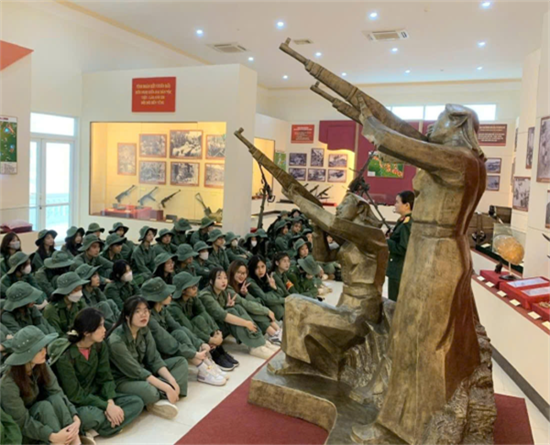 |
| Student's visit to MR2's Meusum |
Strengthening student management and training; modernising facilities and promoting digital transformation
The Centre requires all students to learn and live as in a military unit. There are officers responsible for the management of students who eat, stay, and act with students; strictly maintain daily and weekly schedules; and develop the scientific, neat, and organised lifestyle, together with the sense of discipline and team spirit for students. To improve management efficiency, the Centre coordinates closely with partner schools to agree on the plan, targets and timelines for each course; promptly grasps students' mindset and resolves arising issues so that students focus attentively on their studies and training.
What’s more, it proactively invests in and improves its facilities and training grounds towards a solid, synchronised, and modern manner. Based on the allocated budget, it actively purchases additional visual aids, uniforms, etc.; promotes the application of information technology and digital transformation in management, operation, teaching and learning; and proactively proposes to relevant agencies the addition of equipment and shooting simulators to serve training. It continues to build and improve the system of electronic lectures, digital learning materials, question banks, 3D simulations, and visualisations of training content; coordinates with the Phu Tho Provincial Military Command to bring students to study in the province's simulated defence zone. Last but not least, it upgrades dormitories, messes, and specialised classrooms to meet the learning and living needs of approximately 3,000 students per course in the future.
With strong political will and a systematic, scientific approach, the Centre for Defence and security education of Hung Vuong University continues to strive to make a solid leap forward, further improving the quality of defence and security education for students, meeting the requirements of national construction and defence.
Lieutenant Colonel GIANG THE VINH, Deputy Director of the Centre