
Improving the quality of foreign language teaching and learning is both an urgent short-term requirement and a fundamental long-term task, contributing to the development of high-quality human resources to meet the requirements of building the Army and fulfilling military and national defence tasks in the new situation. Fully aware of this, the Military Science Academy has been vigorously promoting comprehensive reform and making breakthroughs in improving training quality through synchronised and effective measures under a strategic vision.
In recent years, under the leadership and direction of the Central Military Commission and the Ministry of National Defence, and directly and regularly by the Party Committee and commanders of the General Department II, together with guidance from functional agencies, the Military Science Academy has adopted various measures to promote comprehensive renewal of education and training in general, and foreign language training in particular, achieving significant results.
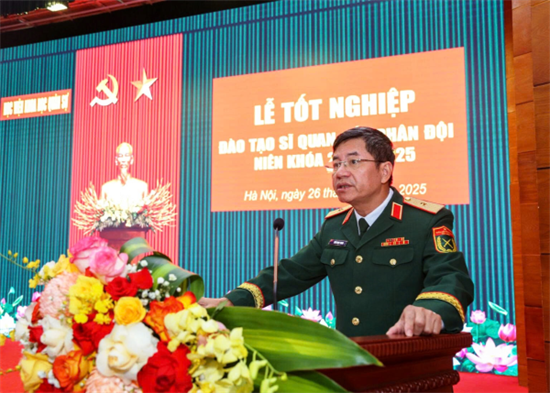 |
| Maj. Gen. Tran Ngoc Trung speaks at the convocation of class 2021 - 2025 |
Notably, the awareness of cadres, lecturers, and cadets regarding the position, role, and value of foreign languages has steadily improved. Training programmes and curricula have gradually been standardised and aligned more closely with practical objectives and requirements. Efforts to build the contingent of lecturers and education management cadres have been emphasised, while investment in modernising facilities and applying science, technology, and digital transformation in foreign language training has been promoted. The work of enrolment, inspection, supervision, and the assessment of learning outcomes has also witnessed innovations tailored to different target groups in the direction of standardisation and modernisation. As a result, the Academy’s foreign language training has continuously expanded in scale, target groups, and student throughput, affirming its role as the Army’s leading high-quality centres for foreign language training and language proficiency assessment.
At present, the world and regional situation continue to evolve in complex and unpredictable ways. The task of building the Army to be “revolutionary, regular, elite, and modern”, along with the continued promotion of international integration and defence diplomacy, sets very high requirements. These developments demand that the Academy’s education and training, particularly foreign language training, undergo further innovation and improvement in order to develop a contingent of personnel proficient in foreign languages for the sector, the Army, and the cause of national industrialisation and modernisation. To achieve this objective, the Academy is focusing on effectively implementing several major solutions.
First, strengthening the leadership and direction of Party committees and commanders at all levels over the task of foreign language education and training. This is a principle and a decisive solution to ensure that foreign language training is conducted appropriately and effectively. Accordingly, the Academy will continue to thoroughly grasp and strictly implement leadership, directive, and guiding documents concerning education and training. The focus will be placed on Resolution No. 71-NQ/TW, dated 22 August 2025, of the Politburo on breakthroughs in the development of education and training; Resolution No. 1657-NQ/QUTW of the Central Military Commission and Resolution No. 1175-NQ/ĐUTC of the Party Committee of the General Department II on renewing education and training to meet task requirements in the new situation; Directive No. 89/CT-BQP, dated 9 November 2016, of the Ministry of National Defence on urgent measures to improve the quality of foreign language teaching and learning within the military school system; and the Project on “Foreign Language Training and Fostering in the Army for the 2015–2020 Period and the following years,” etc. On that basis, leadership resolutions will be issued, while targets, measures, and implementation plans will be supplemented to ensure scientific soundness and high feasibility. At the same time, the Academy will proactively coordinate with agencies within and outside the General Department, as well as with military and civil academies and schools, to effectively implement the policy of diversifying forms and types of foreign language education and training across both the military and civilian systems. This approach will practically meet the demand for high-quality human resources not only for the sector and the Army but also for the broader cause of national industrialisation and modernisation.
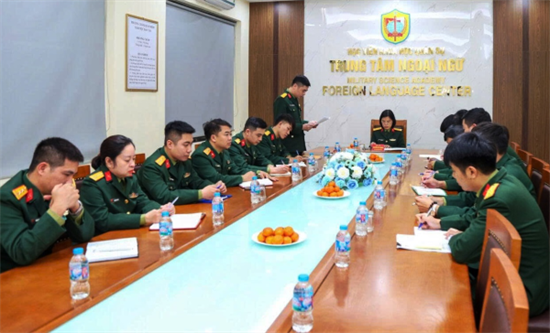 |
| Centre for foreign language training reviews its operation in 2025 |
To achieve greater effectiveness, the Academy attaches particular importance to upholding the responsibility of leaders at all levels, who bear direct responsibility for the quality of foreign language training. Responsibilities are clearly assigned to each agency, faculty, department, and lecturer in the organisation and implementation of training activities. Regular preliminary and final reviews are conducted to promptly identify difficulties and shortcomings and to adjust unsuitable contents. In parallel with these measures, the Academy consistently carries out education and dissemination activities to raise awareness among cadres, lecturers, and cadets regarding the role and significance of foreign languages. At the same time, the Academy actively promotes the Determined to Win Emulation movement, the Study and following of Ho Chi Minh’s ideology, morality, and style’, and the policy of ‘Lifelong learning’. Efforts are also devoted to building a learning environment that encourages the use of foreign languages, enabling personnel and cadets to fully contribute their capabilities and creating substantive improvements in the quality and effectiveness of foreign language training, thereby meeting mission requirements in the new situation.
Second, focusing on building a contingent of foreign language lecturers meeting national and international standards. The Academy will continue to thoroughly grasp and effectively implement the breakthrough in improving the quality of cadres, with priority given to the contingent of lecturers. In the course of implementation, attention will be devoted to effective personnel planning to ensure a reasonable structure in terms of quantity, qualifications, age, and language specialisations in line with development strategies and training requirements. This will be combined with improving the quality of recruitment, strictly implementing procedures for assessing political qualities, ethics, pedagogical competence, and scientific research capability, while also identifying and developing potential successors. Priority will be given to fostering promising young lecturers who are dedicated to the profession and committed to the Academy, thereby ensuring continuity and sustainable development.
Alongside the continued consolidation of the organisational structure of foreign language faculties and departments in a streamlined and scientific manner, the Academy will actively implement measures to improve lecturers’ professional qualifications, pedagogical skills, and capacity to apply digital technologies and artificial intelligence, as well as modern teaching methods and knowledge of culture, ethics, and law, in accordance with academic title standards and the titles of educators. Training and professional development programmes will focus on standardising and modernising professional competencies, particularly the capability to teach foreign languages in association with the military environment and specialised fields. Training and professional development will be diversified in form, combining formal training, regular in-service training, self-study, and learning through teaching practice and scientific research with expanded cooperation with reputable foreign language training institutions both domestically and internationally. Through these measures, lecturers will not only improve their language specialisation and update modern knowledge and teaching methods, but also gain access to advanced training models and international assessment standards. At the same time, the Academy will foster a favourable academic environment and appropriate incentive mechanisms to encourage lecturers to proactively enhance their professional competence, thereby contributing to improved foreign language training quality.
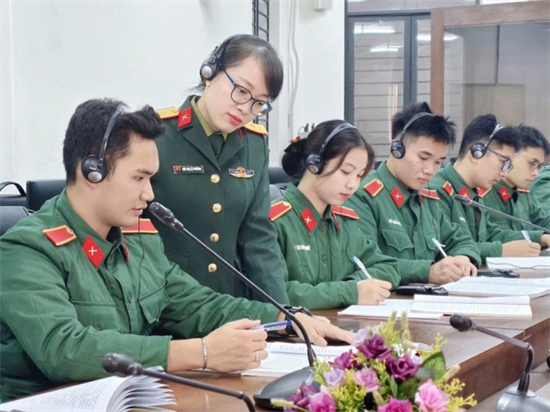 |
| An interpreting lesson of the English Department, Military Science Academy |
Third, promoting comprehensive innovation in the content, programmes, processes, and methods of foreign language training. Building on achieved results, the Academy will continue to promote the renewal of training processes, programmes, content, and methods across all specialisations and levels of study in the direction of greater specialisation, depth, quality, and effectiveness, ensuring scientific soundness, continuity, inheritance, and close alignment with practical requirements and development trends. In terms of training content, emphasis will be placed on developing foreign language proficiency associated with the specific characteristics of military science, particularly specialised foreign language skills serving strategic research, international cooperation, and participation in scientific forums and conferences. Training programmes will be designed with an open and flexible orientation, regularly updated and closely linked to learning outcomes and practical requirements. Digitalisation and standardisation will be implemented through learning management systems, learner databases, and online testing and assessment platforms; technology will be applied in both training management and the organisation of teaching and learning, thereby forming a comprehensive and interconnected training process from teaching organisation and learning monitoring to outcome assessment.
In line with the goal of placing learners at the centre of the educational process, the Academy will continue to promote learners’ initiative, creativity, and capacity for self-study and independent research. Particular emphasis will be placed on renewing teaching methods, especially through the application of science, technology, and digital transformation in implementing and enhancing active learning approaches, such as blended learning, the flipped classroom model, and case-based learning associated with research in military science and defence diplomacy.
At the same time, interaction between lecturers and learners will be strengthened; teaching, learning, and scientific research will be closely integrated. Online learning platforms, foreign language teaching software, pronunciation training tools, speech recognition systems, artificial intelligence, and simulation and virtual reality technologies will be utilised to recreate international communication environments, enabling learners to develop communication skills and practical foreign language competence in contexts closely aligned with real-world and multicultural environments. As a result, the teaching and learning process will no longer be confined to the traditional classroom but will expand into digital learning spaces, creating conditions for learners to study flexibly, proactively, and continuously. In addition, inspection and supervision of training activities will be conducted effectively, with strict compliance with regulations governing education and training. The Academy will continue developing a comprehensive bank of graduation examination questions for different training groups; diversify examination and assessment methods; and expand the use of computer-based multiple-choice testing for end-of-course and subject examinations.
Fourth, increasing investment in building educational and training facilities in a modern, synchronised, and standardised direction. The Academy will continue to provide advice on, mobilise, and effectively utilise resources to develop infrastructure, facilities, and equipment serving foreign language teaching and learning in accordance with the “smart school” model. In the immediate term, priority will be given to upgrading foreign language classrooms into smart classrooms equipped with interactive boards, high-quality projection screens, standardised sound systems, and listening–speaking–pronunciation training software. Classroom spaces will be designed flexibly to meet the requirements of practising communication skills, interpretation, military dialogue, and academic discussion. At the same time, a synchronised information technology infrastructure will be developed to support the implementation of blended learning models combining face-to-face and online teaching, in line with the specific characteristics of the training environment. In parallel with this effort, the Academy will continue researching, compiling, and refining the system of textbooks and teaching materials for foreign language education, ensuring “standardisation and modernisation” and alignment with different levels of study, academic specialisations, training groups, and the specific characteristics of the military environment. The Academy will also maintain and further develop direct foreign language learning software for use across the entire Army; develop electronic lectures in English, Russian, and the languages of neighbouring countries to support distance education, online teaching, and self-study of foreign languages for cadres and soldiers in the Army. In addition, international cooperation and linkages in foreign language training will be further promoted.
Improving the quality of foreign language training is an objective and urgent requirement in the process of building a modern Army. With its established tradition, available resources, and sound strategic orientation, together with strong determination, the Military Science Academy will continue to innovate and further improve the quality of foreign language training, thereby contributing to the development of high-quality human resources capable of meeting the requirements of building the Army and defending the Fatherland in the new era.
Major General, Assoc. Prof., Dr. TRAN NGOC TRUNG, Director of the Academy