
The rapid development of military science and technology has been profoundly changing the methods and means of conducting modern warfare, in which unmanned aerial vehicles (UAV) are playing an increasingly important role. As a pioneer in researching, developing, and applying science and technology to military activities, the US attaches great importance to UAV development as a means of increasing its military power and transforming its methods of warfare.
UAV development history and its growing importance in modern warfare
According to international military experts, the US was the first country to develop and employ UAVs. As early as the First World War, the US tested Kettering Bug, a suicide UAV capable of carrying weapons to a target and detonating on impact. During the Second World War, the country continued to develop and use UAVs controlled via radio signals. During the Cold War, Washington tested and deployed a number of advanced unmanned systems, such as the Ryan Firebee system for reconnaissance missions over enemy airspace. However, due to their limited functionality and high costs, the practical use of such vehicles remained restricted.
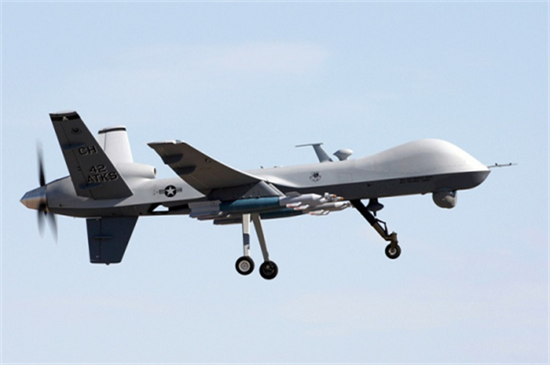 |
| MQ-9 Reaper of the US (photo: Military Today) |
Early in the 1990s, with advances in science and technology, especially in telecommunications and automation, the Pentagon focused on developing a new generation of UAVs with longer ranges (tens of thousands of kilometres), longer endurance (up to 24 hours), and the ability to carry weapons, including small missiles. A representative example of this generation is MQ-1 Predator, widely used in US military operations in Afghanistan (2001) and Iraq (2003). The next generation, MQ-9 Reaper, features more advanced capabilities and is regarded as one of the most modern and lethal UAVs, notably used in the assassination of Iranian General Soleimani in early 2020.
Over the past decade, with advances in semiconductor, sensors, navigation and data transmission technologies, and especially artificial intelligence (AI), the cost of producing UAVs has decreased significantly, while many new capabilities have been added to these platforms. In the past, each UAV cost millions of US dollars, whereas today a UAV with comparable capabilities can be acquired for only a few thousand US dollars. A typical example is LUCAS UAV, produced at a cost of around USD 20,000, yet its capabilities are broadly comparable to those of the MQ-series unmanned aircraft, which cost millions of US dollars. This cost disparity between attack UAVs priced at only tens of thousands of US dollars and interception systems costing up to millions of US dollars has underscored the structural cost asymmetry in modern warfare.
Scientists note that the rapid development of AI technology, sensors, and precision navigation is making these platforms increasingly “intelligent” and more highly autonomous. In particular, thanks to the integration of data processing algorithms, target recognition systems, and automatic navigation, many UAVs are capable of analysing the combat environment on their own, selecting optimal flight paths, and continuing operation even when control signals are jammed. Multispectral sensors, combined with satellite positioning systems and inertial guidance, enable UAVs to detect, track, and strike targets with very high precision.
In the context of modern warfare with more emphasis on flexible, high-intensity and prolonged operations, UAVs are regarded as a platform capable of meeting multiple operational requirements of contemporary combat at the same time. With their low cost, ease of large-scale deployment, and ability to reduce casualties, UAVs are widely considered to deliver higher combat effectiveness than many traditional weapons. Therefore, no longer confined to reconnaissance missions, UAVs have played an increasingly important role in creating direct advantages on the battlefield, especially in conditions of prolonged attritional warfare.
Recent conflicts in Ukraine and the Middle East have shown that low-cost UAVs, with their wide-area coverage capability, have significantly reshaped battlefield dynamics.
The US policy of UAV development in the coming period
In the global context of rapid, complex, and unpredictable changes, the US, as a leading country in the research, development, and application of UAVs, has proactively adjusted its policies to accelerate the development, production, and large-scale deployment of such systems. To realise the goal of making UAVs a principal factor in force structure, the US Administration and Congress have introduced a series of systematic adjustments, ranging from institutional reforms and changes in defence industry policy to adjustments in force structure and training. Priority is given to not only developing new technologies, but also enhancing the capacity to produce and deploy UAVs at a scale sufficient to sustain high-intensity and prolonged warfare.
Institutionally, the issuance of Executive Order 14307 (June 2025), together with directives from the US Department of Defence (now the Department of War), has helped remove procedural barriers, shorten the cycle of testing, approval, and procurement, and enhance the capacity for UAV research, development, and production. Financially, the US Congress allocated USD 1.4 billion (the fiscal year 2025 defence budget) to expand the small UAV industrial base, reflecting a priority on building sustainable production capacity rather than individual purchases. In terms of organisational structure, according to international sources, the US Military’s plan to acquire at least one million UAVs within the next three years and equip each division with around 1,000 UAVs before 2027 demonstrates that UAVs are being widely incorporated into unit organisation, rather than being confined to specialised forces.
In addition to investment in expanding the scale of UAV production plants under the traditional model, the US Military is also applying new technologies to shorten UAV production time, including the “Mission Configurable Unmanned Aerial Systems” program by the US Army Research Laboratory. Under this program, UAVs are designed to meet the specific mission requirements of each combat unit, with their airframes produced by 3D-printing technology, while engines, cameras, and sensors are assembled from an available pool of components. According to military experts, with this new technological process, the US Army can produce a UAV within 24 hours of receiving a specific order.
Alongside the expansion of UAV production and deployment, the US Military is also adjusting its training programs and force organisation. In the Marine Corps, accelerated training programs for UAV operators are being implemented to address the growing demand for operational personnel. Meanwhile, the US Central Command (CENTCOM) has established the Scorpion Strike Task Force, a unit specialising in loitering munitions, which has already been deployed in combat in the Middle East. These measures underscore that UAVs have transformed from mere support tools into integral combat assets.
Notably, besides its strengthened offensive UAV capabilities, the US is also intensifying the development of counter-UAV capabilities as a major pillar. The modernisation of short-range air defence, the enhancement of electronic warfare capabilities, the deployment of low-cost systems for detecting and neutralising UAVs, and the establishment of specialised bodies such as the Joint Interagency Task Force for counter-UAV operations (JIATF-401) and the Joint Counter-Small Unmanned Aircraft Systems University (JCU) show that the US regards UAVs not only as a tool for gaining military advantage, but also as a lethal weapon in modern warfare. This dual-track approach to UAV and counter-UAV capabilities reflects a comprehensive adjustment in force structure and equipment in order to adapt to the modern combat environment, where both the US and its adversaries are capable of deploying large numbers of UAVs.
Impacts on a global scale
According to international researchers, the increased investment by the US and many major powers in the research, development, production, and large-scale deployment of UAVs has significantly influenced the military balance and the international security environment. The global military UAV market is projected to reach around USD 18 - 20 billion in 2026 and rise to more than USD 30 billion by 2034, reflecting the rapidly growing role of unmanned aerial systems in the military power structure of many countries. Therefore, Washington’s UAV development strategy has continuously reshaped strategic thinking on organising and employing military power, in the direction of prioritising sustainability and the ability to sustain attrition.
In modern warfare, the decisive factor lies not only in the technological sophistication of military equipment, but also in the ability to sustain prolonged, high-intensity operations at minimal cost. With their capacity for mass production and flexible deployment, UAVs enable countries to maintain a continuous presence in sensitive areas close to their adversaries. Such a regular presence not only enhances surveillance, intelligence gathering, and rapid response to emerging situations, but also puts pressure on adversaries. In addition, the use of UAVs significantly reduces the risk of casualties among combat forces, which in turn affects decisions on the use of military force. When personnel losses and public pressure are reduced, countries are more willing to deploy military assets in low-intensity operations or in “grey-zone” competition scenarios. However, the use of UAVs in combat may also increase the risk of unintended encounters, miscalculations, or unintended escalation, especially within a strategically competitive environment of mistrust.
Therefore, researchers argue that the integration of UAVs by the US and some major powers as a core component of their force structure has driven many other countries to adjust their defence and security policies in order to avoid falling behind. This trend may fuel a new arms race not only in UAV technology, but also in counter-UAV capabilities, electronic warfare, and command, control, and real-time data integration systems. The development of swarm UAVs with advanced automation and long-endurance operational capability may intensify complexity and risks to global security, while also forcing countries to reassess their strategic interests, potential risks, and the timing of the use of military power in handling international disputes.
Leveraging its strengths in science and technology as well as its defence industry potential, the US is steadily refining its UAV strategy, accelerating their integration into force structure, and developing counter-UAV capabilities. This shift, however, has raised international concerns that such developments could profoundly reshape the conduct of modern warfare and alter the global security environment in the years ahead.
NGUYEN HONG QUANG, PhD
Americas Department, Ministry of Foreign Affairs