
In response to the increasingly demanding requirements of weapon and equipment support for the objective of building the Air Defence - Air Force Service into a modern force, the Party Committee and Board of Directors (BOD) of Factory A31 have thoroughly grasped and creatively applied Uncle Ho’s teachings in improving the capacity to repair new-generation, modern weapons and technical equipment, achieving positive results.
As a core and leading facility across the Military for repairing surface-to-air missile systems - the key strategic weapons in the national air defence system - Factory A31 has continuously affirmed its role as the “final-tier hospital”, where weapons and equipment for training and combat-readiness units are “revived”, thereby contributing to firmly safeguarding the Fatherland’s airspace.
 |
| Factory leadership inspects technical materials and spare parts |
In recent years, the growing number and variety of new-generation weapons and equipment requiring maintenance and repair have posed numerous difficulties and challenges for the Factory. Grasping President Ho Chi Minh’s teachings: “In work, one must foresee, prepare, and plan ahead”, the Factory’s Party Committee and BOD have proactively implemented a wide range of coordinated measures, with a focus on strengthening scientific and technological potential, promoting scientific research and innovation, creating a solid foundation for improving and mastering the repair of new-generation, modern weapons and equipment.
Building scientific and technological potential as a foundation for enhancing repair capacity
Repairing and restoring new-generation weapons and equipment require a highly qualified technical workforce, with in-depth expertise, mastery of technology, and the ability to adapt quickly to scientific and technological advances. At the same time, this work also requires synchronised and modern technological production lines and facilities. In response to these requirements, grasping Uncle Ho’s teachings: “We must learn to master technology and fully utilise machine capacity; we must seek initiatives to organise labour rationally”, the Factory has identified the development of scientific and technological potential as a central task. In this regard, high-quality human resource development has been seen as the key, while modernising technological production lines and facilities serves as the direct prerequisite.
Accordingly, the Factory has set the goal of building a contingent of officers, engineers, and technical workers with deep professional expertise, high-level skills, and the ability to conduct research and quickly adapt to technological developments in the field of military engineering. To achieve this goal, based on an accurate assessment of the current workforce, the Factory has proactively developed and refined a system of standards for positions, titles, and professional requirements for each repair production line, thereby reorganising and streamlining its organisational structure in an adept, compact, effective manner, ensuring unified management and utilisation, assigning the right people to the right jobs, and prioritising the development of highly skilled technical personnel.
Over the years, the Factory has diversified training methods, closely combining on-site training with sending personnel to training and refresher courses at academies and schools both inside and outside the Military, proactively coordinating with the Military Technical Academy, the Air Defence - Air Force Academy, and the Military Industry and Telecommunications Group (Viettel), among others, to organise specialised training courses on repairing new-generation equipment. At the same time, the Factory has promoted the role of experienced officers and technicians in training and mentoring, and passing on practical experience to younger personnel. To create breakthroughs in enhancing its repair capacity, the Factory has established “High-Tech Teams” composed primarily of officers and engineers with deep expertise and strong technological aptitude to research and handle complex technical failures and master new technologies such as electronics, microwave engineering, precision mechanics, and control programming. Besides, the Factory has fostered a democratic working environment, an industrial working style, and professionalism, encouraging creativity, effectively implementing policies to motivate its staff members to remain committed to their work and maintain long-term dedication. To date, over 60% of its technical cadres hold postgraduate degrees, while more than 85% of its technical workers are highly skilled (grade 5/7 and above).
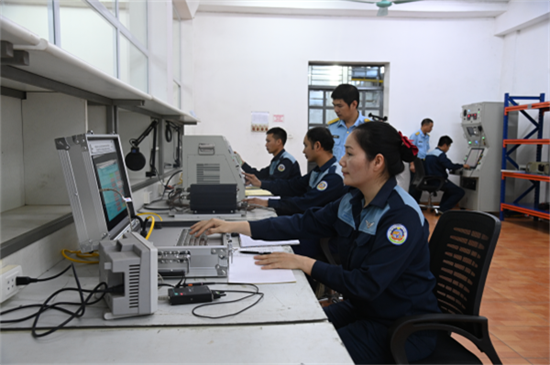 |
| Operating modern repair systems |
Alongside human resource development, the Factory has focused on investing in and modernising equipment, technological production lines, and infrastructure. Closely following its task requirements and development orientations towards 2030 with a vision to 2050, it has advised on the formulation and effective implementation of the project “Investment in technology for repairing new-generation surface-to-air missile systems, Phase II”, while beginning the implementation of Phase III and other projects aimed at comprehensively upgrading its facilities and technological production lines in a modern, synchronised, and specialised manner. Great value has been attached to investing in technological production lines and specialised inspection, diagnostic, and repair equipment for new-generation technical systems, as well as upgrading workshops and technical infrastructure to meet high-tech requirements. Up to now, most investment items have basically been completed and proven effective in improving the quality of repair and repair depth, expanding the Factory’s research and technological application capacity, reducing repair time, and broadening the scope of technological mastery. This forms a solid foundation for the Factory to enhance its capacity to repair and produce new-generation weapons and equipment and successfully fulfil all assigned tasks.
Promoting innovation, the application of science and technology, and digital transformation
Thoroughly grasping President Ho Chi Minh’s teachings: “We must improve working tools and machinery to achieve high productivity and good quality”, the Factory’s Party Committee and BOD have identified breakthroughs in science and technology development, innovation, and digital transformation as a central and key task and important driving force to improve the capacity to repair weapons and equipment. To that end, the Factory has promoted scientific research movements, initiatives, and technical improvements, with emphasis on in-depth analysis of operating principles, setting “standard parameters” for equipment as a basis for standardising repair technological processes, promoting research, design, and manufacture of specialised measuring and testing devices and various test benches, optimising production stages. It has also translated, compiled, and completed technical and technological documents to serve repair and training in the operation and use of new equipment.
To develop the movement in a substantive, effective way, annually, based on proposals submitted by collectives and individuals, the Factory’s Science and Technology Council has appraised, approved, and selected feasible, highly applicable research projects and initiatives for funding support and implementation, while creating favourable conditions for research activities. Notably, the Factory has established a “Science and Technology Development Fund”, creating a legal framework and stable financial resources to promote research and innovation. It has adopted specific policies to promptly commend and reward collectives and individuals with outstanding achievements in this field. As a result, since 2020, both the quantity and quality of research projects and initiatives have increased, with more diverse research areas, including new ones such as optoelectronics, image processing, information technology. In total, 147 projects, initiatives, and technical improvements at various levels have been successfully implemented, including 4 Ministry of National Defence-level projects and tasks, 1 at General Department of Logistics and Technology level, 4 at Service level. Many others have also been effectively applied in practice.
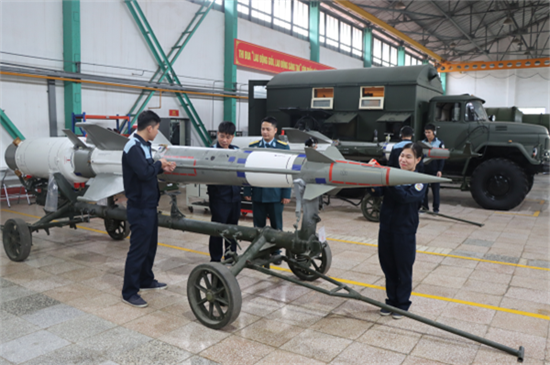 |
| Checking and repairing new-generation weapon systems |
Furthermore, the Factory has promoted digital transformation and improved modern governance methods, strictly maintaining quality management in accordance with TCVN ISO 9001:2015 standards, strengthening the application of information technology in repair operations, material management, progress monitoring, and data analysis. It has focused on fostering digital thinking and working skills for its officers, engineers, and technicians, enabling them to gradually master technological production lines to meet its development requirements in the digital era.
Promoting research, design, manufacture, improvement, and localisation of materials and components
In reality, materials and components for repairing and restoring weapons and technical equipment remain heavily dependent on imported sources, with high costs and limited supply. Bearing in mind Uncle Ho’s teachings: “Fundamentally, we must rely on our own efforts and strive to produce for ourselves”, the Factory has concentrated its efforts on research, design, manufacture, improvement, and localisation of materials and components, gradually mastering technical supply to meet its mission requirements in all situations. Priority has been given to materials and components with high failure rates, scarce supply, or high cost. It has organised this work in a systematic and methodical manner, ranging from research and analysis of technical characteristics to design, prototyping, testing, and completion of production processes. Its agencies and workshops have developed specific and feasible implementation plans, with a focus on calculating and fully preparing funding, materials, and supporting equipment. At the same time, specialised research groups have been established in such fields as electronics, automatic control, and software programming, gradually refining technical solutions and production processes suitable to the Factory’s actual conditions. Thanks to these sound and steady approaches, the Factory has now mastered technologies to manufacture hundreds of blocks and modules of modern equipment, with the quality equivalent to imported products, contributing to saving State budget, enhancing self-reliance in technical assurance, and improving the combat readiness capacity of weapons and equipment.
Building on its recorded achievements and experience, thoroughly grasping and implementing Uncle Ho’s teachings on “economising manpower and resources” and “preserving weapons and equipment in the best possible condition”, Factory A31 will continue upholding proactiveness, creativity, self-reliance, and self-strengthening, overcoming all difficulties, and striving to master new technologies as a solid foundation for building the Factory into a core, leading modern defence industry facility in repairing surface-to-air missile systems, capable of taking part in projects on manufacturing and upgrading new weapons and equipment when assigned, contributing to accelerating the modernisation of the Air Defence - Air Force Service.
Sr. Col. PHAM DUC GIANG
Director of the Factory