
In late 1426, at Tot Dong - Chuc Dong, Lam Son insurgent army organised an ambush, smashing two Ming army corps commanded by Wang Tong. This completely derailed the enemy’s counter-offensive plan against Lam Son army’s base, driving the Ming forces deep into a passive position, creating a decisive turning point in our resistance war against Ming invaders. The battle left behind many valuable lessons in military art, most notably the art of deception and strategic positioning.
In mid-1426, under the command of Le Loi, Lam Son army organised various columns to advance northwards. This aimed to expand their operational area and wage a war of attrition against Ming troops in preparation for later decisive battles.
Facing a disadvantageous situation in Giao Chi, the Ming court dispatched Marquis of Chengshan, Wang Tong, as Commander-in-Chief, along with Chief Military Commissioner Ma Ying as Participating General, to lead reinforcements. Immediately upon arriving at Dong Quan citadel, they organised troops to attack Lam Son army’s base in an attempt to completely suppress the uprising. With a massive force at his disposal, a smug Wang Tong believed that in a “single battle”, he could “capture our entire army”.
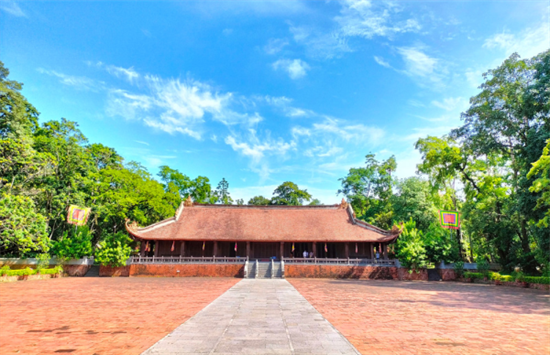 |
| Lam Kinh relic site where Le Loi is worshipped (photo: thanhhoa.gov.vn) |
In that context, Le Loi and Lam Son High Command were determined to maintain the initiative, concentrating their forces to defeat the Ming counter-offensive. Accurately anticipating the enemy’s intention to attack Cao Bo, Lam Son army set up two ambush positions at Tot Dong and Chuc Dong. Through a tenacious fighting spirit and unique military tactics, the ambushes at Tot Dong and Chuc Dong inflicted heavy casualties on the Ming forces in terms of both personnel and weaponry, plunging them further into a passive state. The victory at Tot Dong and Chuc Dong created a decisive turning point in our people’s resistance war against Ming invaders. Furthermore, it left behind many valuable lessons in military art, notably the art of deception and strategic positioning, which are demonstrated in the following aspects.
Firstly, firmly grasping the enemy’s scheme and correctly determining the ambush positions. In order to maximise the preferred combat style of “setting ambushes, using surprise troops, avoiding the enemy’s spearhead, exploiting their vulnerabilities, employing the few to defeat the many, and taking the weak against the strong”, the prerequisite was to select a strategic ambush location. It had to be a place the enemy would pass through, where our troops could easily conceal themselves, deploy formations, and create the element of surprise; upon attacking, our troops would hold an advantageous position, whilst the enemy would be at a disadvantage. Firmly grasping Ming army’s intention to attack Cao Bo with two columns: the main force directly commanded by Wang Tong advancing from Ninh Kieu to attack Lam Son insurgent base in Cao Bo, and a surprise force secretly crossing Ninh Giang river to take a detour and attack Cao Bo from the rear, Lam Son High Command chose Tot Dong and Chuc Dong as the locations to set up their ambush.
The selection of Tot Dong and Chuc Dong for the ambushes constituted a sharp military vision. This is because Tot Dong was a low-lying area, a muddy, sunken rice field; it was overgrown with sedge, featuring treacherous terrain that was easy to attack but difficult to defend; furthermore, there was only a single path running through Tot Dong and Yen Duyet up to Cao Bo. Meanwhile, Chuc Dong was an area situated at the foot of Chuc Son mountain, roughly 6 kilometres from Tot Dong and adjacent to the west of Ninh Kieu base, boasting perilous terrain and dominating crucial waterways and land routes. In these two treacherous areas, should the two Ming columns (primarily cavalry and infantry) fall into the ambush, their formations would be stretched, and coordinated command would become ineffective; most notably, the muddy terrain would severely limit the manoeuvrability of their cavalry. Conversely, Lam Son insurgents were well-positioned to take advantage of the mounds, hillocks, and dense reeds and sedge to conceal their troops, secretly manoeuvre their forces, and execute surprise attacks from multiple directions.
Exactly as anticipated, the two Ming columns commanded by Wang Tong secretly crossed the river, manoeuvring in two axes to attack Cao Bo. When the vanguard of the main force reached Tot Dong, their rearguard had just entered the ambush site at Chuc Dong; Lam Son insurgents in both ambush positions completely locked down the entire main force. Seizing the opportune moment, our troops charged from multiple directions, blocking the front, sealing off the rear, and attacking the flanks, causing Ming army’s formation to become congested and fragmented into several parts. At the same time, heavy rain began to fall, making the sunken rice fields even muddier, causing Ming cavalry and infantry to become bogged down, unable to utilise their strengths. Unexpectedly attacked under unfavourable weather and terrain conditions, their cavalry and infantry units were mired, lost their combat capability, and scrambled to flee, creating a favourable opportunity for Lam Son insurgents to press the advantage, hunt down and annihilate them.
 |
| Tot Dong - Chuc Dong battle map (photo: Military History of Vietnam, Volume 5) |
Second, closely combining the establishment of strategic positions with proactively breaking the enemy’s initial offensive momentum. Executing the plan to destroy Lam Son insurgents’ bases, Wang Tong divided his army into three columns to occupy Co So, Sa Doi, and Thanh Oai, using them as springboards to organise the offensive. Among them, the column at Co So commanded by Wang Tong was the primary thrust, whilst the other two were supporting flanks. Faced with Ming army’s overwhelming strength, described as “flags covering the fields, spears illuminating the sky”, the insurgents did not flinch, resolutely maintaining the initiative, breaking each assaults, ultimately defeating their counter-offensive. Two generals, Pham Van Xao and Ly Trien, proactively ordered their troops to temporarily leave their encampment and occupy advantageous areas, using them as springboards to attack the Ming column at Thanh Oai bridge. This was a column isolated to the southwest, far from Co So base, with a smaller force, commanded by two generals, Shan Shou and Ma Qi. Having a firm grasp of Ming army’s situation, the insurgents set up their battlefield, placing an ambush in Co Lam field, and then sent troops out to provoke a battle. They executed the stratagem of “luring the tiger out of the mountain” to entice the enemy out of their camp, tricking them into the ambush to annihilate them. Overconfident, Shan Shou and Ma Qi ordered their troops to give chase, fell into the ambush, and had the majority of their forces wiped out by Lam Son insurgents. Terrified, the Ming column at Sa Doi bridge, commanded by Fang Zheng and Li An, fled back to Dong Quan citadel. Thanks to their brilliant strategy and the art of deception and ambush, the insurgents broke the initial counter-offensive formation, narrowed the battlefield, and overturned Ming army’s plan; simultaneously, they avoided having to disperse their forces to deal with multiple directions and thrusts at once, thereby securing the conditions to concentrate their military strength and defeat the enemy’s main force.
Although Ming army’s initial offensive momentum had been broken, their forces remained incredibly strong. Therefore, Lam Son High Command decided to concentrate their forces and create an advantageous battlefield to attack the main column commanded by Wang Tong. Accordingly, the Lam Son column commanded by Generals Dinh Le and Nguyen Xi, stationed in Thanh Dam, swiftly manoeuvred to converge at Cao Bo to consolidate and reinforce their troops. To ensure a certain victory against the main column, the insurgents did not spread their forces evenly to simultaneously attack the vanguard, the centre, and the rearguard. Instead, they concentrated the majority of their forces in Tot Dong to shatter the enemy vanguard; they deployed just enough troops in Chuc Dong to act as a blocking force, attacking the rearguard and standing ready to intercept and pursue the enemy as they fled. Implementing the tactic of “using short troops to control long formations”, within each area, the insurgent forces were divided into small groups with compact weaponry, manoeuvring flexibly, secretly laying in ambush along both sides of the road. It can be seen that the insurgents’ decision - rather than spreading their forces evenly to fight both columns, they concentrated their strength to strike directly at the primary target, the main column, creating overwhelming power to ensure a certain victory - was completely correct. This is because once the main component is destroyed, the remaining parts inevitably fall into a passive, chaotic state and quickly disintegrate. At the same time, this aligned with the practical condition of having to “use the few to defeat the many, and take the weak against the strong”.
Thanks to the effective ambush formation, when the insurgents simultaneously charged from multiple directions, fighting fiercely with a momentum “like a bursting dam”, they drove Ming troops into the mud and quagmire. This forced the column commanded by Wang Tong into a situation akin to “a large fish swimming in shallow water” or “a fierce beast trapped in an open field”, rendering them powerless to resist and leaving flight as their only option.
Third, flexibly, creatively applying the art of “hoisting the enemy with their own petard”. In the ambush at Tot Dong and Chuc Dong, the art of “hoisting the enemy with their own petard” was applied flexibly, creatively by the insurgents, thus achieving immense effectiveness. Through the interrogation of prisoners of war, the insurgents discovered Ming army’s scheme to “fire a cannon behind our army” as a signal for the main and surprise columns to execute a coordinated pincer attack on our troops at Cao Bo. Based on this intelligence, the insurgents proactively employed a counter-stratagem - using the enemy’s own trick to fight back. When the main column commanded by Wang Tong advanced along the single path to Tot Dong, and the surprise column crossed Ninh Giang bridge, the insurgents seized the exact moment to fire a signal cannon. This led Ming troops to mistakenly believe it was their own signal, hastily urging their forces deeper into the insurgents’ ambush site. Meanwhile, our ambushing troops remained “lying completely motionless”, making Ming army even more convinced that the route was clear of ambushes. This increased their overconfidence and negligence in defence, creating a prime opportunity for the insurgents to charge and annihilate them.
With this outstanding execution of the counter-stratagem, Lam Son insurgents not only shattered Ming army’s initial coordination plan but also used that very signal to deceive and propel them faster into the prepared ambush. The later development showed that the main column commanded by Wang Tong, taken entirely by surprise, could not react in time; its formation disintegrated after just a few hours of fighting. The “surprise” column, manoeuvring on the road, upon hearing that the main force had been crushed at Tot Dong, panicked and hastily retreated. Fleeing back towards Dong Quan, they fell straight into the intercepting ambush prepared by the insurgents at Chuc Dong and were largely wiped out. As Ming troops became bogged down in the muddy fields, our ambushing forces pressed the advantage, charging forward to pursue, annihilate, and capture tens of thousands alive, “seizing countless horses, military supplies, weapons, and wagons”, achieving total victory. Describing this glorious feat of arms, Nguyen Trai wrote in the Great Proclamation upon the Pacification of the Wu: “At Ninh Kieu, blood flowed in rivers, the stench spreading for ten thousand miles / At Tot Dong, corpses littered the fields, the foul smell lasting for a thousand autumns”.
Though much time has passed, the art of deception and strategic positioning in the battle of Tot Dong - Chuc Dong in 1426 retains its original value. It should continue to be studied, developed, and creatively applied in modern warfare conditions, contributing to the enrichment of Vietnamese military art theory and the firm protection of the Fatherland in the new situation.
Sr. Col. PHAM HUU AN, PhD
Head of the Operational Department
Army Academy