
Northeast Asia is a region of global strategic importance, home to several potential security flashpoints in Asia, including the Korean Peninsula, the East China Sea, and the Taiwan Strait. Amidst intensifying strategic competition among major powers, defence and security developments in Northeast Asia are not only reshaping the regional balance of power but also exerting profound impacts on the peace, stability, and security architecture of the Asia-Pacific region.
Defence and security developments in Northeast Asia
Over the past decades, the security architecture in Northeast Asia has largely been underpinned by the US-led alliance system. Under this framework, Washington has provided a security umbrella for its allies, Japan and South Korea. In return, these countries have accepted constraints on the development of offensive military capabilities and remained heavily dependent on the US in shaping their security and defence policies.
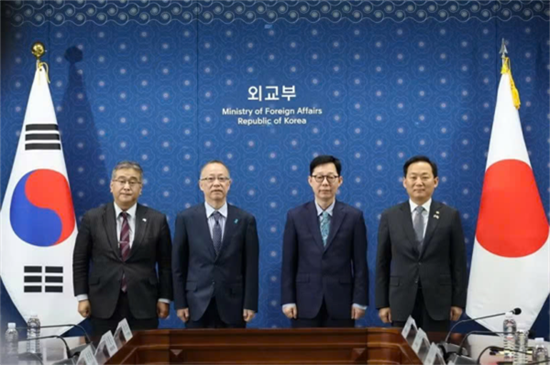 |
| 2+2 dialogue between South Korea and Japan (photo: Yonhap) |
According to many scholars, given the historical animosities between China and Japan, Washington’s restraint of Tokyo has helped reduce the risk of direct military rivalry between the two countries and contributed to a relatively stable balance in Northeast Asia. Furthermore, prior to the 2008 global financial crisis, a certain degree of mutual understanding and cooperation between China and the US in managing sensitive issues, such as differences over the Taiwan Strait and the Korean Peninsula, also helped sustain a relatively stable regional security environment albeit one still marked by considerable uncertainties.
However, in recent years, this fragile balance has begun to show signs of strain. The balance of power among the region’s major powers has been shifting at a rapid pace. Whereas China’s GDP only caught up with that of Japan around 2010, China’s economy is now several times larger than Japan’s. Concurrently, intensifying strategic competition among major powers, coupled with growing security frictions among regional actors in Northeast Asia, is reshaping the regional strategic landscape in increasingly complex ways.
China has firmly established itself as a leading military power in Northeast Asia. By 2025, China’s share of total military expenditure in Asia had risen to nearly 44%, compared with an average of approximately 37% during the 2010 - 2020 period. According to assessments by various international research institutions, China is currently among the world’s fastest-modernising militaries. In particular, China’s nuclear deterrent has expanded significantly. According to the US Department of Defence’s 2025 China Military Power Report, Beijing is on track to field 1,000 nuclear warheads by 2030. If so, China would achieve a degree of strategic parity with the US and Russia - the two military superpowers that currently possess around 90% of the world's nuclear weapons. Meanwhile, North Korea’s growing nuclear and missile capabilities are viewed by the US, Japan, and South Korea as a major threat to their national security. For its part, Pyongyang regards recent US military actions against Venezuela and Iran as further evidence that nuclear weapons are the most important guarantee of national survival. Consequently, North Korea now regards the preservation of its status as a nuclear-armed state as non-negotiable.
Against this backdrop, it is evident that in recent years, the US has strengthened military cooperation with its allies Japan and South Korea through both bilateral frameworks and trilateral coordination. During the administration of President Joe Biden, Washington encouraged Tokyo and Seoul to improve bilateral relations, bolstered trilateral intelligence sharing, and in 2023, conducted the first-ever trilateral US-Japan-South Korea aerial exercise near the Korean Peninsula. Under the Donald Trump 2.0 administration, despite reversing many policies of its predecessor, the US has maintained trilateral security cooperation and, in some respects, further strengthened it. Joint aerial exercises among the three countries have expanded in both scale and sophistication. Faced with a rapidly rising China, an increasingly unpredictable US, and a North Korea equipped with nuclear strike capabilities, both Japan and South Korea have taken important steps to strengthen their own military capabilities. They have also quietly adopted a hedging strategy, maintaining close alliance ties with the US while strengthening their autonomous deterrent capabilities.
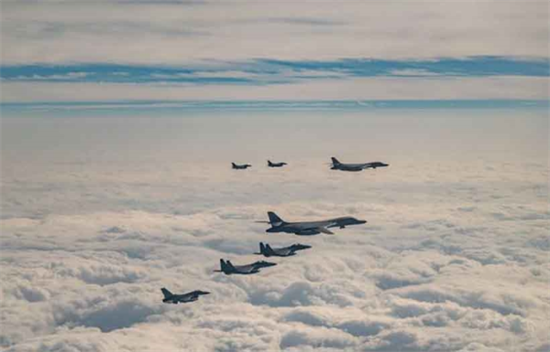 |
| Trilateral US-Japan-South Korea aerial exercise in 2024 (photo: VNA) |
According to military analysts, Japan is actively seeking viable alternatives for its security and defence arrangements. The Japanese Government’s decision to increase defence spending to 2% of GDP and its ongoing review of three key national security documents indicate that Tokyo no longer leaves its national security entirely in the hands of the US. Recently, Prime Minister Sanae Takaichi has pushed for the removal of restrictions on arms exports, marking a break with one of Japan's long-standing post-war taboos. Even the issue of nuclear weapons development, long considered a political taboo in Japan, has begun to give rise to voices reflecting a gradual shift in thinking. A Reuters poll released in August 2025 showed growing public support for easing Japan’s three non-nuclear principles which prohibit the possession, production, or introduction of nuclear weapons into the country.
For its part, South Korea has responded proactively to the evolving regional security landscape. Over the past several decades, no middle power in Asia has achieved such remarkable progress in advancing its defence industry as South Korea. The country has firmly established itself among the world’s top ten arms exporters and aspires to rise to fourth place globally. In response to concerns over a deteriorating security environment, South Korea has steadily expanded its inventory of strategic long-range strike weapons to enhance deterrence capabilities. The South Korean Ministry of National Defence plans to deploy additional Hyunmoo-5 ballistic missiles, which reportedly have a range of up to 5,500 kilometres and can carry a conventional warhead weighing up to nine tonnes. Although South Korea’s political leaders remain cautious given the country’s status as a signatory to the Treaty on the non-proliferation of nuclear weapons, public opinion appears considerably more receptive, with more than 70% of respondents reportedly supporting the possession of nuclear weapons.
Tokyo and Seoul are also intensifying bilateral defence and security cooperation alongside their respective alliances with the US and the trilateral US-Japan-South Korea cooperation framework. On 7 May 2026, the two countries held, for the first time, a vice-ministerial-level 2+2 dialogue between their foreign and defence officials in Seoul. Amid growing concerns that the US military is becoming overstretched by conflicts in the Middle East and other global issues, potentially creating a “power vacuum” in East Asia, the two sides agreed to enhance bilateral security cooperation and elevate their security dialogue from the director-general level to the vice-ministerial level.
Implications for the Asia-Pacific region
Defence and security developments in Northeast Asia have had and will continue to have profound impacts on the strategic environment of the Asia-Pacific region.
First, these developments are accelerating the trend towards military build-up across the region. According to the Stockholm International Peace Research Institute (SIPRI), of the $2.9 trillion spent globally on defence in 2025, defence expenditure in the Asia-Pacific region reached $681 billion, up 8.5% from 2024, the largest rise since 2009. Notably, US President Donald Trump has proposed a record defence budget of $1.5 trillion for 2027, a 40% increase over the 2026 level. He has also called on US allies in Asia to increase defence spending to 5% of GDP, matching the level pledged by NATO members. This raises the risk of an arms race in the region.
Second, international observers argue that ongoing debate over nuclear weapons in Northeast Asia, particularly in South Korea and Japan, could further complicate the regional security environment. If strategic competition among major powers and shifts in US policies compel Japan and South Korea to develop their own nuclear deterrent, the Asia-Pacific region would become home to a growing concentration of nuclear-armed states. Such a scenario would not only have adverse implications for the regional security environment but also undermine the Treaty on the non-proliferation of nuclear weapons (NPT).
Third, these defence and security developments in Northeast Asia are driving a restructuring of the security order in Asia Pacific. Although the US remains the world’s leading military power, it no longer enjoys overwhelming power and influence. The traditional “hub-and-spokes” system is gradually evolving into a complex network of security cooperation. Simultaneously, despite its rapid rise, China has yet to acquire sufficient capability to shape the regional order entirely on its own terms. Meanwhile, middle powers and other countries are strengthening their strategic autonomy and reducing their dependence on major powers. As a result, a more clearly defined multipolar order is emerging, accompanied by the inherent uncertainties associated with the transition from the old order to a new one.
Fourth, at a time when multilateralism is facing growing challenges, inclusive security cooperation mechanisms, including those led by ASEAN such as the ASEAN Regional Forum (ARF), are likely to face increasing competition from minilateral security arrangements led by major powers. These include the Quad, AUKUS, and various trilateral or quadrilateral security mechanisms involving the US and its allies and partners. Certain traditional security mechanisms that once played important roles in crisis management and regional dialogue, such as the Six-Party Talks on North Korea’s nuclear program, will remain dormant or may even be abandoned altogether. Consequently, strategic trust among countries and the habit of multilateral cooperation in addressing common security challenges will be eroded to some extent.
Finally, rising security risks in Northeast Asia may directly impact the security and development of Southeast Asian nations. China, Japan, and South Korea are major trade, investment, and tourism partners of Southeast Asian countries, as well as important dialogue partners of ASEAN. Any friction or confrontation among Northeast Asian countries will inevitably generate spillover effects on Southeast Asia. This reality suggests that to truly maintain its central role in the regional architecture, ASEAN must become more proactive in addressing issues that extend beyond Southeast Asia. ASEAN should promote habits of cooperation and mechanisms for managing differences among its dialogue partners in Northeast Asia, thereby both protecting its legitimate interests and making a constructive contribution to peace, cooperation, and development in the region.
VU DUY THANH, PhD
Deputy Director of the Department of Foreign Policy
Ministry of Foreign Affairs