
Enhancing the operational effectiveness of permanent maritime militia squadrons is both an urgent requirement and a long-term strategic task, contributing to the building and consolidation of the all-people national defence posture in close association with the people’s security posture across the nation’s maritime domain in a comprehensive and resilient manner. This article proposes solutions for applying science and technology to the management, operation, and utilisation of the equipment and vessels of permanent maritime militia squadrons to meet the requirements of safeguarding national sovereignty over the seas and islands in the new situation.
In recent years, under the resolute leadership and direction of the Central Military Commission and the Ministry of National Defence, military agencies, units, and several coastal localities have actively implemented the second phase of the Project on “Building permanent maritime militia squadrons for the protection of national sovereignty over seas and islands in the new situation,” achieving a number of important initial results. However, given that this force has only recently been established and is tasked with the highly specialised and demanding mission of safeguarding national maritime sovereignty, its organisation and operations continue to encounter numerous difficulties, constraints, and shortcomings. To enable permanent maritime militia squadrons to successfully fulfil their assigned political missions, alongside the decisive role of personnel, investment in, mastery of, and effective utilisation of technical equipment and vessels is of critical importance.
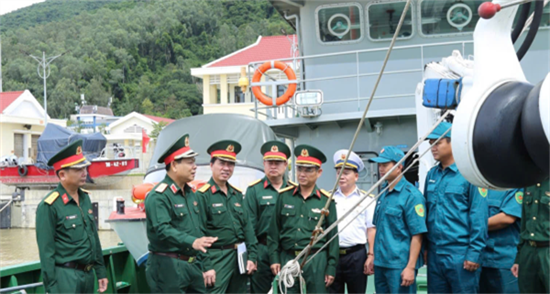 |
| Leader of Military Region 9 checks training work of permanent maritime militia squadron of An Giang province |
Against the backdrop of the rapid advancement of the Fourth Industrial Revolution - with digital technologies, advanced materials, and artificial intelligence playing increasingly prominent roles - both opportunities and challenges have emerged for technical management, equipment operation, and maintenance support. Traditional approaches to technical support have revealed significant limitations, no longer meeting the growing demands for speed, accuracy, and predictive capability. Furthermore, owing to the harsh maritime operating environment and the highly independent nature of their missions, each vessel of a permanent maritime militia squadron must cope with complex situations. Such vessels serve not merely as means of mobility, but as “combat positions at sea” and “living markers of national sovereignty.” The reliability of propulsion systems, the security of communications, and the accuracy of radar systems directly determine both the survivability of crews and their ability to accomplish assigned missions. Accordingly, accelerating the application of science and technology to the management, operation, and utilisation of the equipment and vessels of permanent maritime militia squadrons is not merely a technical solution; it is an objective and indispensable requirement. It represents a fundamental prerequisite for maintaining a high level of combat readiness in accordance with the principle of “maintaining equipment in good condition, ensuring durable use, safety, and economy,” while sustaining long-term operational mobility and combat effectiveness for crews operating in distant maritime areas.
With the determined engagement of the entire political system, military agencies at all levels have proactively coordinated with and advised local Party committees and authorities on planning and allocating budgetary resources and infrastructure for the construction of barracks, piers, and integrated fleets of steel-hulled vessels for permanent maritime militia squadrons. At the same time, emphasis has been placed on strengthening training in the operation and use of technical equipment and vessels. Units have initially applied information technology to equipment management through software systems for managing Category-1 and Category-2 equipment, as well as the annual inventory management software used for the comprehensive inventory conducted at 00:00 on 1 January each year. These systems enable close monitoring of equipment and technical materials while synchronising vessel management data with specialised agencies across the armed forces. To master technically sophisticated and highly automated systems - including radar, electronic radio communications, electro-optical equipment, and automatic monitoring and protection systems - the military regions assigned responsibility for permanent maritime militia squadrons have proactively coordinated with units of the Navy to organise numerous specialised training and advanced technical courses for ship crews. Owing to this solid technical support, since 2022 the vessels of the permanent maritime militia squadrons have consistently maintained high combat readiness, successfully carried out operational deployments, and effectively combined fishing activities with maritime patrols and target detection, thereby making an important contribution to safeguarding national sovereignty over seas and islands and combating illegal, unreported, and unregulated (IUU) fishing. In particular, the results of the National “Excellent Ship” Contest and Permanent Maritime Militia Squadron Training Contest held in 2024 and 2025 have demonstrated the growing technological proficiency of these squadrons.
Despite these encouraging achievements, practical experience in operating and maintaining the equipment and vessels of the permanent maritime militia squadrons has also revealed a number of shortcomings and challenges. The operational reliability of certain maritime technical systems remains limited, while some electronic and electromechanical equipment is still prone to malfunction and microcircuit failures. The harsh marine environment, characterised by high salinity and humidity, accelerates electrochemical corrosion, causing rust on hulls and piping systems and leading to the rapid deterioration of electronic components. At the same time, localities generally lack specialised technical support facilities dedicated to vessel maintenance. Routine maintenance and preservation activities at unit level have not always received adequate attention. In some crews, equipment has been allowed to corrode, while marine fouling organisms such as barnacles and shellfish continue to accumulate on hulls, propellers, and cooling-water systems. Moreover, the capability to independently troubleshoot and repair minor faults on site remains limited. A degree of reliance on manufacturers’ warranty services persists, resulting in prolonged periods during which vessels remain in port and reducing their operational availability, thereby adversely affecting mission performance.
 |
| The maritime militia practice shooting on board |
These shortcomings stem from a number of causes. Most notably, the permanent maritime militia squadron is a newly established type of unit whose organisational structure does not yet include full-time specialists responsible for naval engineering, military medicine, ordnance, fuel supply, or finance. Likewise, the Military Commands of provinces and centrally administered cities have yet to be staffed with specialised naval technical officers capable of directing and supervising this professional field. In addition, personnel serving in permanent maritime militia squadrons are recruited primarily from coastal fishing communities. Although they possess firm political commitment, courage, and extensive practical seafaring experience, their educational backgrounds are uneven and their knowledge and skills in information technology remain limited. Furthermore, the duration of training for command positions, including squadron commanders, captains, and chief engineers, at military educational institutions is relatively short, providing only a limited body of specialised knowledge. Consequently, their command and control capabilities, together with their proficiency in operating vessels and technical equipment - particularly highly automated, high-technology systems and digital technical reporting software - remain inadequate. To overcome these shortcomings, remove existing bottlenecks, and achieve a fundamental qualitative improvement in the application of science and technology to the management, operation, and utilisation of equipment and vessels, military agencies at all levels should focus on the comprehensive implementation of the following key groups of measures.
Firstly, to strengthen the leadership and direction of Party committees while promoting the application of science and technology, digital transformation, and administrative reform in logistics and technical support. Provincial and municipal Military Commands responsible for permanent maritime militia squadrons should incorporate the application of science and technology, digital transformation, and the modernisation of technical management into their regular leadership resolutions. At the same time, command and management methods should be fundamentally reformed by eliminating unnecessary intermediate procedures in reporting and proposal processes. Priority should be given to the effective utilisation of specialised technical management software deployed by the Ministry of National Defence, particularly the software for managing Category-1 and Category-2 equipment. Concurrently, the entire system of technical records, logbooks, and equipment dossiers should be fully digitised, with regular updates on operating hours, maintenance and failure histories, and consumption norms. In addition, electronic document management systems and digital signatures should be comprehensively applied in the approval of maintenance plans and the allocation of technical materials and fuel. An online technical reporting system should also be established to enable technical authorities to monitor, in real time, the operational and technical status of the weapons, equipment, and technical systems assigned to each vessel and crew.
Secondly, to enhance on-site technical support capabilities, with particular emphasis on preservation and maintenance under maritime operating conditions. This constitutes the key factor directly determining the technical readiness coefficient of vessels and equipment. Each permanent maritime militia squadron should strictly maintain established technical routines and schedules, while strengthening measures to prevent electrochemical corrosion and hull deterioration through the use of specialised protective materials and marine-grade coatings. For weapons and ammunition carried aboard vessels during prolonged deployments, moisture-proof storage procedures must be strictly observed in accordance with prescribed regulations. Ship crews should maximise their capability to detect and rectify technical faults on site, while proactively developing maintenance plans and submitting timely requests to higher authorities for scheduled servicing and repairs, ensuring that all maintenance work is carried out on schedule and to the required quality standards.
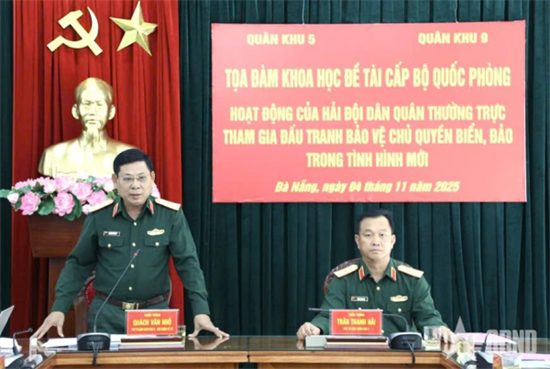 |
| A conference on the participation of the permanent maritime militia squadrons in the protection of national sovereignty over seas and islands in the new period (Photo: qdnd.vn) |
Thirdly, to renew training methods and maximise the effective utilisation of the advanced technologies installed aboard vessels. Priority should be given to training ship crews - particularly commanders, captains, and chief engineers - to master sophisticated systems such as radar, electro-optical equipment, and communications systems. Greater emphasis should be placed on the “hands-on, demonstration-based” training approach, while operating procedures should be digitised into electronic manuals and instructional video clips to facilitate learning and retention. Cooperation with the Navy should continue in organising advanced specialised training courses. At the same time, reliable communication channels should be established to enable higher-level technical authorities and specialists to provide direct guidance and technical assistance, allowing ship crews to independently troubleshoot and rectify technical failures arising during operations at sea.
Finally, to ensure the dual-use capability of vessels and integrate technical support with civil defence and joint operational requirements. The technical readiness of all equipment and systems must consistently satisfy dual-use requirements, ensuring that vessels are capable of both conducting sovereignty patrols and being rapidly deployed for civil defence missions, disaster response, search and rescue operations at sea. Vessels must continuously maintain prescribed reserves of logistical supplies, medical equipment, fuel, food, and provisions sufficient for extended deployments. During mission execution, close coordination should be maintained with the Navy and the Coast Guard operating in the area to facilitate the sharing of maritime target information, while ensuring mutual support in the provision of specialised technical materials and the organisation of towing and repair operations in the event of serious incidents occurring in distant maritime areas.
Practical experience gained from the establishment, training, and operation of permanent maritime militia squadrons over recent years has clearly demonstrated the soundness and strategic significance of the Party’s and the State’s policy. To maximise the squadrons’ capability for sustained maritime operations, prolonged deployments, and high combat readiness, it is essential to accelerate the application of science and technology, digital technologies, and advanced materials in equipment procurement, while improving the management, operation, and utilisation of vessels and technical equipment. This is both an urgent requirement and a long-term strategic imperative for enhancing the effectiveness of permanent maritime militia squadrons.
Senior Colonel NGUYEN TIEN DUNG, M.A., Head of the Military Science Department,
Military Region 9