During the 1966 Sa Thay Campaign, by employing “lure-and-trap” tactics, we guided and decoyed elite, battle-hardened US units into disadvantageous areas to annihilate them, contributing to the defeat of the second strategic counter-offensive by the US and puppet forces in the Central Highlands theatre.
In mid-1966, following their heavy defeat in the first strategic counter-offensive, the US continued to deploy several elite units and an array of modern war materiel to South Vietnam in an attempt to regain the initiative on the battlefield.
Notably, they dispatched the 4th Infantry Division to the Central Highlands, coordinating with other forces to establish a new posture of “search and destroy” and “pacification”. In the Central Highlands, the US 4th Infantry Division and the 3rd Brigade of the 25th Infantry Division set up bases in Kon Tum and Tan Canh, forming a mobile force to “search and destroy” main units of the Liberation Army. The Saigon puppet units were tasked with “pacification”, controlling the territory, and suppressing the local population; meanwhile, the 1st Cavalry Division (Airmobile) and the 101st Airborne Brigade served as quick reaction and counter-attack forces. Possessing elite, battle-hardened troops, alongside superiority in firepower and manoeuvrability, the US military became increasingly aggressive and complacent, underestimating the combat power and operational art of the Liberation Army.
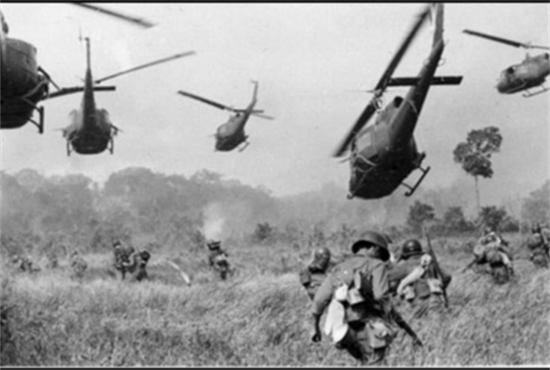 |
| US heliborne deployment during Sa Thay Campaign (photo: qdnd.vn) |
On our side, acting upon the directive of the Central Military Commission, the Central Highlands Front Command resolved to launch an offensive campaign against the enemy in Sa Thay area - Sa Thay Campaign. This was aimed at inflicting attrition upon and annihilating a significant portion of the enemy’s effective strength, particularly US troops, and supporting the masses’ movement to break the enemy’s occupation. Simultaneously, it sought to draw in and pin down US strategic mobile forces within the mountainous and forested terrain of the Central Highlands, thereby creating favourable conditions for our Military and people across the South Vietnam theatre to defeat the enemy’s second strategic counter-offensive. Consequently, the Sa Thay Campaign achieved a resounding victory, partially defeating the enemy’s scheme to seize the initiative in the Central Highlands theatre. Most notably, the Campaign became a quintessential model of military deception and “lure-and-trap” tactics, which is demonstrated through several distinct features as follows.
First, firmly grasping the enemy’s operational patterns and tactics, accurately determining the provocation target. In order to devise plans, establish the posture, decoy and lure the enemy into disadvantageous areas, render them unable to exploit their strengths, and force them to fight on our terms, the Campaign Command directed reconnaissance forces, in coordination with local armed forces, to firmly grasp the characteristics, operational patterns, and combat tactics of the US military, particularly their air assault tactics. This served as the basis for formulating the operational plan. Accordingly, upon detecting our main units, the enemy would employ “heliborne” tactics to land troops on our flanks and in our rear to encircle and cut off our retreat, combined with deep-penetration commando forces launching convergent attacks. If the counter-attack failed, they would continue to air-drop troops deep into the campaign area to destroy our logistics and technical bases, severing our support and supply lines to the frontline forces. However, the US 4th Infantry Division had newly arrived in Vietnam; their combat morale was not high, and they feared night combat, close-quarters combat, and interspersed combat. They applied heliborne tactics in a rigid and mechanical manner; their aviation and artillery firepower could not be deployed effectively when they engaged in close-quarters and interspersed combat, and they often relied heavily on supporting firepower. In practice, through grasping, studying, and accurately assessing the enemy situation, the Campaign Command and its agencies promptly anticipated and finalised the combat determination. They determined suitable combat methods, organised the utilisation and deployment of forces and materiel reasonably, created a lethal battle posture, and employed military deception and “lure-and-trap” measures with high efficacy.
To lure the enemy out of their bases, the Campaign Command selected Plei Gi-rang commando camp - the rear base of the US 4th and 25th Infantry Divisions - as the provocation target. This was a crucial link in the enemy’s defensive system, tasked with providing early warning and interdicting the transport and supply lines of our Military and people to the Central Highlands front. The enemy forces at this commando camp were thinly stretched; consequently, when being attacked and besieged, they would lack the strength to mount their own counter-attack and would be compelled to call upon other forces for rescue and relief. If we skilfully provoked them and applied sufficient pressure, we could lure US troops into a mobile rescue and relief operation. Furthermore, the terrain from the west of the Plei Gi-rang stronghold to the Vietnam - Cambodia border was exceedingly treacherous, with alternating high and low mountain ranges forming valleys, deep ravines, and dense forests. This created a system of natural obstacles that restricted the manoeuvrability of mechanised vehicles, meaning the enemy could not counter-attack by land, leaving air assault as their sole option. Conversely, the treacherous, mountainous terrain assisted us in organising and deploying forces while ensuring secrecy, thereby achieving the element of surprise in combat.
Exactly as anticipated, after Regiment 95 besieged and shelled the Plei Gi-rang stronghold to initiate the Campaign, the enemy immediately mobilised the US 4th Infantry Division to conduct an air assault into Sa Thay area in a bid to “search and destroy” main units of the Liberation Army. This created the conditions for our units to launch offensives to annihilate a portion of their effective strength, step-by-step luring the enemy deep into the Campaign’s battle posture.
Second, establishing a deep and lethal battle posture, forming “echelons” of enemy annihilation. The main operational area of the Campaign covered approximately 500 square kilometres, from Route 15 to the Vietnam - Cambodia border, and from Sung Le to Sung Thien. To facilitate command and combat coordination, the Campaign Command divided the main operational area into four zones: A, B, C, and D, deploying forces and means to form “echelons” of enemy annihilation. Accordingly, Zone A was situated east of Po Ko River; here we deployed Regiment 9 to conduct provocation attacks, besieging and applying pressure on the Plei Gi-rang stronghold in order to lure the enemy into Zone B.
Zone B was located behind Zone A, where Regiment 320 was tasked with engaging the enemy’s counter-attacks and continuing to provoke and lure the enemy into air-dropping troops into Zone C. Thus, Zones A and B were considered the first “echelon”; this was where provocation activities and small-scale, isolated battles took place to attrite each enemy platoon and company, generating initial reactions to stimulate and lure the enemy deeper into our battle posture. Zones C and D (the decisive battle zones) constituted the second “echelon”, located west of Sa Thay River; this was where the key battles and decisive key battles of the Campaign were planned. Here, the Campaign Command deployed the main forces of Division 1, specifically: Regiment 88 in Zone C, Regiment 66 in Zone D; the 120mm mortar battalion and the 12.7mm anti-aircraft machine gun battalion served as general support forces, aimed at creating a superiority in strength sufficient to launch large-scale battles of annihilation against US troops and achieve the set objectives of the Campaign.
This method of establishing a battle posture into “echelons” of enemy annihilation with escalating scale, tempo, and intensity was a distinctive feature of the “lure-and-trap” art; it was suited to the heavily compartmentalised terrain and the enemy’s air assault patterns and tactics. All the zones, despite having different missions, were closely linked with and reinforced one another; the combat results in one zone served as the foundation for conducting operational activities in the zones behind it. Furthermore, units in the rear provided support and reinforcement for those at the front, creating a deep, formidable, solid battle posture.
Additionally, the Campaign Command directed Regiments 66, 88, and 320 to organise a system of platoon- and company-sized strongpoints and seize tactically valuable terrain within their respective operational areas to create an interlocking posture and isolate enemy forces. These strongpoints of varying scales added an element of initiative in luring and decoying the enemy and in selecting the battle space; they assisted the Campaign Command in more accurately anticipating options for engaging the landing enemy - a crucial requirement in anti-air assault operations.
Owing to an excellent battle posture, we successfully lured the 2nd Battalion of the 2nd Brigade, 4th Infantry Division, along with several US commando and heavy weapons companies, into air-dropping in Zone C; their landing areas closely aligned with our anticipated plans, presenting a favourable opportunity for Regiment 88 to launch assaults, annihilate hundreds of US troops, and destroy numerous weapons and helicopters.
Third, flexibly, creatively applying measures of deception and decoying. In the Sa Thay Campaign, deception operations were organised in various forms and measures. During Phase 1 of the Campaign, alongside executing the provocation attack to put pressure on the Plei Gi-rang stronghold, we utilised engineering and signal forces in coordination with Regiment 95 to build 2 suspension bridges across Po Ko River and deploy wired communications lines running along the west of Po Ko River. Simultaneously, we constructed dummy positions, lit fires, generated smoke, detonated explosives, and so forth. These activities misled the enemy into believing that our main units were preparing for a heavy assault on the Plei Gi-rang stronghold. Consequently, they hastily deployed forces from the 4th Infantry Division to counter-attack in an attempt to execute their “search and destroy” intent, creating favourable conditions for us to realise our operational plan.
Moving into Phase 2, the Campaign Command moved Regiment 320 back to Zone B. Relying on the strongpoint system, they organised mobile offensives to fight small, isolated engagements. The Campaign Command also directed units to speed up the building of dummy bridges across Sa Thay River, construct dummy positions in Zone D, and generate smoke in Zone C, with a view to resolutely luring the enemy deep into the decisive battle zone to execute the key campaign battles. These flexible and creative deception measures, gradually increasing in intensity, distracted the enemy and forced them to make a critical decision: “Only by deploying combat troops to jump into battle on the battlefield chosen by the adversary is there hope of finding the target and carrying out the ‘search and destroy’ intent against main units of the Liberation Army”. Therefore, they simultaneously deployed forces from the US 4th Infantry Division, the 25th Infantry Division, and the 1st Cavalry Division (Airmobile) to join the battle.
Furthermore, the Campaign Command directed units to strictly adhere to secrecy regulations and organise camouflage for field fortifications to avoid being detected by enemy means of reconnaissance and observation. As a result, the moment enemy troops landed, before they could establish a firm foothold, they received a staggering blow by us, thereby suffering a swift defeat.
The “lure-and-trap” art of our Military and people in the Sa Thay Campaign constitutes valuable experience that retains its full value to this day, requiring continued study and application in training and combat.
Col. LE DINH TRUNG, PhD
Faculty of Military Pedagogy
Infantry Officer College No.1