Combat support for the artillery - missile force is an important part of the art of artillery - missile operations, directly contributing to enhancing the firepower and combat strength of this key force. In countering enemy strategic airborne landings, such support is exceptionally demanding and fraught with difficulties, thus requiring thorough research and consideration.
In a war to defend the Fatherland (should it occur), the enemy may conduct strategic airborne landings either at the outset or in the course of their invasion, seeking to attack and rapidly control key targets, such as political, military, and economic centres, airfields, and seaports. Through such actions, they seek to divide and disrupt our strategic defensive posture to achieve their strategic- and operational-level objectives.
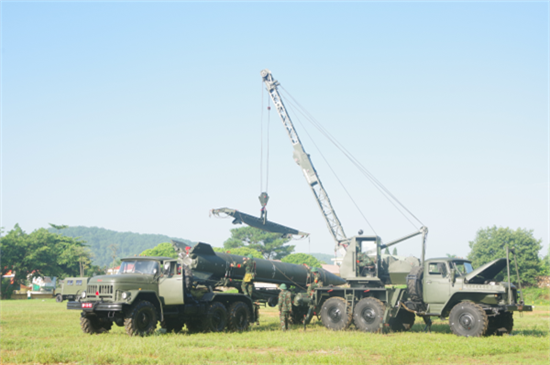 |
| Technical support for Scud-B systems |
Countering enemy airborne landings is an extremely complex task requiring extensive fire support. Yet the strength of our artillery - missile force is limited, and our force has to operate under intense enemy troop assaults, fire strikes, and widespread electronic warfare. To accomplish the task, our force must resolve numerous issues in the organisation, preparation, and conduct of operations. In this regard, combat support is of particular importance, as it directly determines the ability to maintain and bring into full play combat power of the artillery - missile force.
Combat support for the artillery - missile force covers many areas. Within the scope of this article, the author would like to put forward several key issues as follows.
1. Ensuring reconnaissance and survey support
This is one of the foremost aspects of combat support, intended to provide commanders and artillery - missile agencies at all levels with information on the enemy, our forces, and the area of operations. It serves as the basis for opportune operational decisions and plans and for the accurate calculation of firing data. In countering enemy strategic airborne landings, one or several campaigns and engagements may be carried out simultaneously or successively over a wide area and through diverse tactical forms. Operations are likely to be intense, with rapidly changing, unexpected, complex situations. Hence, to provide effective reconnaissance and survey support and accurate firing data for the artillery - missile force, the battlefield artillery - missile command must closely follow the battlefield command’s operational intent to develop its own operational decision and combat support plans. These should include plans for reconnaissance, enemy monitoring, survey, firing-data calculation, target designation, and assessment of firing results.
Given the enemy’s high mobility and the rapidly changing situation, the battlefield artillery - missile command and its units must thoroughly study the area of operations and prepare plans for command observation posts, auxiliary observation posts, and mobile deep-penetration reconnaissance teams interconnected with command posts and firing positions to form an integrated, concealed, resilient system for each counter-airborne landing scenario, with priority given to the main plan. At the same time, they must maintain close, continuous coordination with staff agencies at all levels, intelligence and reconnaissance forces, and local people to collect and cross-check information, thereby improving the timeliness and accuracy of reconnaissance, survey, and firing-data determination in each phase and for each task of engaging the enemy at landing sites and zones.
To ensure effective reconnaissance and survey support, preparations must be made in peacetime. In addition to procuring, producing, and providing new, modern reconnaissance and survey equipment and establishing a multi-layered, multi-domain reconnaissance network comprising surveillance radars, counter-battery radars, UAVs, electro-optical systems, and satellite imagery, the Artillery - Missile Command (AMC) should work with and direct artillery - missile agencies of military regions, army corps, and localities to proactively build a widespread, interconnected, resilient artillery - missile posture. This includes identifying locations for observation posts, command posts, and firing positions and densifying artillery - missile control networks, especially in strategic directions and areas where the enemy is likely to conduct strategic airborne landings, with a view to enabling the artillery - missile force to operate effectively when situations arise.
2. Ensuring fortifications, camouflage, deception, and protection against enemy high-tech weapons
Artillery - missile positions and activities are easily detected and constitute chief targets for the enemy’s search-and-destroy efforts. Therefore, providing fortifications, camouflage, deception, and protection against enemy high-tech weapons for the artillery - missile force is of special importance to concealing operational intent, preserving the strength of the force, maintaining combat power, and increasing the effectiveness of fire strikes against the enemy.
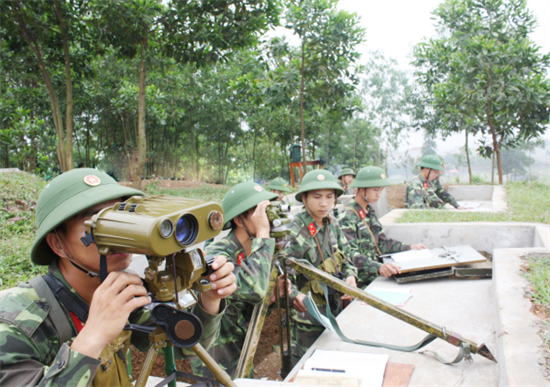 |
| A training course designed for artillery reconnaissance troops |
To that end, the AMC, battlefield artillery - missile agencies, and commanders and units at all levels must thoroughly grasp and effectively implement the policy of preparing fortifications and positions early and right in peacetime, in close association with the building of defensive zones and the people’s war posture for Fatherland protection under each anticipated counter-airborne landing scenario and in each relevant area. In the process, commanders, agencies, and units must closely combine military works with natural terrain, caves, underground facilities, and existing infrastructure to create interconnected, concealed, resilient, in-depth systems. Along directions and in areas where enemy strategic airborne landings are anticipated, primary, reserve, and decoy positions, concealed manoeuvre routes, and protective works for command posts, depots, and artillery - missile logistics - technical bases should be gradually developed.
Alongside the construction of fortifications and defensive positions, artillery - missile units must organise camouflage and deception systematically and scientifically. Attention should be paid to flexibly combining traditional measures with modern technical solutions, such as infrared-resistant camouflage nets, radar-absorbing materials, heat-signature suppression for prime movers and missile launchers, and smoke screens, so as to neutralise enemy high-tech radars, thermal imaging sensors, and UAVs. At the same time, deception operations should be actively carried out under the principle of “concealing the real and displaying the fake”. Units must also enhance their ability to manoeuvre and rapidly displace equipment and positions, apply rapid deploy-fire-displace procedures to fire quickly, accurately and withdraw promptly to preserve their strength.
The workload required to provide fortifications, camouflage, deception, and protection against enemy high-tech weapons is heavy, mainly concentrated in the immediate, time-compressed preparation phase. Thus, right in peacetime, the AMC should coordinate with and direct the artillery - missile force across the Military to construct and prepare in advance part of the fortification and position system under the plans for countering enemy strategic airborne landings. Priority should be given to constructing solid fortifications and combat works for command posts and firing positions of operational- and strategic-level artillery - missile units. Greater investment is required in mobile engineering equipment, modern fortification materials, camouflage means capable of countering enemy high-tech reconnaissance, and equipment for rapid manoeuvre. Besides, training should be intensified to ensure that troops are proficient in building fortifications, establishing field positions, manoeuvring in dispersed formations, conducting camouflage and deception, and operating under intense electronic suppression or persistent UAV surveillance. Doing so will enable our troops to flexibly respond to enemy attacks and sustain their combat power.
3. Ensuring communications and countering enemy cyber and electronic warfare
Recent military conflicts have shown that a unit may remain physically intact yet be rendered combat-ineffective when its command communications system is electronically suppressed or destroyed. Hence, ensuring uninterrupted, timely, reliable communications for the artillery - missile force in countering enemy strategic airborne landings is of special importance to seizing and maintaining the operational initiative.
Accordingly, commanders and artillery - missile agencies must formulate communications assurance plans scientifically. Multiple means, channels, and support plans should be combined to maintain command and coordination communications across both the preparation and conduct of operations. In the process, technical and tactical measures must be applied synchronously to safeguard equipment, protect transmission security, and keep command and coordination networks continuous and uninterrupted.
Operations to counter enemy strategic airborne landings during strategic defensive operations are carried out within a highly developed people’s war posture. Alongside communications plans directly for the artillery - missile force, it is therefore necessary to bring into full play the combined strength of supporting forces, particularly specialised electronic and cyber warfare forces. Furthermore, to meet the requirements of communications in the new conditions of a war to defend the Fatherland, the AMC must give advice on the procurement and modernisation of new-generation communications equipment suited to each echelon. Priority should be given to supplementing mobile communications vehicles integrating satellite, microwave, radio, wired, and fibre-optic means and links along each direction and in each area, thereby creating a network of sustainable communications nodes. Exercises of different scales and operational forms should be organised to improve the capacity to ensure communications and counter electronic warfare.
4. Ensuring logistics and technical support
Operations to counter enemy strategic airborne landings during strategic defensive operations may continue for a prolonged period, generating very high demands for supplies, weapons, and technical equipment, especially ammunition. To effectively perform this important aspect of support work, battlefield artillery - missile agencies and unit commanders must formulate scientific logistics - technical support plans for each scenario and area. They must establish echeloned reserves of supplies, maintain close coordination, flexibly apply appropriate support methods and measures, and enhance the mobile support capacity of logistics - technical forces, particularly for the replenishment of ammunition and fuel. To that end, right in peacetime, the AMC should continue to undertake research to give advice to the Central Military Commission and the Ministry of National Defence on adjusting the disposition of the artillery - missile force in a scientific, appropriate manner in each strategic area, especially strategic reserve artillery - missile brigades. This also entails preparing a system of warehouses, logistics - technical bases, manoeuvre routes, and artillery - missile positions in accordance with operational plans to meet the requirements of modern, high-intensity combat.
Providing combat support for the artillery - missile force in countering enemy strategic airborne landings during strategic defensive operations in a war to defend the Fatherland involves an enormous workload and numerous challenges. Therefore, this issue should continue to be studied thoroughly in both theory and practice in accordance with the requirements of modern warfare, with the aim of improving the combat power and capacity of the artillery - missile force in the new context of a war to protect the Fatherland.
Maj. Gen. BUI NGOC TUYEN
Political Commissar of the AMC