
Defence and security education for students - the future masters of the country - holds extremely important significance. In response to the requirements of Fatherland construction and protection in the new situation as well as the fundamental and comprehensive reform of education and training, Ho Chi Minh City University of Industry and Trade has always paid attention to leading, directing, and effectively performing this important work.
Ho Chi Minh City University of Industry and Trade is a public tertiary education institution under the Ministry of Industry and Trade (MoIT), providing multi-disciplinary and multi-field training in industry and commerce. Over the years, the University has been fully autonomous in delivering the subject of defence and security education, with an annual enrolment of 4,800 - 5,000 students.
Students are a youthful, aspirational force with the ability to acquire modern knowledge, science, and technology, serving as an important resource in national construction and defence. They are also individuals in the process of maturity and personality development; without proper education and orientation in political ideology, ideal, knowledge, skills, and responsibility for the cause of national construction and defence, they easily fall into misperceptions and political apathy, especially under the negative impacts of the market economy, social media, and hostile forces’ propaganda, incitement, and manipulation efforts. Fully aware of this reality, alongside improving specialised training, the University has attached importance to directing the enhancement of the quality of defence and security education in accordance with the Law on Defence and Security Education, thereby achieving positive results.
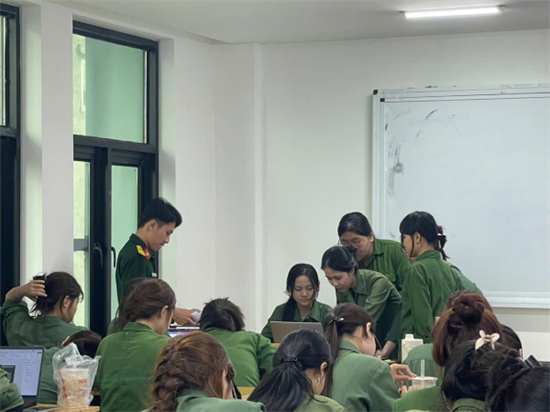 |
| Defence and security education at a training hall |
Over the past five years, more than 99% of students have met the requirements of this important subject; over 75% have achieved good or excellent results. Most students, after completing the subject, have possessed basic knowledge of the Party’s lines and the State’s policies and laws on defence and security, developing political steadfastness, demonstrating a strong sense of discipline and responsibility in Fatherland construction and protection.
To achieve these results, the University has first focused on building a team of lecturers and managers of defence and security education subject who meet standards in qualifications and capacity. It has given advice to the MoIT on recruiting lecturers holding a second degree in defence and security education from institutions such as Ho Chi Minh City University of Education and Tran Dai Nghia University, as well as selecting officers with great knowledge, capability, experience, and professional passion from Infantry Officer College No.2. Annually, based on its organisational structure and practical needs, it has proactively developed plans for lecturer training, development, and utilisation, ensuring sufficient quantity, high quality, and a reasonable structure to meet its teaching requirements.
To update knowledge of defence and security, the University has regularly organised training courses, requiring each lecturer to participate in at least one professional training session organised by the Ministry of Education and Training (MoET) and one pedagogical training session held by the University itself each year. It has strictly maintained professional activities, conducting trial lectures, promoting the emulation movement of “good teaching, good learning”, organising “Excellent Lecturer Contests”, sending its lecturers to work at units and localities, encouraging self-study among its staff to improve their comprehensive competence. In addition, it has focused on effectively promoting academic activities, creating a favourable environment for cadres and lecturers to share and acquire knowledge, enhance their professional expertise, and accumulate experience. Appropriate remuneration policies have been implemented to retain and attract personnel with good moral qualities and great professional competence. With these synchronous measures, to date, 100% of lecturers and managers of defence and security education subject have held master’s degrees or higher, possessing qualities, capacity, and working methods that meet the specific requirements of the subject.
The subject of defence and security education is a difficult one, highly specialised, and delivered within a short period; therefore, innovating teaching and training content and methods is an urgent and important requirement for improving education quality. Grasping and following Circular 05/2020/TT-BGDĐT, dated 18 March 2020, by the MoET promulgating the defence and security education programme in intermediate pedagogical schools, pedagogical colleges, and tertiary education institutions, the University has advocated innovation towards comprehensive development of qualities and capacities. In terms of content, emphasis has been placed on equipping students with basic knowledge of the Party’s lines and viewpoints, and the State’s policies and laws on all-people national defence and people’s security, the tradition of the nation and the armed forces, Vietnamese military art, the building of an all-people national defence posture associated with the people’s security posture, the building of the people’s armed forces, responsibilities in fulfilling military and public security obligations, and students’ role in the fight against hostile forces’ exploitation of ethnic and religious issues to undermine the Vietnamese revolution. At the same time, students have been trained in military regulations and etiquette, and equipped with basic skills in individual military techniques and tactics during combat, including the use of some common infantry weapons and AK gun shooting techniques.
 |
| A training session on gun shooting techniques |
Methodologically, the University has concentrated innovation on the “learner-centred” principle, promoting dynamism, initiative, and creativity, helping students grasp fundamental knowledge as a basis for application in practical conditions. To date, it has redesigned over 90% of lessons using new methods to facilitate students’ active knowledge acquisition; 100% of theoretical lectures have been turned into electronic ones. In the teaching process, lecturers have been required to thoroughly study the characteristics of target groups to prepare content and methods properly; emphasis has been placed on organising extracurricular activities such as military games and cultural exchanges to reduce rigidity and boredom, and stimulate learners’ interest. Students have been guided to collect and study materials, update domestic defence and security news and international political affairs, thereby building correct political awareness, viewpoints, and understanding of defence and security among students.
For military content, training has been organised through classroom simulation and field practice so that students could observe and practise directly, understand the structure, features, and use of common weapons, grasp basic technical and tactical combat movements; besides, combat experience and creative methods of situation handling have been delivered for practical application. Centralised training has been effectively organised to maintain discipline in a military environment; training has been closely combined with discipline management and physical training to form students’ working style, sense of discipline, teamwork spirit, and military skills. As a result, upon completing the course, students have generally acquired necessary military and security skills, showing a good sense of discipline, improving their physical fitness, fostering a spirit of readiness to devote themselves to the cause of Fatherland protection.
To effectively implement Circular 19/2022/TT-BGDĐT, dated 22 December 2022, by the MoET promulgating the list of minimum teaching equipment for the subject of defence and security education, the University has mobilised resources to modernise its facilities and equipment serving the subject. Recognising this as a fundamental and long-term solution, alongside receiving weapons and technical equipment such as modified AK guns, MBT03 training shooting machines, CKC rifles, B40 and B41 launchers, RPD light machine guns, training grenades, and target systems, in recent years, the University has used its own budget to invest in facilities and equipment appropriate to the requirements of the subject, especially practical training models and uniforms, upgrading lecture halls, training grounds, and specialised classrooms, supplementing textbooks, newspapers, reference materials, projectors, fire and explosion warning devices, and display cabinets for infantry weapons. Notably, it has invested in a 1.6-hectare training area, including a 2,000 m² artificial grass drill ground, a 2,500 m² tactical field, a 3,000 m² shooting practice range, and a 1,000 m² grenade throwing area.
To improve students’ living and training conditions, the University has focused on upgrading its central dining hall at the dormitory to serve 450 students per meal, improving dormitory facilities located more than 500 metres from the main campus and training grounds; each floor has 12 rooms organised into one company, with each room corresponding to one squad (10 students); all floors and rooms are equipped with boards and regulations in accordance with military standards.
In addition to the above solutions, the University has directed the Faculty of Physical Training and Defence and Security Education to focus on building a healthy military pedagogical cultural environment, creating favourable conditions for students to study and train, considering this a motivational and appropriate solution to raise the quality of this subject. With the motto “Building a disciplined, united unit with good teaching and good learning”, the Faculty has innovated methods of managing students suited to their age groups, maintaining daily and weekly routines, helping students approach the military environment. It has closely combined study with training, aligning formal education with extracurricular activities, effectively maintaining visits to military units and historical sites. It has regularly coordinated with local authorities to organise activities such as incense offering to commemorate fallen heroes, volunteer activities, and military, sport, and cultural events to strengthen solidarity and create a healthy educational environment, encouraging students to self-train, strictly comply with regulations, and mature after completing the programme.
By synchronously implementing the above solutions, Ho Chi Minh City University of Industry and Trade has successfully fulfilled its assigned tasks, practically improving the quality of defence and security education for students, developing a young generation with political steadfastness, strong will, a strong sense of discipline, and willingness to perform defence and security tasks, contributing to building strong, modern all-people national defence and people’s security and firmly safeguarding the Socialist Vietnamese Fatherland in the new era - the era of the nation’s rise.
Associate Prof. NGUYEN XUAN HOAN, PhD
Rector of the University