
Resolution No. 80-NQ/TW, dated 07 January 2026, of the Politburo (13th term) on the development of Vietnamese culture stipulates that: “Human and cultural development is the foundation, an important endogenous resource, a great driving force, a pillar, and a regulator for the rapid and sustainable development of the country”. This viewpoint both inherits and develops the previous ones, while reflecting the strategic vision of our Party on the role of culture in the new era of development of the country.
In the development of nations in general, and Vietnam in particular, culture is not only the crystallisation of national history, tradition, and identity, but also plays a particularly important role in guiding, promoting, and regulating the development. Therefore, fully understanding and leveraging the role of culture represent a strategic requirement to create a solid foundation for the country's rapid and sustainable development.
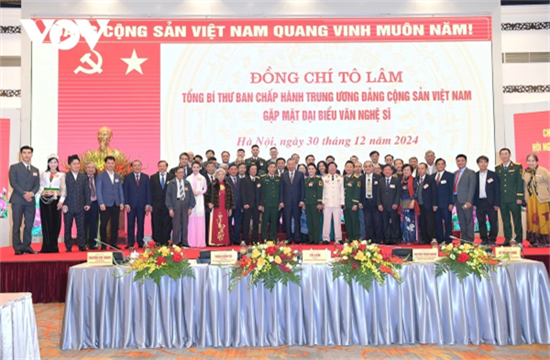 |
| Party General Secretary To Lam meets with artists in 2024 |
Culture as a solid foundation
Culture, in essence, is a system of material and spiritual values generated and accumulated by humankind throughout history. Among those, core values such as human standards, family values, cultural norms, national values, etc., form a solid foundation for the existence and development of nations.
President Ho Chi Minh clearly stated that: “Culture illuminates the way for nations”. Resolutions of our Party throughout various periods also affirm that culture is the spiritual foundation of society, a part of the superstructure, and profoundly influences the spiritual life and development of society. Over the past 40 years of reform, the Party has perceived the role of culture in an increasingly comprehensive and profound manner. Resolution No. 80-NQ/TW has decided on developing culture into a truly solid foundation for the country's rapid and sustainable development. This viewpoint represents the Party's new vision and is consistent with President Ho Chi Minh's thought, when he soon pointed out five major aspects in building the national culture.
As a foundation, culture guides all social activities and human behaviour, strengthens national unity, enhances social trust, and maintains political stability. At the same time, it regulates how people think, act, and behave, thereby shaping the model of development. A healthy culture will lead the society towards humane and progressive development. In contrast, if it is eroded, the society is prone to trust crisis, distorted values, and unpredictable consequences.
Culture as a crucial endogenous resource
Unlike tangible resources such as capital, technology, or natural resources, which can be diminished or depleted, culture is a unique endogenous resource capable of regeneration and development if it is nurtured, preserved, and promoted in the right direction. This resource is embodied in the values, beliefs, behavioural standards, and intellect of the people – elements that constitute a nation's “soft power”. Practical experience shows that a progressive culture will foster individuals with high levels of knowledge, morality, willpower, and social responsibility. This is such an abundant source of “soft energy” that influences the quality of growth, governance efficacy, and the enduring competitiveness of the economy.
Amid the increasingly deep international integration, while national competitiveness does not rely solely on resources or capital, culture is increasingly asserting itself as a sustainable resource with strong regenerability. Cultural industry, creative economy, cultural tourism, etc., are becoming new pillars of growth, directly contributing to GDP and enhancing the nation's standing. In this spirit, Resolution No. 80-NQ/TW of the Politburo aims that: By 2030, cultural industry will contribute 7% of GDP; By 2045, cultural industry and creative economy will truly become pillars of sustainable development, contributing 9% of GDP; Vietnam will be in the Top 3 in ASEAN and Top 30 globally in national soft power index and the value of cultural industry exports.
 |
| Artists march at the A80 National Parade in 2025 |
Culture as a powerful driving force
This perspective reflects a significant change in the Party's thinking of the role of culture. Besides its role as endogenous resources, culture is also a powerful driving force promoting national rapid and sustainable development. Culture not only “exists” but always “evolves”, generating inner strength in each individual and society as a whole, i.e. the rising aspiration, the innovative spirit, and the national self-reliance.
A healthy cultural environment will inspire the dedicating spirit and social responsibility, transforming them into action in labour and production, while guiding development policies towards a humanity and harmony between economic growth with social progress and equity, and between modernisation and the preservation of national identity. In the context of deep integration, culture becomes a driving force, enhancing national standing and contributing to attracting external resources. When cultural values permeate all aspects of social life, they will create “soft energy” that promotes reform, improves governance efficiency, and enhances national competitiveness. Therefore, Resolution No. 80-NQ/TW requires that all plans, projects, and programmes be included with cultural considerations, synchronous with breakthrough policies on economic, educational, technological development, and digital transformation, etc.
Culture as a pillar of development
Resolution No. 80-NQ/TW of the Politburo identifies culture as one of the pillars of sustainable development, ensuring harmony between economic growth and social progress. A disregard of culture can lead to unbalanced development, resulting in negative consequences such as widening the rich-poor gap, moral decay, and a crisis of values. Conversely, when culture is paid due attention, it will guide development towards a humane, sustainable, inclusive direction and protect national identity in the process of integration.
Adhering to this viewpoint, we should resolutely avoid the tendency to pursuit pure economic development. Instead, culture should be treated equally to economics, politics, and society. Investing in culture is investing in the sustainable development of the country and the future of the nation. At the same time, it is necessary to emphasise the role of human beings as the centre, subject, goal, and most important driving force of sustainable development; maximising the value and strength of Vietnamese culture and people in the new era.
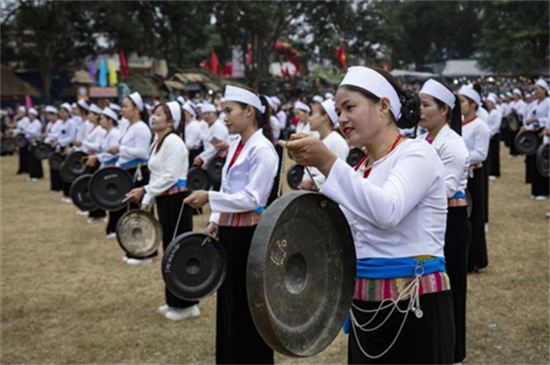 |
| A unique cultural performance of the ethnic minority group in Phu Tho province |
Culture as a regulating system for development
This is a theoretical highlight in Resolution No. 80-NQ/TW of the Politburo on culture. It has been proved that, among the components of development, culture is the regulator that ensures the right, harmonious, and sustainable development. Without the regulation of culture, development may well deviates from the right track, pursuing pure economic growth, neglecting humanistic values, and leading to negative consequences for the society, the environment, and the people.
As a system of values, norms, and a “filter”, culture guides, controls, and regulates the behaviour of development actors, from policy making to implementation. Culture helps balance immediate and long-term interests, economic development with social justice, and international integration with national identity preservation. Simultaneously, it helps building a healthy and disciplined development environment, emphasising accountability, integrity, and public service ethics. In the condition of a socialist-oriented market economy, culture becomes even more important as contributing to mitigating the negative aspects of the market mechanism and preventing ideological, moral, and lifestyle degradation. It can be said that culture is not only the “foundation” but also the “compass” and “soft regulator” for the entire development process. When culture is permeated in social life, it will not only ensure the rapid development but also keep it on the right track, sustainable, and humane.
To ensure that culture always upholds its role as a foundation, a crucial endogenous resource, a powerful driving force, a pillar, and a regulating system for the rapid and sustainable development of the country in the new era, it is necessary to implement many strategic solutions simultaneously, focusing on the following ones:
First, perfecting institutions and raising awareness of the role of culture. First and foremost, it is necessary to institutionalise all the viewpoints of Resolution No. 80-NQ/TW of the Politburo into a specific, synchronised, and feasible system of cultural policies. Culture must be placed on par with economic, political, and social factors in the making of development policies. At the same time, it is necessary to raise awareness of the entire society, especially of leaders and managers, about the role of culture. This is a prerequisite for culture to truly become the “permanent pillar” in the national development strategy.
Secondly, developing Vietnamese people comprehensively, meeting the requirements of new era. People are both the subject and the target of cultural development. Therefore, it is necessary to focus on building a system of values of Vietnamese people in the new era with core qualities, such as: patriotism, solidarity, self-reliance, compassion, honesty, responsibility, self-discipline, and creativity. Education and training play a crucial role in this process. Emphasis should be placed on building healthy cultural environments in families, schools, workplaces, and communities. When people are developed comprehensively, culture will become the most powerful endogenous resource.
Thirdly, promoting the development of cultural industries and the creative economy. This is a crucial direction for transforming cultural potentials into specific economic values. Accordingly, the Government should have incentives for investments and innovations in fields such as film, music, fine arts, design, cultural tourism, etc. The combination of tradition and modernity will bring about high-value cultural products that meet domestic needs while also being internationally competitive.
Fourth, building a healthy cultural environment and strengthening the regulatory role of culture. In the context of increasingly deep international integration and digital transformation, special attention should be paid to building a cultural environment in cyberspace to disseminate positive values while strengthening management and guidance of cultural and media activities to limit negative impacts. Culture must truly become a “soft regulatory system”, helping the society run stably, smoothly, and humanely.
In addition, it is necessary to effectively leverage the role of the community in preserving and promoting cultural values to harness a combined national strength so that culture always remains the foundation, an important endogenous resource, a great driving force, a pillar, and a regulatory system for the rapid and sustainable development of the country in the new era.
Senior Colonel, Dr. NGUYEN THI THANH NGA, Deputy Head of the Department of Theatre, Cinema and Creative Writing, Military University of Culture and Arts