
During the North Phu Yen Campaign, despite confronting the most elite and battle-hardened forces of the US military, our armed forces and people, employing the outstanding art of siege and ambush, dealt a devastating blow to the enemy and diminished both their strategic posture and strength across Military Region 5 battlefield, laying the groundwork for victory in the second dry-season strategic counter-offensive.
Following their devastating defeat in the first dry-season strategic counter-offensive (1965 - 1966), the US and puppet forces suffered massive losses in manpower and materiel; troop morale plummeted, and infighting among factions within the puppet regime intensified. However, driven by their obstinate and belligerent nature, they continued to increase troop numbers, consolidate and adjust their force deployment, bolster the Saigon puppet army, and feverishly prepare for the second dry-season strategic counter-offensive, vainly attempting to achieve their “search and destroy” and “pacification” strategy.
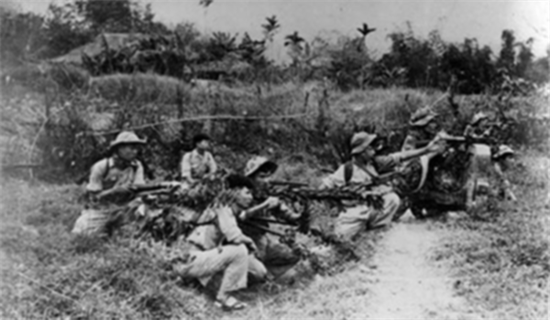 |
| Combating the enemy’s airborne forces (file photo) |
On our side, thoroughly grasping the directive to “continue maintaining and developing the strategic offensive posture” issued by the Party Central Committee, Military Region 5’s Party Committee and Command decided to launch the North Phu Yen Campaign. The aim was to attrite and annihilate a significant portion of enemy manpower, create conditions to intensify guerrilla warfare, support the political struggle of the masses, and foster the tactical coordination of the three-category armed forces. With a courageous, resourceful, and creative fighting spirit, coupled with a unique operational art, our troops and people dealt the enemy a critical blow, thereby degrading their posture and strength on Military Region 5 battlefield. The victory of the North Phu Yen Campaign marked a new leap forward in the art of siege and ambush, which is manifested in several key aspects as follows.
First, the accurate selection of the siege target. Adhering closely to the guiding principle of siege and ambush - with a primary focus on engaging the enemy outside their fortifications and executing the tactic of “attacking where there is no citadel, fighting where there is no battlefield” - the Campaign Command identified the strongholds of Hon Ba Co, Hon Ba Nac, and Hon Ngang as the siege targets. This was a precise choice founded upon meticulous study and assessment of the enemy’s situation, our own posture, and the topography of the operational area, demonstrating the sharp tactical thinking and vision of the Campaign Command and its staff. These strongholds held a crucial position, commanding Route 6 and acting as vital links in the enemy’s interconnected force deployment in the North Phu Yen area. Securing this area would sever communications on Route 6, directly threatening National Highway 1, Dong Tre Training Centre, and La Hai base - a critical link in the US-puppet disposition in the South Central Coast - thereby jeopardising the enemy’s posture along their strategic lines of communication. This was precisely a vital choke point; our attack would shatter the enemy’s interconnected deployment, forcing the US military not to “stand idly by” but to dispatch mobile forces for relief and rescue. Furthermore, the puppet troops garrisoned in these strongholds comprised civil guards and commandos with limited combat capabilities and declining morale. Thus, an attack would guarantee a certain victory, preserving our manpower and materiel for subsequent battles. In addition, the topography of this area was complex; it predominantly consisted of villages and paddy fields interspersed with hills and mountains, providing us with ideal conditions to establish ambush positions to annihilate enemy land-based relief forces. The interlacing of various large and small high grounds facilitated the construction of battlefield fortifications, the deployment of combat equipment, the concealment of troops, and our plans to deal with enemy airborne assault scenarios, and so forth.
Indeed, during the Campaign, upon our assault and annihilation of Hon Ba Co and Hon Ngang strongholds, we subsequently established an ambush zone stretching from Hon Ngang to Hon Mot. This compelled the enemy in Dong Tre and La Hai to mobilise relief forces, which were then heavily mauled by our troops. Our assault in Hon Ba Nac stronghold, combined with an artillery bombardment of Dong Tre Training Centre immediately triggered a chain reaction from the enemy. They dispatched a battalion of the puppet 47th Regiment to occupy the areas of Chi Thanh, Hon Don, and Phong Nien to protect National Highway 1. Concurrently, they deployed the US 101st Airborne Division and the 1st Cavalry Division (Airmobile) to conduct airborne assaults in the areas of Dong Tron, Go Thi Thung, and Hill 258 where we had already set up our ambush. This created highly favourable conditions for successfully executing key engagement and securing victory for the Campaign.
Second, the establishment of a lethal tactical posture and the execution of flexible battlefield transformations. While our troops’ combat capabilities remained largely limited, the enemy possessed overwhelming superiority in modern weaponry and equipment, rapid heliborne mobility, and extensive fire support; the decisive factor ensuring the success of the Campaign were our establishment of tactical posture and manoeuvrability to disrupt enemy posture and lure them out of their fortifications. Therefore, the Campaign Command directed the local armed forces of Tuy An and Dong Xuan districts to actively interdict lines of communication, sabotage bridges and roads, and restrict the enemy’s overland relief capabilities. Simultaneously, Regiment 10 and Battalion 85 deployed ambush positions along the stretch from Hon Ngang to Nui Mot, repelling the enemy’s overland relief operations. By resolutely holding the strongholds of Hon Ba Co, Hon Ba Nac, and Hon Ngang, they effectively baited and provoked the enemy, compelling the US forces to launch airborne relief assaults.
Executing the stratagem of “turning the enemy’s own plot against them” to counter the enemy’s airborne assault tactic of “broad envelopment and deep leapfrogging”, the Campaign Command used Regiment 20 as the primary force against the heliborne troops. The force was divided into smaller contingents, deployed extensively and in depth, ensuring effective concealment across Hill 258, Contour Line 200, Da Stream, and Dong Tron. By stepping up deception measures and exerting control via anti-aircraft fire, they forced the enemy to land troops in disadvantageous drop zones. Notably, Company 1 of Battalion 9 constructed a solid, interconnected network of battlefield fortifications. Holding fast at Hill 258, they defeated dozens of attack waves, annihilated hundreds of US troops, shot down two helicopters, and thwarted the enemy plan to converge enemy forces from the southeast of Hill 258 with those at Dong Tron. This forged an interlocking, lethal, and flexible tactical array, allowing us to engage the enemy through various scenarios. Consequently, wherever the enemy landed, they found themselves surrounded, isolated, and cut off by our forces. Subjected to continuous attacks from the front, flanks, and rear, their morale quickly collapsed, ultimately leading to their annihilation.
Throughout the command and execution of operations, the Campaign Command and its staff consistently maintained a firm grasp of both the enemy’s and our own situations, as well as the developments of each engagement, proactively adjusting their tactical resolve and operational plans. Upon detecting the appearance of enemy reconnaissance aircraft, the Campaign Command assessed that the 1st Cavalry Division (Airmobile) would likely enter the fray. Consequently, they directed Regiment 20 to accelerate the tempo of combat, inflicting even heavier casualties upon the 101st Airborne Division to provoke the 1st Cavalry Division (Airmobile) into joining the battle. Simultaneously, the Campaign Command adjusted the force deployment plan, concentrating both regular regiments (10 and 20) to engage the airborne assault forces. Within this arrangement, Regiment 20 acted as the first echelon and Regiment 10 as the second echelon. Battalion 85 operated north of Ky Lo River, forcing the enemy to further divide their force, while sapper units stood ready to raid the enemy in the Van Hoa and Cho Don areas. Although the US military manoeuvred its forces and altered its tactics swiftly, the Campaign Command and its staff promptly directed adjustments to the force deployment. This created a new, advantageous tactical posture, maintaining the initiative and simultaneously inflicting heavy casualties on two of the most formidable US units. This perfectly exemplified the art of “using the few to defeat the many, using the weak to overcome the strong”, flexibly combining the dispersion and concentration of forces at the precise moment to secure victory for the Campaign.
Third, fully utilising the combined strength of people’s warfare to defeat the enemy’s combat tactics. The North Phu Yen Campaign fully unleashed the combined strength of the three-category armed forces (regular troops, regional troops, and guerrilla militias) in close coordination with the uprisings of the local masses. The coordinated combat operations, alongside the combat service and combat support activities provided by the district regional troops and the commune and village guerrilla militias, forged an interconnected and widespread tactical posture. This compelled the enemy to stretch their forces thin to defend everywhere at all times, thereby creating opportunities and favourable conditions for the regular troops to execute concentrated, highly effective strikes.
In the operational reality of the Campaign, when Battalion 85 and sapper units raided Tam Giang stronghold, the local armed forces maintained coordination to besiege and attack several district capitals in Song Cau and Son Hoa districts, and dismantled the communications centre at Chop Chai, inflicting heavy manpower and materiel losses on the enemy. Simultaneously, regional troops and guerrillas in South Phu Yen moved into villages and communes to dismantle strategic hamlets, eliminate collaborators and puppet officials, and lay siege to enemy posts. They coordinated with the Campaign’s forces to create an extensive offensive posture, forcing the enemy to stretch and disperse both manpower and firepower in their defence. Alongside participating in combat, the local armed forces and people also excelled in their combat support and combat service roles. Notably, the guerrilla militias and the masses in the communes of An Nghiep, An Xuan, and An Dinh constructed thousands of metres of communication trenches and hundreds of metres of tunnels, while establishing combat emplacements in numerous locations. By coordinating with the Campaign’s forces to organise anti-aircraft zones and directly participating in suppressive fire, they forced the enemy into a passive position, compelling them to land in areas where our tactical array had been established in advance. This created the conditions for Regiments 10 and 20 to consolidate disposition. Subsequently, they launched mobile offensives, raids, and ambushes at Go Dung, Go Thi Thung, Hill 258, and Dong Tron, annihilating a large number of US troops and fulfilling the established objectives of the Campaign.
The art of siege and ambush is a distinctive feature of the Vietnamese military art that requires continued research and summarisation through various campaigns, including the North Phu Yen Campaign. This enriches the theoretical repository of our military art, allowing for its creative application in any potential war to defend the Fatherland.
Col. HOANG HOP, MA
Infantry Officer College No.1