
Naval Region 2 (hereafter referred to as the Region) is the core force tasked with managing and safeguarding national sovereignty over a sea and island area stretching from Ba Kiem cape (Lam Dong province) to Ganh Hao river estuary (Ca Mau province), extending to offshore shoals, the DK1 offshore platforms, and the EEZ adjacent to the maritime delimitation line between Vietnam, Indonesia, and Malaysia. This is a maritime area of great strategic importance in terms of defence, security, and economy.
In carrying out its assigned tasks, alongside favourable conditions, the Region has faced numerous difficulties, particularly amid increasingly complex maritime security developments. Violations of sovereignty and sovereign rights by foreign vessels continue to occur, while crimes, smuggling, and trade fraud show signs of increasing. At the same time, units under the Region are widely dispersed; they are tasked with managing a large number of vessels, offshore platforms, stations, and posts far from the mainland, operating under harsh weather conditions and confronting many complicated, dangerous situations. Meanwhile, families of cadres and soldiers still encounter various hardships in their daily life.
 |
| Presenting gifts to fishermen’s children on the occasion of Lunar New Year |
These realities necessitate the Region’s Party Committee and Command adopting sound guidelines and solutions, and exercising their comprehensive leadership and direction over all aspects of work, with Party building identified as a central focus. In practice, results from self-criticism and criticism under the Resolution of the 4th Plenum of the 13th Party Central Committee on the building and rectification of the Party and political system have shown that, alongside notable achievements, the work of Party organisation building still reveals certain shortcomings. These include limitations in overall leadership capacity, insufficient effectiveness in addressing weak points, manifestations of mediocrity, and shortcomings in the exemplary and pioneering role of some cadres and Party members.
With a forthright spirit and firm determination to rectify these shortcomings, the Region Party Committee Standing Board has formulated an action programme to implement the Resolution, focusing on key issues that directly affect the leadership capacity and combativeness of Party organisations. First and foremost, priority has been given to strengthening ideological work and enhancing the management, education, and training of cadres and Party members. Accordingly, Party committees at all levels have organised study sessions to help Party members deeply understand the Party’s lines, the State’s policies and laws, and the current tasks of the Military, the Navy, and the Region. Emphasis has been placed on fostering political willpower, ethics, lifestyle, and a pioneering, exemplary spirit, and improving professional qualifications, expertise, and working methods among cadres and Party members.
The Region Party Committee Standing Board has required all Party members to uphold Party consciousness, exemplary conduct, and innovation in every task. Party members must strictly comply with the law, discipline, and unit regulations, continuously strive to master their specialised knowledge and foster unity and comradeship within their collectives. Commanding officers must be “comprehensive, detailed, decisive, and meticulous”; political cadres must be “politically steadfast, sharp-minded, mature, and sociable”; professional staff members, non-commissioned officers, and soldiers must be “proficient in both theory and practice, devoted to duty, and creative in task performance”. Party committees at all levels have effectively managed both the quantity and quality of Party members through record management and regular assessment, with particular attention paid to those serving in key units and in remote and isolated areas. As a result, the contingent of cadres and Party members has demonstrated firm political willpower, sound moral qualities, and a healthy lifestyle, together with strong professional competence and leadership and management capacity. Manifestations of mediocrity, pragmatism, opportunism, reluctance to face hardship, and perfunctory attitudes toward work have been gradually rectified. Each cadre and Party member has become self-aware in regulating their conduct and complying with regulations, especially in the face of difficulties, showing readiness to accept challenges and sacrifices to accomplish assigned tasks.
Second, concentrated efforts have been made to improve the quality of Party activities, with a breakthrough in renewing the process of issuing and realising resolutions. Previously, Party activities in a number of grass-roots Party organisations, especially Party cells, still revealed shortcomings: draft resolutions tended to be general; the content of Party meetings lacked depth; the quality of self-criticism and criticism remained modest; discussions often failed to delve into key leadership issues. Some Party committees and Party organisations showed limited capacity to concretise higher echelons’ resolutions in line with their own practical conditions and lacked effective measures to thoroughly address weaknesses and shortcomings. Against that backdrop, the Resolution of the Region Party Congress for the 2025 - 2030 term clearly stipulates the requirement to “regularly consolidate and enhance the quality of Party committees and Party organisations at all levels to meet task requirements, with emphasis on improving overall leadership capacity and combativeness of Party committees and grassroots Party organisations”. Accordingly, the Region Party Committee Standing Board has opportunely rectified shortcomings and required Party committees and grass-roots Party organisations, particularly Party secretaries, to thoroughly grasp higher echelons’ resolutions and directives, as well as their own units’ political tasks. This aims to carefully prepare draft resolutions that both ensure comprehensive leadership and maintain clear focus and priorities, thereby resolving shortcomings and newly emerging issues. At the same time, leadership and command styles at all levels have been renewed towards a more practice-oriented, grassroots-focused approach, guided by the spirit of daring to think, daring to speak, daring to do, daring to take responsibility, daring to be innovative, daring to face difficulties and challenges, and daring to act for the common good.
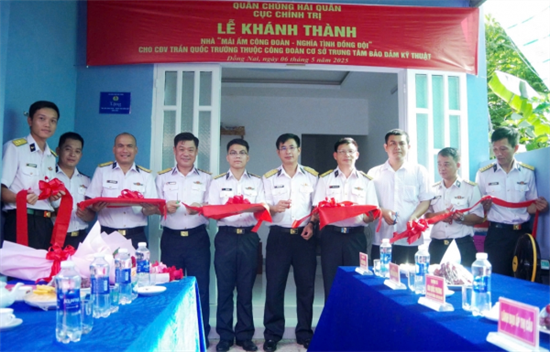 |
| Handing over a house of comradeship to a staff member of the Region |
In regular meetings, grass-roots Party organisations have focused on studying Party resolutions and evaluating the fulfilment of Party member duties, and striving for pure and strong Party organisations according to the “four good” criteria. Attention has been paid to defining tasks, authority, responsibilities, and leadership - command relationships to facilitate effective performance of Party organisations’ functions and commanders’ responsibilities. Furthermore, Party meetings have been conducted in strict adherence to prescribed procedures and steps, while manifestations of formalistic democracy have been removed. In implementing resolutions, the Region Party Committee has required every cadre and Party member to uphold a strong sense of self-discipline and a pioneering, exemplary role, and to resolutely fight against wrong viewpoints and misguided perceptions. As a result, all leadership guidelines of the Region Party committees have been executed thoroughly, opportunely, effectively. The tendency toward vague or superficial leadership has been corrected; undue interference in administrative affairs has been avoided; signs of authoritarianism and arbitrariness in management and operation have been prevented.
Third, strict observance of procedures for selecting, training, arranging, and consolidating Party committees and key cadres has been ensured, with a strong focus on improving the quality of Party members in association with building a competent cadre contingent. At the recent Party Congress, the Region Party Committee Standing Board attached importance to consolidating and reinforcing Party committees in tandem with planning and appointing key cadres in agencies and units, ensuring comprehensiveness, an appropriate structure, and strategic focus. Personnel-related decisions by Party committees and commands have taken into account the requirement to enhance both the quantity and quality of Party members in key units; the number of Party members has been ensured sufficiently to establish Party committees and Party groups at grass-roots units. To date, 100% of ship-based Party cells across the Region Party Committee have established Party committees. To build a contingent of cadres with a rational structure for meeting the requirements of leadership and command, the Region Party Committee Standing Board has proactively reviewed and supplemented planning for key cadres at all levels, ensuring diversified personnel sources and age structures, with a balanced combination of experienced cadres and younger, less experienced personnel.
To improve cadres’ qualifications, Party committees and commands at all levels have effectively implemented the principle of training based on positions, combining institutional training with in-service training, pairing senior cadres with junior ones, and fostering development through practical activities at units. Particular emphasis has been placed on improving command capacity, staff work skills, and the ability to conduct Party and political work during assigned tasks. To ensure cadre development, the Region Party Committee Standing Board has effectively carried out the rotation of cadres among ships, offshore platforms, stations, and posts, as well as between agencies and units. Due regard has been paid to holding meetings with cadres showing signs of mediocrity or poor task performance, and setting clear timelines for rectification and improvement.
Through the synchronous implementation of stages and steps, a pool of cadres across the Region has been strengthened in terms of quantity, quality, and structure. Cadres have exhibited good political qualities, professional competence, ethics, lifestyle, and working style, gaining great prestige within collectives and fulfilling assigned tasks effectively. Specifically, 70% of cadres possess college or university degrees; over 80% have fulfilled their tasks well or excellently; 100% of secretaries and deputy secretaries of Party cells and Party organisations have received fundamental training with college or university degrees and are qualified to conduct Party and political work at their units.
Fourth, leadership over inspection, supervision, and implementation of the Party Charter at all levels has been strengthened. Upholding the principle of being “proactive, combative, educational, and effective”, from the outset of the term, the Region Party Committee and subordinate Party committees have issued thematic resolutions, term-wide plans, and Working Regulations for Inspection Commissions. They have opportunely disseminated leadership and direction documents from higher-level Party Committees and Inspection Commissions regarding inspection and supervision work. Regular supervision has been linked with inspecting and supervising Party organisations, cadres, and Party members in the study and following of Ho Chi Minh’s thought, ethics, and lifestyle as well as the correction of shortcomings under the Resolution of the 4th Plenum of the 13th Party Central Committee on Party building and rectification. Following the motto that “supervision must be expansive, while inspection must be focused and targeted”, all-level Party committees have concentrated on inspecting and supervising the enhancement of leadership effectiveness in carrying out central political tasks, complying with Party organisational principles, managing and training cadres and Party members in sensitive areas prone to negative practices.
Priority inspection and supervision targets have included Party organisations with poor task performance and cadres or Party members showing signs of violating moral standards, State law, or military discipline. After inspections, each collective and individual has been required to develop plans with detailed measures and timelines to rectify their identified shortcomings, thereby contributing to maintaining Party discipline and enhancing the leadership capacity and combativeness of Party organisations.
The synchronous implementation of the above solutions, combined with effective efforts in combating corruption and negative practices and maintaining internal political security, has substantively contributed to making the Region Party Organisation pure and strong with high leadership capacity and combativeness, enabling the Region to successfully fulfil its assigned tasks of managing, protecting, and safeguarding national sea and island sovereignty, firmly defending the Fatherland in the new situation.
Sr. Col. DO HONG DUYEN
Deputy Political Commissar of the Region