
Thoroughly grasping and concretising the Resolution of the 14th National Party Congress (hereafter the Resolution) in training, education, and scientific research is an important task for military academies and schools today. This contributes to translating the Resolution into practice, developing high-quality human resources for the Vietnam People’s Army (VPA), building a revolutionary, regular, elite, and modern VPA, strengthening national defence and security, and firmly protecting the Fatherland in the new context.
In the article entitled “Advance! Victory will surely be ours!” published in January 2026, General Secretary To Lam affirmed that “the Resolution has truly become a blueprint for action for the Party and the entire political system, guiding the country along its new development path. The Resolution has built on the viewpoints, thoughts, and lessons learned from previous Party congresses, while reflecting innovative and creative thinking, aspirations for national advancement, and the strong political determination of the entire Party, people, and VPA in the cause of building and protecting the Fatherland in the new context.
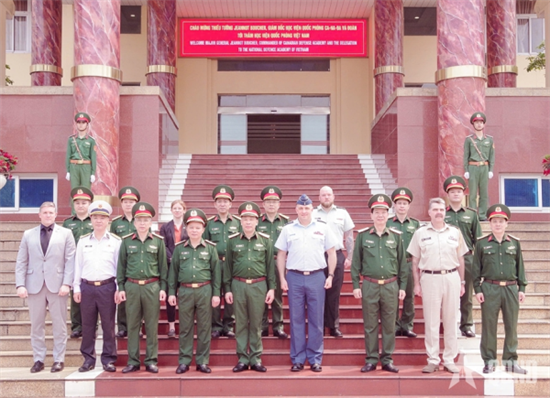 |
| Group photo between the Board of Directors of the National Defence Academy of Vietnam and the delegation from the Canadian Defence Academy (photo: qdnd.vn) |
Therefore, thoroughly grasping and flexibly applying the Resolution to training, education, and scientific research is both a responsibility and an honour, as well as a regular and central task of military academies and schools. This aims to rapidly translate the Resolution into practice, contributing to building a revolutionary, regular, elite, and modern VPA, strengthening national defence and security, and firmly safeguarding the Fatherland. To translate determination into action, military academies and schools need to study and implement the Resolution in a serious, methodical, and coordinated manner, focusing on the following key measures.
First, studying, disseminating, concretising, and implementing the Resolution in line with functions and assigned tasks. Party committees and Party organisations at military academies and schools must organise conferences and study sessions on the contents of the Resolution and other resolutions of the Party Central Committee (14th tenure) for all cadres, Party members, lecturers, cadets, employees, and soldiers. This will help create an extensive and meaningful political education drive, providing additional motivation and determination for personnel, thereby fostering a strong sense of self-awareness, responsibility, active study and research, solidarity, and unity in successfully accomplishing all assigned tasks. Party committees of these institutions must promptly supplement and complete their action programmes for executing the Resolution, the Resolution of the 12th Congress of the Military Party Organisation, and resolutions of Party congresses at all levels for the 2025 - 2030 tenure, in the spirit of “not a single day wasted, not a single week delayed”.
In addition, focus should be placed on building “pure, strong, and exemplary” Party organisations within military academies and schools, together with comprehensively strong, “exemplary” institutions. Priority should be given to developing a contingent of cadres and Party members, especially key leaders at all levels, with steadfast political resolve, good moral qualities, high professional competence, and the spirit of “7 dares”. Leadership and direction should continue to be strengthened in studying and effectively implementing the “two-steadfastness, two-acceleration, two-prevention” principle and the “five-pillar” motto. The Determined-to-win emulation movement, along with peak and breakthrough emulation campaigns, should be regularly promoted, thus yielding significant improvements in both awareness and implementation of the Resolution. Military academies and schools must also proactively study and thoroughly grasp the resolutions and directives of Party committees at all levels, while resolutely combating toxic information and distortions spread by hostile forces against the Resolution, thereby firmly safeguarding the Party’s ideological foundation.
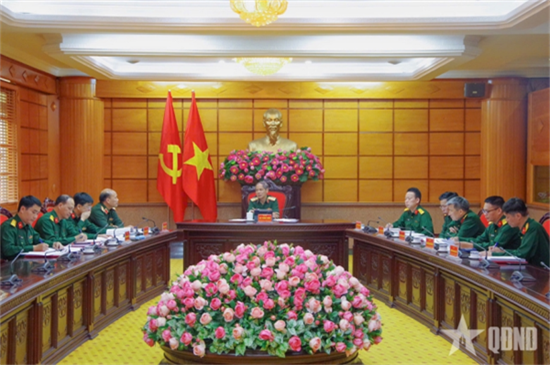 |
| Conference to review party and political work for the period of 2020 - 2025 at National Defence Academy (photo: qdnd.vn) |
Second, thoroughly grasping and flexibly applying the Resolution to training and education. Military academies and schools need to grasp the guiding viewpoints, objectives, tasks, and measures set forth in the Resolution, especially those related to military affairs, national defence, security, and Fatherland protection. On this basis, they should closely cooperate with functional agencies of the Ministry of National Defence (MND) to incorporate new contents into training and education programmes, ensuring consistency and practical relevance for each target group of training. Due regard should be paid to improving the quality of training for cadres at all levels, particularly those at operational and strategic levels, as well as enhancing the quality of national defence and security education for various target groups. Based on their functions and tasks, functional agencies, faculties, and cadet management units of these institutions should focus on studying and creatively applying the Resolution in order to improve the expertise, professional capacity, and pedagogical skills of cadres and lecturers.
Teaching content must aim to help learners grasp the guiding viewpoints, objectives, and solutions defined in the Resolution. This includes the Party’s new thinking and emerging issues regarding national defence and security in the new context, particularly the viewpoint that: “Socio-economic development and environmental protection are the central tasks; Party building is the key; cultural and human development serves as the foundation; and national defence and security consolidation, together with the promotion of foreign affairs and international integration, constitutes as essential and regular tasks”. Other key contents include building a revolutionary, regular, elite, and modern VPA and People’s Public Security Force, building strong and modern national defence; developing a proactive, self-reliant, dual-use, and modern defence industry: consolidating a strong all-people national defence posture and “people’s hearts and minds posture”. Attention should be paid to closely combining socio-economic development with national defence, security, and foreign affairs, promoting the role of the state sector in the socialist-orientated market economy, developing Vietnamese culture, and strengthening great national unity.
In teaching activities, lecturers and instructors must integrate military science and technology, military social sciences and humanities, and military art into various forms of combat operations across air, land, sea, and electromagnetic domains at tactical, operational, and strategic levels, in line with the requirements of people’s warfare under modern conditions. Emphasis should be placed on issues related to contents, methods and measures for preventing and defeating hostile forces’ sabotage plots and activities, as well as addressing non-traditional security challenges and civil defence issues. This contributes to proactively preventing and effectively handling strategic contingencies, while countering forms of warfare employing high-tech weapons and multi-domain operations. The application of science and technology, digital transformation, and modern teaching methods should be accelerated in training and education. The motto that “the training quality of military schools determines the combat readiness capacity of units” must be strictly upheld. For learners, it is essential to firmly grasp the Party’s viewpoints, guidelines, and resolutions, and promptly update comprehensive, in-depth, and practice-orientated knowledge related to work and combat duties. Upon graduation, they must possess required political qualities, leadership and command capabilities, and the ability to effectively carry out military and defence tasks. At the same time, they must demonstrate strong determination, proficiency in command and combat coordination, and mastery of automated command systems and modern weapons to meet the requirements of building and protecting the Fatherland.
Third, thoroughly grasping and applying the Resolution to military, national defence, and Fatherland protection scientific research. Military academies and schools need to thoroughly grasp and flexibly apply the Resolution and the resolutions the Party Central Committee (14th tenure) to their scientific research activities, thereby meeting their task requirements and assisting functional agencies, the Central Military Commission (CMC), and the MND in advising the Party and the State on issues related to military affairs, national defence, and Fatherland protection. Accordingly, in addition to conducting military scientific research and participating in programmes and projects at various levels, military academies and schools should actively cooperate with ministries, sectors, localities, the MND’s functional agencies, research institutes, and units across the entire VPA in accelerating scientific research and theoretical development in the fields of economics, politics, security, military science and technology, military art, and military social sciences and humanities.
Research efforts should focus on proposing and supplementing new contents aligned with the tasks of building the armed forces and developing a revolutionary, regular, elite, modern VPA. Importance should be attached to building strong and modern all-people national defence, developing new military technologies, and enhancing “soft power” for Fatherland protection. At the same time, Vietnamese military art should continue to be developed to meet the requirements of modern warfare. The contents of the Resolution must also be incorporated into textbooks, teaching materials, and specialised topics in a scientific and systematic manner suited to each training programme and target group.
Fourth, thoroughly grasping and applying the Resolution to strategic research, forecasting, and advisory work. Military academies and schools should bring into play the role of Party committees and commands at all levels, and the contingent of cadres, scientists, and experienced lecturers in researching, forecasting, and advising on military affairs, national defence, security, and Fatherland protection. Regular coordination with central and local functional agencies, particularly those under the MND, should be maintained to ensure early and accurate assessments of global, regional, and domestic situations. This involves correctly identifying partners and adversaries, clearly understanding hostile forces’ sabotage plots and tactics, and closely monitoring changes in the defence and security policies of other nations as well as strategic competition among major powers. On that basis, military academies and schools can provide accurate, timely, and effective recommendations to the CMC and the MND, enabling them to propose appropriate strategies, responses, and effective solutions to the Party and the State for handling defence and security situations and avoiding strategic surprise in all circumstances.
With the strong engagement and determination of Party committees and commands of military academies and schools, together with the efforts of all cadres, lecturers, cadets and soldiers, there is every reason to believe the study and application of the Resolution to training, education, and scientific research will achieve practical and substantive results. This will contribute to developing high-quality human resources for the Military and successfully fulfilling the tasks of VPA building, national defence consolidation, and Fatherland protection.
Sr. Lt. Gen., Associate Prof. TRAN VIET KHOA, PhD
Member of the Party Central Committee
Member of the CMC
Director of the National Defence Academy