
Inheriting and promoting its 60-year tradition of construction, combat, and development, Engineering Brigade 28 (Air Defence - Air Force Service) has been promoting the implementation of its “three breakthroughs”, making changes across all aspects of work, contributing to improving the engineering and construction support capacity to meet its mission requirements in the new situation.
Born in the flames of the resistance war against US imperialism for national salvation, Engineering Brigade 281 is honoured to bear the name Engineering Unit 19/5 - the birthday of beloved President Ho Chi Minh; this is not only a source of pride, but also a great spiritual motivation for every officer and soldier of the Brigade to constantly strive to excellently fulfil all assigned tasks.
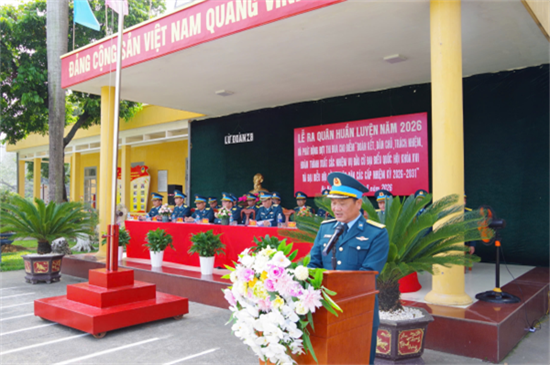 |
| Brigade Commander addresses the launch of the 2026 training season |
Over the past 60 years of construction, combat, and development, generations of officers and soldiers of the Brigade have always been resilient and creative, achieving many outstanding accomplishments, leaving a strong mark on constructions, battlefields, and airfields across the country. Typical examples include K12 Command Post, Khe Gat Airfield, the floating position on West Lake during wartime, and hundreds of airfields, combat works, and modern command posts in peacetime. At the same time, the Brigade has effectively performed tasks of mine clearance, unexploded ordnance disposal, and remediation of war consequences, contributing to socio-economic development, ensuring peaceful lives for the people, and strengthening the air defence - air force posture. In recognition of these achievements, the Brigade has been honoured by the State with the title Hero of the People’s Armed Forces in the renewal period, along with many other noble awards.
In recent years, the building of a modern Service and new developments in air operations have imposed very demanding requirements on the Brigade, especially regarding the quality and progress of defence works. To meet these requirements, the Brigade’s Party Committee and Command have focused their leadership and direction on realising “three breakthroughs” to create comprehensive, sustainable changes in engineering and construction support.
Establishing an adept, compact, specialised, flexible force structure
As the main engineering unit of the Service, the Brigade is stationed in a wide area, with its forces being dispersed and operating independently and far from direct leadership and command; meanwhile, the nature of its tasks is complex, dangerous, and hazardous. This reality necessitates each team, group, and force not only being professionally proficient, but also having sufficient organisational, command, and flexible handling capabilities in all situations. Grasping and implementing Resolution 545-NQ/ĐU, dated 8 June 2022, by the Service Party Committee on organisational adjustment for the 2021 - 2030 period, the Brigade Party Committee has issued Resolution 475-NQ/ĐU on “Leading the Brigade’s force organisation for the 2021 - 2030 period and beyond”, clearly defining the objective of establishing an adept, compact, specialised, flexible force structure without overlapping functions and tasks, suitable to equipment and methods of engineering and construction support in the new situation. Based on that resolution, the Brigade has concentrated on reducing intermediate layers, increasing personnel directly performing tasks, ensuring each component would be “adept, compact, specialised, and flexible”, with high and rapid mobility in multiple directions. Priority has been given to consolidating forces in charge of the tasks requiring high standards of quality, progress, and safety, such as teams responsible for constructing underground tunnels, aircraft shelters, and command works, or settling bombs and explosives in difficult, complex areas.
In addition, the Brigade has paid attention to consolidating all-level party committees in sync with force adjustments, focusing on assigning cadres with good qualities, capabilities, and experience to key positions, especially in sections performing independent tasks far from their main units. At the same time, it has enhanced the leadership capacity and combativeness of party organisations, maintaining the principle of democratic centralism, assigning specific responsibilities to party committee members and key cadres of agencies and units in inspecting, urging, guiding, and assisting sub-units in various areas, directions, and construction sites. Doing so has helped build high unity across the Brigade, strengthen political steadfastness, and guarantee the resolve, proactiveness, creativity, and good task performance of all organisations and individuals, regardless of dispersed, independent conditions or difficult areas.
Good training, strict discipline, absolute safety
This is the key breakthrough and foundation for the Brigade to improve its engineering and construction support capacity. Grasping and implementing higher echelons’ resolutions and directives on training, regularity building, and discipline management, the Brigade has issued specialised resolutions and plans for close leadership and direction, clearly defining targets and requirements for each group and stage, taking the building of an “adept, compact, specialised, flexible” force as the training objective. Training work has been organised comprehensively and synchronously, in accordance with the functions and tasks of engineering and construction support; there have been a combination between military training and political education, between theory and practice, between concentrated training with dispersed and field training to be relevant to construction and engineering combat conditions.
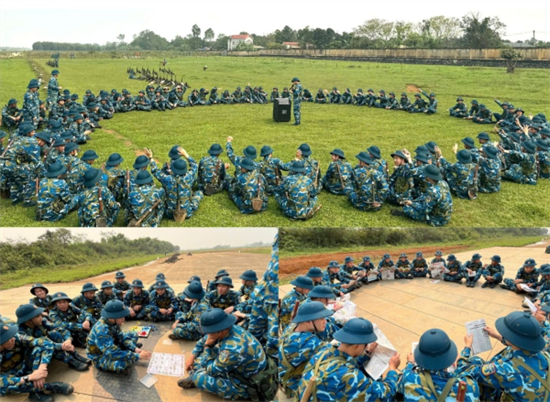 |
| Break time for troops on the training ground |
For its cadres, the Brigade has provided comprehensive training in engineering specialities, organisational and commanding capabilities, training methods, and the ability to handle real situations, taking practice, experience transfer, scenario-based training, and training through task execution as the focus, gradually standardising its contingent of cadres towards being “proficient in their assigned responsibilities and well-versed in higher-level tasks”, both mastering specialities and equipment and possessing the ability to organise and command flexibly under independent, dispersed conditions far from direct command. For sub-units, the Brigade has adhered to the motto of “basics, practicality, solidity”, focusing training on construction of military works, fortifications, underground tunnels, and field command posts, manoeuvre support and settlement of obstacles, clearance and disposal of bombs, mines, and explosives. It has promoted training in the direction of “one person proficient in multiple positions”, enhancing the ability to perform multiple roles and substitute for one another during task execution, meeting the requirements of a streamlined force structure and dispersed, independent, flexible operations in all conditions. Notably, due to the inherently hazardous nature of engineering and construction support, the Brigade has placed emphasis on training troops to strictly comply with rules, regulations, and procedures on construction and explosive handling, intensifying training in occupational safety, prevention of labour accidents and technical incidents, and emergency response, especially in underground construction and unexploded ordnance disposal.
In regularity building and discipline management, while upholding the principle “agencies work according to functions, individuals work according to responsibilities, units act according to military regulations”, the Brigade has emphasised the exemplary role of cadres at all levels in promptly grasping and resolving ideological issues and difficulties at grass-roots level, strictly maintaining daily and weekly regimes suitable to field conditions, combining management based on military regulations with education and persuasion to build self-discipline among troops. Particularly, recognising secrecy as the “lifeblood” of defence works, it has regularly rendered officers and soldiers fully aware of the position, significance, and importance of protecting state and military secrets, requiring them to strictly comply with regulations on counter-infiltration and confidentiality in management and construction. It has also closely coordinated with local party committees and authorities in its operational areas to manage troops, grasp and handle arising situations, and maintain security and safety during missions.
Thanks to its synchronous, resolute, practical solutions, the Brigade’s training, regularity building, and discipline management have seen firm improvements. Since 2024, the Brigade has completed 9 works and construction items, ensuring quality, progress, confidentiality, and absolute safety; taking part in the Army-wide Engineering Competition, it has achieved 1 Second Prize and 6 Third Prizes.
Promoting the application of science and technology, innovation, digital transformation, and military administrative reform
In response to the high requirements of engineering and construction support, the Brigade has advocated a shift in mindset from “working fast, solidly” to “working smartly, accurately, efficiently”. To that end, it has actively applied scientific and technological advances in key areas, especially in construction and project management. Emphasis has been placed on investing in and effectively exploiting modern construction equipment and means, gradually approaching and mastering new technologies for military works requiring high technical standards. The Brigade has also promoted scientific research movements, encouraging initiatives and technical improvements, motivating its cadres, engineers, and technicians to proactively research and propose practical solutions suited to real conditions, contributing to increased labour productivity, cost reduction, and enhanced safety in mission implementation.
Furthermore, the Brigade has closely combined digital transformation with administrative reform, gradually building a smooth command and management information system from the Brigade command to subordinate agencies and units, strengthening the application of information technology in command, management, progress control, and technical documentation management, ensuring timeliness, accuracy, and transparency. On the digital platform, it has actively reviewed, supplemented, and standardised working processes and regulations towards “clear personnel, clear tasks, clear timelines, clear responsibilities, clear outputs, clear authority”, without any overlaps. As a result, it has mastered and effectively utilised many types of modern engineering equipment and means, such as multifunctional excavators and bulldozers, concrete batching plants, drilling and cutting equipment, structural processing equipment, and devices for detecting and settling bombs, mines, and explosives, meeting the requirements of constructing complex defence works with high technical demands and flexibly, accurately handling arising tasks and situations.
The results achieved in realising the “three breakthroughs” have created clear improvements in the Brigade’s engineering and construction support capacity. This is an important foundation for Engineering Brigade 28 to continue promoting its tradition of “unity, coordination, bravery, overcoming difficulties, winning victory upon deployment”, striving to master science and technology, enhancing its engineering and construction support capacity, meeting the requirements of building a revolutionary, regular, elite, modern Air Defence - Air Force Service capable of firmly protecting the Fatherland’s airspace in all situations.
Sr. Col. HA QUANG TUNG
Commander of the Brigade
__________________
1 - Originally Engineering Regiment 28, established on 19 May 1966.