
The election of deputies to the 16th National Assembly and deputies to People’s Councils at all levels for the 2026-2031 term takes place in the context of the entire Party, the entire people, and the entire armed forces celebrating the success of, and beginning the implementation of, the Resolution of the 14th National Congress of the Communist Party of Vietnam; continuing the comprehensive renewal of the country; and carrying out the two strategic tasks of building and firmly defending the Socialist Republic of Viet Nam in the new era. This is a political event of great national significance and a broad-based democratic exercise throughout society, serving as the foundation for selecting outstanding deputies who represent the will, aspirations, and mastery of the people and voters nationwide. It contributes to the building, consolidation, and improvement of the socialist rule-of-law State of the people, by the people, and for the people, under the leadership of the Communist Party of Vietnam.
This election features several new elements, including the shortening of the term of the 15th National Assembly and People’s Councils at all levels for the 2021-2026 term; the compression of electoral timelines and procedures; and the organisation of the election on 15 March 2026, two months earlier than previous elections. At the same time, the implementation of the two-tier local government model, the accelerated application of technology and digital transformation, and the rapid development of social media place higher demands on ensuring security, safety, transparency, and uniformity in the electoral process. Notably, the election coincides with the 80th anniversary of the first General Election to elect the National Assembly of Viet Nam (1946-2026), further highlighting the nation’s democratic tradition and the strength of the great national unity bloc, and creating new momentum for the country’s development towards prosperity, affluence, civility, and happiness.
For the Vietnam People’s Army, the election carries particularly important political significance. The Army is both the core force in protecting the Party, the State, the People, and the socialist regime, and a force that directly participates in the election, exercising the rights and fulfilling the civic duties of each servicemember. All cadres and soldiers in the Army are voters, including many forces performing tasks in key areas of defence and security, border regions, and maritime and island areas. In addition, a number of military cadres have been nominated as candidates for the National Assembly and People’s Councils at all levels - an immense honour and a responsibility of special political significance before the Party, the State, the National Assembly, voters, and the entire people.
 |
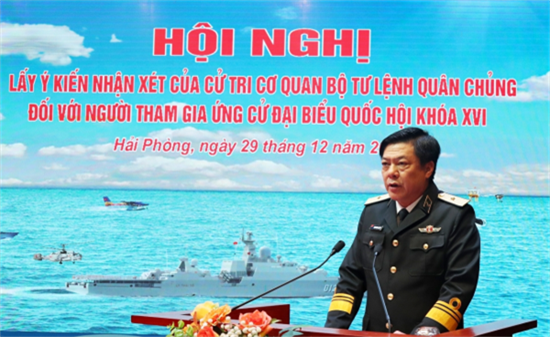
| Sr. Lt. Gen. Truong Thien To chairs the conference on deploying the electionf of deputies to the 16th National Assembly in the Army |
In the context of complex global and regional developments; intensifying strategic competition among major powers; the intertwining of traditional and non-traditional security challenges; and increasingly sophisticated subversive activities by hostile forces, reactionary elements, and political opportunists in cyberspace, the entire armed forces are required to organise and participate in the election in an exemplary manner, ensuring absolute safety and security, while demonstrating firm political resolve and the noble qualities of “Uncle Ho’s Soldiers” in the new era. To ensure unity of awareness and action in participating in and safeguarding the election, agencies and units throughout the armed forces need to synchronously implement several key solutions as follows:
Firstly, the leadership and direction of the Central Party Committee, the Central Military Commission, the Ministry of National Defence, the General Political Department, and functional agencies regarding electoral work must be thoroughly grasped and strictly implemented. Party committees, commissars, junior commissars, commanders, and political agencies at all levels should focus on deeply internalising and strictly, synchronously implementing the leadership and directive documents of the Party, the State, the Central Military Commission, the Ministry of National Defence, the General Political Department, as well as central ministries, sectors, and local party committees and authorities concerning the election, while proactively preparing all combat-readiness plans to protect the election of deputies to the 16th National Assembly and deputies to People’s Councils at all levels for the 2026-2031 term. Particular emphasis should be placed on the following key documents: The Politburo’s Directive No.46-CT/TW dated 16 May 2025 on “Leading the election of deputies to the 16th National Assembly and deputies to People’s Councils at all levels for the 2026-2031 term”; the National Assembly’s Resolution No. 199/2025/QH15 dated 21 May 2025 on “Shortening the term of the 15th National Assembly and People’s Councils at all levels for the 2021-2026 term”; and Directive No.4218-CT/QUTW dated 31 July 2025 of the Standing Board of the Central Military Commission on “The Army’s participation in the election of deputies to the 16th National Assembly and deputies to People’s Councils at all levels for the 2026-2031 term”.
The dissemination and study of these documents must be conducted in a serious, comprehensive, and timely manner, ensuring that every officer, soldier, defence worker and employee, civilian employee in agencies and units, and members of the militia and self-defence force fully understand the significance, importance, content, requirements, and responsibilities involved in participating in, supporting, and safeguarding the election. In parallel, party committees and commanders at all levels must closely lead and direct political and ideological education; proactively grasp and tightly manage the ideological situation and public opinion within their units; and promptly detect, guide, and resolve emerging issues. Firm measures must be taken to combat, prevent, and strictly handle any servicemembers who violate State law or military discipline in connection with the election.
Electoral law dissemination and education must be effectively organised, particularly focusing on new provisions of Law No.83/2025/QH15 dated 24 June 2025 of the National Assembly on the Law amending and supplementing a number of articles of the Law on Election of Deputies to the National Assembly and Deputies to People’s Councils. This is to ensure that every servicemember, defence worker and employee, civilian employee, and member of the militia and self-defence force thoroughly understands citizens’ rights and obligations, electoral principles, and election procedures, as well as the favourable conditions and challenges related to carrying out combat-readiness tasks to safeguard the election. At the same time, close coordination must be maintained with local party committees and authorities in areas where units are stationed to strengthen information dissemination and ensure political security, social order, and safety; proactively participate in guiding and supporting voters in accordance with regulations, thereby contributing to the overall success of the election.
Secondly, the situation should be proactively grasped to ensure combat readiness and firmly maintain political security, social order, and safety in support of the election. Party committees and commanders of agencies and units should intensify leadership and direction in strictly maintaining combat-readiness duty regimes, and in closely monitoring developments across strategic directions, maritime areas, border regions, inland areas, key and sensitive locations, as well as in cyberspace. In coordination with relevant forces, they should promptly exchange information and conduct accurate assessments and forecasts of the schemes, tactics, and subversive activities of hostile, reactionary forces before, during, and after the election. Particular attention must be paid to proactively detecting and preventing acts of incitement, mass gatherings, disturbances, sabotage, or the exploitation of the election to distort information and sow internal division.
Agencies and units must develop and practise proficiency election-protection plans at all levels of contingency; strengthen patrols and area control; and promptly advise local party committees and authorities on measures to ensure the safety and security of key targets and polling stations. Close coordination should be maintained with local party committees, authorities, public security forces, and other relevant forces, ensuring readiness for manoeuvre and effective handling of any arising situations. Proactive plans must also be put in place to respond to natural disasters, fires and explosions, environmental incidents, and other emergencies at polling stations, particularly in units operating far from the mainland or in remote, isolated, and disadvantaged areas.
Under all conditions and circumstances, the entire armed forces must deeply internalise the spirit of proactiveness, determination, and resolute action, ensuring that there is no passivity or surprise in any situation, so that the election is conducted successfully and truly becomes a “great festival of the entire people.”
 |
| One of the military candidates in the election of deputies to the 16th National Assembly |
Thirdly, personnel work, consultation, and nomination of candidates should be effectively carried out in strict compliance with prescribed procedures and regulations, ensuring the selection of the right individuals who meet the required standards and structural composition. This is the decisive stage determining the quality of military candidates participating in the election. Accordingly, agencies and units must thoroughly grasp and strictly implement guiding and directive documents on personnel work for deputies to the 16th National Assembly and deputies to People’s Councils at all levels for the 2026-2031 term. Particular attention should be given to the Politburo’s Regulation No.377-QĐ/TW dated 8 October 2025 on decentralisation of cadre management and on planning, appointment, nomination, temporary suspension, relief from duties, resignation, and dismissal of cadres; Guideline No.36-HD/BTCTW dated 9 September 2025 of the Central Organisation Commission on personnel work for deputies to the 16th National Assembly and deputies to People’s Councils at all levels for the 2026-2031 term; and Guideline No. 4719/HD-CT dated 28 November 2025 of the General Political Department on the conduct of the election of deputies to the 16th National Assembly and deputies to People’s Councils at all levels for the 2026-2031 term within the Army.
Leadership and direction must be exercised rigorously from the initial stages of review, selection, and verification through to assessment and final conclusion, ensuring that military personnel nominated are truly exemplary in political steadfastness, moral qualities, and lifestyle; possess comprehensive competence, sound practical understanding, and high prestige within the Party, the Army, the electorate, and the People; and meet the prescribed age requirements for service. In cases requiring verification, units must proactively conduct reviews and checks, report and seek guidance from functional agencies before submitting to competent party committees for conclusion, absolutely avoiding errors, omissions, or the nomination of personnel who fail to meet required standards.
Close coordination must be strengthened with the Viet Nam Fatherland Front and local electoral bodies throughout the consultation and nomination processes, ensuring the thorough and accurate preparation of candidate dossiers and conference minutes in accordance with regulations. Electoral communication and canvassing must be conducted in a democratic, transparent, equitable, and lawful manner, while firmly maintaining social order and safety. At the same time, internal political security must be well safeguarded; personnel records must be kept secure and confidential; and timely measures must be taken to detect, counter, and strictly handle distortions and fabricated information aimed at undermining the credibility of military candidates. Logistical and technical support for candidate-related activities must be provided in a careful, scientific, and regulation-compliant manner. The synchronous and rigorous implementation of these measures will contribute to selecting truly exemplary and deserving deputies, thereby enhancing the prestige of the Army and reinforcing voters’ confidence in the Army.
Fourthly, intensifying communication efforts and proactively counter false and hostile information, firmly safeguarding the Party’s ideological foundation before, during, and after the election. Communication activities should focus on highlighting the significance and importance of the election, affirming that it is a sacred right and obligation of citizens, and an opportunity for voters to select outstanding representatives who possess both virtue and talent to serve in State power bodies. Propaganda efforts must clearly demonstrate the democratic, open, and transparent nature of the election in strict accordance with the Constitution and the law. The strength and role of military press agencies and internal communication systems should be fully brought into play by opening dedicated pages and columns on the election; increasing coverage of new features in electoral work and candidate standards; and highlighting good practices, innovative approaches, and exemplary collectives and individuals in the electoral process. Comprehensive and timely information should be provided on the progress of election implementation within the Army and in localities, particularly on the results of early voting organised in units performing tasks at sea, on islands, along borders, and in areas far from the mainland, thereby promptly guiding public opinion within the armed forces and disseminating positive information to the wider public.
In the period before, during, and after the election, hostile, reactionary forces and political opportunists are expected to intensify their subversive activities using increasingly sophisticated methods, especially in cyberspace. Therefore, agencies and units must thoroughly grasp and strictly comply with regulations and procedures on information dissemination, communication activities, and spokesperson responsibilities at all levels. Specialised forces must maintain close situational awareness and promptly counter distorted narratives propagated by hostile, reactionary, and opportunistic elements exploiting the election to undermine the Party, the State, and the Army. Proactive measures must be taken to detect, remove, and neutralise harmful and malicious information, preventing its spread and ensuring that the election is conducted in a democratic, secure, lawful, and successful manner.
Finally, conducting the election throughout the entire armed forces in strict compliance with the law, in an exemplary and model manner, ensuring absolute safety and security. Agencies and units must develop scientific, rigorous, and feasible plans for organising the election. All necessary conditions for the electoral process should be thoroughly and carefully prepared, ensuring that the election is genuinely democratic, lawful, safe, economical, and does not adversely affect the fulfilment of routine political and military tasks. At the same time, the entire armed forces must standardise professional training for electoral personnel, ensuring that cadres assigned to electoral duties have a firm grasp of procedures and are proficient in handling situations, particularly in complex areas or locations far from the mainland. All steps must be proactively and fully implemented, from the establishment of polling teams, preparation of polling stations, compilation and public posting of voter lists, to the organisation of voting, vote counting, result consolidation, and reporting in accordance with statutory regulations.
Units that establish separate polling stations should direct functional agencies to review, select, and assign forces on combat readiness to directly protect and support electoral activities at their respective polling sites. Inspection and supervision must be strengthened, with difficulties and obstacles promptly addressed, ensuring absolute internal political security, information security, protection of military secrets, and the safety of personnel throughout the entire process of election preparation and conduct. Proactive measures must be taken to effectively organise early voting for forces performing tasks in border areas, on islands, in remote and isolated regions, and along combat-readiness duty directions, striving to achieve 100% voter participation among military personnel with the highest sense of political responsibility.
The active participation of the entire armed forces in successfully conducting an exemplary, lawful, and absolutely safe election not only affirms the Army’s organisational capacity and management proficiency but also demonstrates the absolute loyalty of officers and soldiers to the Fatherland, to the Party, the State, and the People. Therefore, agencies and units are required to continue thoroughly internalising the resolutions and directives of the Party and the State, the Central Military Commission, the Ministry of National Defence, and the guidance of the General Political Department; to heighten their sense of responsibility; and to strictly implement every content and procedure in organising, participating in, and safeguarding the election of deputies to the 16th National Assembly and deputies to People’s Councils at all levels for the 2026-2031 term. This constitutes a consistent requirement and also the firm determination of the entire armed forces in carrying out this important political task.
Senior Lieutenant General TRUONG THIEN TO, Member of the Party Central Committee, Deputy Chief of the General Political Department of the Viet Nam People’s Army