
Fully aware of their core role in the development of the Academy and their decisive importance to the quality of education and training of military pilots, the Party Committee and the Board of Directors of the Air Force Officer College have been intensifying the comprehensive implementation of leadership measures aimed at building and developing the teaching staff as a whole, with particular emphasis on the cadre of military pilot instructors.
As a leading centre of education, training, and scientific research of the Military and the nation in the field of military aviation, especially military pilot training, over recent years the Air Force Officer College under the Air Defence – Air Force Service has consistently received close leadership and direction from the Party, the State, the Central Military Commission, the Ministry of National Defence, and the Service. This has been reflected in organisational and staffing arrangements, investment in infrastructure development, and the procurement of new equipment and technical means in line with the orientation of being “revolutionary, regular, standardised, and modernised”. In this context, alongside the School’s overall cadre of officers and lecturers, the contingent of military pilot instructors (hereinafter referred to as pilot instructors) in particular has made significant progress in multiple aspects, playing a decisive role in training outcomes and meeting the requirements for building and developing the Air Force, as well as firmly safeguarding the national airspace.
However, compared with practical requirements, the number of pilot instructors remains insufficient relative to authorised staffing levels; the proportion holding postgraduate qualifications is low; and the age structure is still imbalanced, among other limitations. Meanwhile, science and technology, equipment, and technical means continue to advance rapidly, and the operational and combat-readiness requirements of the Service are increasingly demanding. This reality has set very high requirements, compelling the College to continue thoroughly grasping and implementing directives and resolutions on education and training in the new period, with a focus on making breakthroughs in improving the quality of the pilot instructor cadre through the following key solutions.
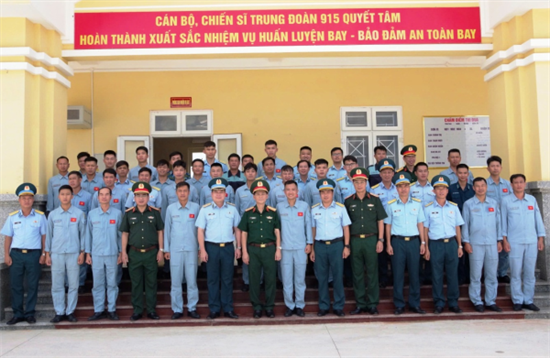 |
| Leaders of the General Staff and the Air Defence and Air Force Service visit Regiment 915 |
First, intensifying dissemination, education, and awareness-raising to enhance understanding and responsibility with regard to the task of building and developing the pilot instructor cadre. This is the most important solution, playing a decisive role in determining the quality of building and developing the College’s pilot instructors. Accordingly, Party committees and commanders at all levels within the College must thoroughly study and strictly implement superior-level leadership documents and directives on cadre and teaching staff development, as well as on the necessity of training high-quality human resources to meet the requirements of national construction and defence in the new situation. The focus should be on Resolution No. 71-NQ/TW, dated 22 August 2025, of the Politburo on breakthroughs in education and training development; Resolution No. 1657-NQ/QUTW, dated 20 December 2022, of the Central Military Commission on renewing education and training to meet the requirements of building the Military in the new situation; Decision No. 3525/QD-BQP, dated 3 August 2023, of the Ministry of National Defence approving the Scheme on “Building the contingent of teachers and educational management personnel in the Military for the period 2023–2030 and beyond”; and Resolution No. 165-NQ/DU, dated 12 September 2023, of the Party Committee of the Air Force Officer Training School on building the contingent of teachers and educational management personnel for the period 2023–2030 and beyond, among others. Through this process, Party committees, command systems, and all cadres and Party members will clearly recognise that pilot instructors constitute a critically important component and are the key actors in the process of training military pilots, a particularly vital human resource for the Service, the Military, and the country. Developing this cadre is, in essence, human development; it is both a regular task and a long-term strategic mission, and a crucial aspect of the College’s cadre work. This is carried out through purposeful and planned influence by Party committees and commanders at all levels on the collective of pilot instructors, with the aim of ensuring sufficient numbers, standardised quality, and synchronised structure and age composition, thereby meeting the requirements of military pilot training in the new period.
Second, building and effectively implementing a development plan for the cadre of military pilot instructors. Proper implementation of this task will enable the College to gain a comprehensive understanding of the current situation and future fluctuations of the pilot instructor contingent, thereby allowing timely adjustments to decisions in line with education and training missions. Accordingly, the Party Committee, the Board of Directors, functional agencies, and regiments should proactively formulate development plans for the pilot instructor cadre based on authorised staffing and actual needs, considering this a fundamental requirement to ensure sufficient numbers, improved quality, and synchronised structure and age composition, thus creating a solid and sustainable development foundation. To ensure effectiveness, planning must be conducted in a systematic and methodical manner, based on an accurate assessment of the current situation and implemented through a closed-loop process, from selection, training, and professional development to assignment and utilisation of pilot instructors, ensuring a complete and balanced structure (in terms of both standards and age), with continuous succession between generations. Emphasis should be placed on linking the planning of the pilot instructor cadre with the development of commanders at formation, squadron, and regiment levels; on developing and implementing a teaching competency framework aligned with advanced academic training, as well as education, training, and professional development aimed at improving physical fitness, revolutionary moral qualities, professional passion, determination, and fortitude. At the same time, it is necessary to formulate and effectively implement rotation and field-practice plans; and plans for further training and talent development to create sources for doctoral degrees, academic titles such as Associate Professor and Professor, as well as honours including Meritorious Teacher, People’s Teacher, and outstanding teaching awards at various levels. These measures are intended to meet both immediate and long-term requirements, in line with the practical demands of education and training tasks and the School’s combat readiness and operational capabilities, while also aligning with the orientation for developing the military pilot force of the Military and the country in the new period.
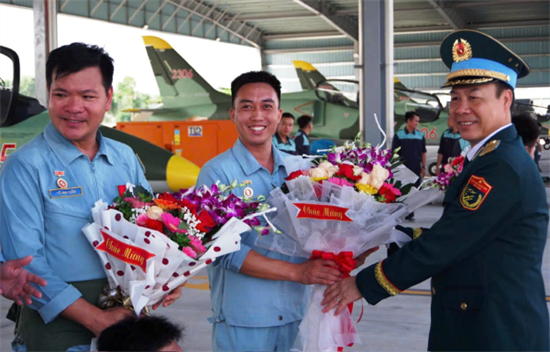 |
| Leader of the College congratulates pilots of Regiment 910 on their successful accomplishment of task in the Anniversary of the 80th National Day |
Third, refining and effectively implementing the processes and training programmes for military pilot instructors towards standardising professional titles, thereby ensuring sustainable development. The Party Committee and the Board of Directors of the School lead and direct the rigorous implementation of all stages, beginning with the selection of input sources, namely, pilot cadets graduating with good or excellent results, possessing sound political qualities and moral integrity, pedagogical aptitude, teamwork skills, and sufficient competence, qualifications, and technical proficiency in operating the aircraft types in service. At the same time, higher authorities are requested to assign experienced pilots with pedagogical capability from air units within the Service to undergo training to become pilot instructors.
Throughout implementation, alongside educational content aimed at enhancing awareness, building firm political resolve, loyalty, enthusiasm, and professional dedication, the College actively renovates training contents and programmes to ensure they are fundamental, systematic, unified, in-depth, comprehensive, well-balanced, and scientifically sound. This approach combines modernity with the inheritance and promotion of traditions and combats experience, and closely links theory with practice, as well as classroom instruction with hands-on training on various training aircraft types.
The training process for pilot instructors is conducted in a strict and disciplined manner. Phase One takes place at flying regiments, where pilots implement plans for assistant instructor and flight instructor development by conducting simple training flights at formation and squadron levels. Phase Two focuses on completing training for all flight exercises included in the syllabus for pilot cadets and carrying out formal instructor certification. After certification, pilot instructors continue to refine advanced pilot instructor training syllabi in line with their designated titles on specific aircraft types, covering all required components such as dual flights, solo flights, rear-seat flights, and coordinated flying. In accordance with accumulated total flight hours, instructors are gradually developed to attain Class 3, Class 2, and ultimately Class 1 pilot status. In parallel, the College continues to review and refine standards for pilot instructors in line with international benchmarks, setting high requirements for political qualities, scientific knowledge, skills, and practical flying proficiency. This is intended to enhance awareness and responsibility in self-discipline and professional cultivation, and to promote the capacity for self-improvement and self-development among pilot instructors. At the same time, selected pilot instructors are sent to participate in overseas training programmes and aircraft conversion courses to master new platforms and advanced technical equipment, serving as the core force for improving the overall quality of the College’s pilot instructor cadre. In practice, the College’s training and professional development of pilot instructors in recent years have consistently met task requirements, with the vast majority of trained instructors effectively fulfilling their roles and responsibilities in accordance with their professional titles and specialisations, and achieving high effectiveness in teaching and flight training.
Fourth, creating a favourable environment that enables the cadre of military pilot instructors to devote themselves fully. The equipment directly used in pilot training, namely aircraft, simulator devices, and mock-up cabins, constitutes the core material foundation of instruction. Ensuring adequate facilities and equipment for teaching and training makes a practical contribution to improving training quality, enabling pilot instructors to effectively implement teaching and flight-training tasks. In recent years, with the close attention of the Ministry of National Defence and the General Staff, the Air Force Officer College has been invested with several new aircraft types and a wide range of modern teaching equipment. In particular, the completion and commissioning of the Flight Training Simulation Centre, Parachute Training Simulation Centre, and Aeronautical Engineering Training Centre has played an important role in ensuring equipment support for the College’s education and training missions, while providing strong support for the teaching and flight-training activities of pilot instructors. The system of modern specialised classrooms, especially simulator-based training cabins applying simulation and digital technologies, has delivered very high utilisation efficiency, helping to reduce training time and costs on actual aircraft while ensuring safety in training.
In the time ahead, alongside strengthening leadership and direction in the management, maintenance, and effective exploitation of existing facilities and equipment, the College will continue to propose that higher authorities invest in new equipment, particularly the addition of aircraft, replacement materiel, and synchronised systems incorporating advanced simulation technologies. At the same time, plans will be developed and conditions created to enable pilot instructors to participate in aircraft conversion training and advanced professional development, enhancing their ability to access and gradually master new-generation aircraft in service, as well as modern simulation-based equipment. These efforts will support effective implementation of digital transformation tasks and create breakthroughs in improving the quality of military pilot education and training.
In parallel, the College consistently pays close attention to ensuring appropriate special entitlements and benefits, while caring for accommodation, daily living conditions, and family support policies. This serves to motivate pilot instructors to remain committed to the School, maintain passion for their profession, devote their energy and intellect, and successfully fulfil the important responsibility of training military pilots in service of the Fatherland.
Major General LE VAN UY, Political Commissar, Air Force Officer College