
Regiment 31 of Division 309, Military Region 7, formerly known as Hai-Hung-Thai Combat Detachment No.2, is one of the first four main-force regiments of the Vietnam People’s Army. From the very outset of its establishment, the Regiment took part in its first engagement at the Con Gai School battlefield, securing a resounding victory. In January 1951, as part of Division 320 under the designation Regiment 64, it operated across six provinces in the Red River Delta. Between 1951 and 1965, the Regiment participated in nine major campaigns, fighting 491 battles, eliminating nearly 15,000 enemy troops, shooting down three aircraft, destroying 24 tanks, and neutralising hundreds of tonnes of enemy war materiel. Many of its engagements have been recorded in history, notably the battles of Hung Cong, Dong Mit, and the ambush on Route 1 at Mao Chu Hamlet, Ha Nam. In late 1965, the Regiment was deployed to the Military Region 5 theatre, where it was redesignated Regiment 31 and placed under the command of Division 2, Military Region 5, operating in the Quang Nam-Da Nang area. Over nearly a decade of combat in this theatre, the Regiment took part in 25 campaigns featuring numerous fierce engagements, putting more than 31,000 enemy troops out of action; completely annihilating nine battalions, 75 companies, 117 platoons, and seven tank and armoured vehicle squadrons; and inflicting heavy losses on three brigades, three task forces, 35 battalions, and 111 companies. It also destroyed 503 motor vehicles, shot down 436 aircraft, demolished 50 artillery pieces, and captured substantial quantities of enemy war materiel.
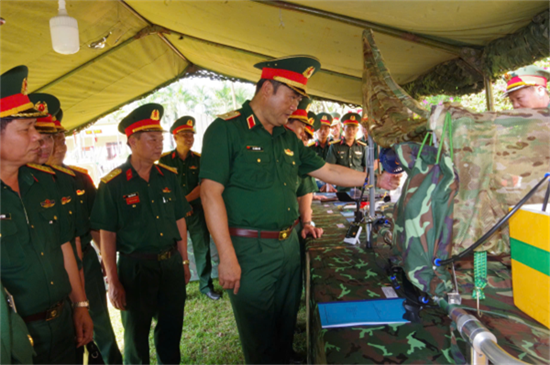 |
| Leader of MR7 examines the innitiatives exhibited by the Regiment |
During the Spring 1975 General Offensive and Uprising, the Regiment took part in the liberation of Tien Phuoc district town, Tam Ky township (Quang Nam), and the city of Da Nang. Following national reunification, the Regiment continued to engage in combat to defend the south-western border and undertook international missions in Cambodia. Upon fulfilling its international obligations and returning home, since September 1989 to date, the Regiment has served within Division 309 of Corps 4 (formerly), now under Military Region 7, undertaking training, maintaining combat readiness, and carrying out ad hoc missions as assigned. In recognition of its outstanding feats and achievements, the Regiment was honoured by President Ho Chi Minh with two titles: “Determined-to-Win Regiment” (1948) and “Brave and determined regiment” (1952). On two occasions, the Party and the State conferred upon the Regiment the title of Heroic Unit of the People’s Armed Forces, together with 21 Orders of Military Merit, 265 Orders of Combat Merit, and numerous other prestigious awards.
In recent years, in response to the increasingly demanding requirements of military and defence tasks, the Regiment has introduced a number of breakthrough guidelines and solutions to enhance its overall quality and combat power, achieving positive results and accumulating valuable experience.
Firstly, priority has been given to building strong political foundations as a prerequisite for improving overall quality and combat strength. Accordingly, the Regiment has focused on building clean and strong party organisations through the resolute and comprehensive implementation of various models, including: “Four-Good Grassroots Party Organisation”; “Five-Good Party Cell, Five-Good Party Member”; and “Cadres and Party Members Mentoring the Masses and Subordinates”. As a result, 100% of subordinate party organisations have fulfilled their tasks or better, with no weak organisations; all 26 party cells have met the “Five-Good Party Cell” standard. The vast majority of cadres and party members have demonstrated steadfastness and resilience in the face of difficulties and challenges, with no signs of political, ideological, moral, or lifestyle degradation, nor manifestations of “self-evolution” or “self-transformation”. At the same time, the Regiment has effectively implemented projects and directives on political education, achieving high results: 100 per cent of non-commissioned officers and enlisted personnel met requirements in political awareness assessments, with 80.1% rated good or excellent; among officers and professional servicemen, 100% met requirements, with 98.03% achieving good or excellent results. In parallel, the Regiment has effectively implemented Conclusion No.01-KL/TW dated 18 May 2021 of the Politburo (13th Tenure) on continuing the implementation of Directive No.05-CT/TW of the Politburo (12th tenure); Resolution No.847-NQ/QUTW dated 28 December 2021 of the Central Military Commission on “Promoting the qualities of ‘Uncle Ho’s Soldiers’ and resolutely combating individualism in the new situation”; and the movement “Promoting tradition, dedicating talent, and being worthy of the title “Uncle Ho’s Soldiers” in the new era. These efforts have contributed to thwarting hostile forces’ schemes and subversive tactics. Agencies and units have effectively carried out ideological management and public opinion orientation under the guiding principle of being “close to the soldiers, understanding the soldiers, and trusting the soldiers”, promptly identifying, preventing, and resolving emerging issues so as to prevent the development of negative thinking. Consequently, during the implementation of the policy of restructuring forces in a lean, compact, and strong manner - specifically the transfer from Corps 4 to Military Region 7 - the Regiment maintained firm political and ideological stability. In addition, emulation and commendation work has been conducted in an orderly and effective manner, with numerous collective and individual models excelling in task performance. Over the past five years, the Regiment has twice been awarded the “Emulation Flag of the Ministry of National Defence”, twice received the title “Excellent Training Unit”, and 13 collectives have been honoured with the title “Determined-to-Win Unit”.
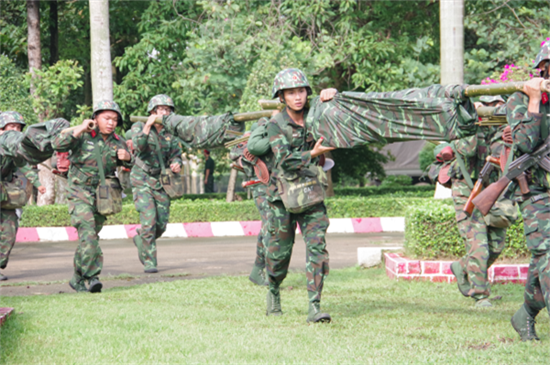 |
| Conducting manoeuvring drill |
Secondly, breakthroughs have been made in improving training quality and combat readiness. This constitutes the decisive content and solution directly determining overall quality and combat power. Accordingly, prior to training cycles, the Regiment directs the consolidation and organisation of training and refresher courses for cadres at all levels, from squad (weapon team) leaders upwards, with a focus on weak areas and newly introduced content. As a result, 100% of trainers have been trained in accordance with decentralised requirements; 91.2% of battalion-level cadres and 75% of company- and platoon-level cadres have achieved good or excellent training results; and 70% of squad (weapon team) leaders have effectively fulfilled their responsibilities in guiding and commanding troops during training. The Regiment attaches importance to investment in building training grounds and ranges, while promoting initiatives and technical innovations. Since 2021, more than VND 7 billion has been invested; 159 initiatives have been implemented, many of which have been effectively applied in the training process. In training activities, the Regiment adheres closely to the principle of “basic, practical, and solid”, placing emphasis on synchronous and in-depth training closely aligned with assigned missions, target audiences, operational terrain, and weapons and equipment authorised in the table of organisation. Training efforts focus on improving infantry technical and tactical proficiency, drill and discipline; intensifying long-distance marches, heavy-load carrying, and river-crossing exercises to enhance both the physical endurance and psychological resilience of troops. At the same time, the Regiment places strong emphasis on renewing the content and forms of exercises at all levels, particularly live-fire field exercises, in order to hone skills and immerse troops in conditions close to actual combat, thereby ensuring readiness to receive and successfully accomplish tasks under all circumstances. During the 2020-2025 term, 100% of inspections across all training subjects met requirements, with 78% or more rated good or excellent, and the Regiment overall assessed as good. With regard to new recruit training, 100% met requirements, with 76.7% or more achieving good or excellent results; grenade-throwing and demolition subjects were rated excellent, while AK sub-machine gun live-fire Exercise No.1 achieved a good rating. Annual live-fire exercises at levels ranging from squad to battalion have consistently been rated excellent, with absolute safety ensured. To successfully handle potential contingencies, the Regiment regularly disseminates and thoroughly educates cadres and soldiers on resolutions, orders, directives, and regulations concerning combat readiness, ensuring a clear understanding of the schemes and tactics of hostile forces, potential adversaries, and the unit’s tasks. It proactively reviews, adjusts, supplements, and completes the system of operational documents; A2 plans; and plans for fire and explosion prevention, forest fire prevention, disaster and incident response, natural disaster mitigation, and search and rescue, organising drills to achieve high proficiency. The Regiment strictly maintains duty rosters and ensures personnel readiness in full compliance with regulations. It also proactively coordinates with local party committees, authorities, and armed forces to maintain a firm grasp of the political security situation, social order, and safety in the area, and to develop coordinated response plans, thereby avoiding passivity or surprise in all circumstances.
Thirdly, regularity building and discipline training have been vigorously promoted. This is identified as both an objective and a key measure for building the Regiment into a comprehensively strong unit that is “exemplary and typical”, capable of successfully fulfilling all assigned tasks. Accordingly, the Regiment has thoroughly disseminated and concretised the strict implementation of higher-level documents, directives, and regulations on regularity building and discipline management, thereby effecting a marked improvement in awareness and compliance with the law and military discipline among cadres and soldiers. The Regiment requires cadres to work strictly in accordance with their assigned responsibilities and to act in conformity with regulations; to live, eat, work, and share daily life with the troops so as to understand their thoughts, sentiments, and aspirations - particularly those of servicemen facing difficult personal circumstances - thereby fostering unity and cohesion within the collective. Units strictly maintain daily, weekly, and ceremonial routines, as well as military bearing and conduct in line with regulations; closely integrate administrative management with ideological management; and coordinate among units, local authorities, and families in educating and managing troops. Emphasis is placed on the exemplary role, compassion, sense of responsibility, and model conduct of cadres and party members, while higher echelons proactively assist subordinate units in resolving difficulties. The Regiment exercises strict control over personnel strength and all troop activities at all times and in all places, including during rest periods and leave, ensuring that no violations of law or discipline occur. In parallel, it attaches great importance to effectively promoting the campaign “Building a good, healthy, and rich cultural environment in the Army”. Each year, more than 95% of agencies and units meet the standards for a good cultural environment. Gardens, greenery, panels, signboards, slogans, and displays are developed in a synchronous and uniform manner from headquarters to subordinate units; cultural, artistic, sports, physical training, and recreational activities are organised and maintained on a regular basis. These efforts orient troop activities towards fostering a healthy cultural life, pushing back social vices and preventing disciplinary violations. As a result, regularity building and discipline training have achieved clear and steady progress: minor disciplinary violations requiring administrative handling remain below 0.2%; there have been no serious violations of law or discipline; and no safety incidents in training or traffic accidents attributable to subjective factors.
Honoured and proud of its glorious tradition of 80 years of construction, combat, victory, and growth, Regiment 31 continues to strive to enhance its overall quality and combat power, successfully accomplishing all assigned missions and writing new chapters of achievement in the new era.
Colonel TRINH DANG PHU, Regiment Commander