
Training new soldiers is the first stage of decisive importance to forming military skills, qualities, and mettle of revolutionary soldiers, directly contributing to increasing the overall quality and combat strength of the entire Military.
Fully aware of that fact, over the years, Division 395 under Military Region 3 has taken many breakthrough measures to improve the quality of new soldier training and achieved encouraging results. The Division has consistently fulfilled its new soldier training tasks with excellence; 100% of the training contents have been rated good or excellent; absolute safety has been ensured, without any desertions, unauthorised absences, or violations requiring disciplinary action. In the process, the Division has drawn many lessons which are also seen as the measures for 2026.
First of all, the leadership and direction of party committees and commands at all levels over new soldier training are strengthened. Grasping resolutions, directives, and guidance from higher echelons, particularly the training order and conscription targets set by Commander of Military Region 3, the Division Party Committee annually issues a specialised resolution on leadership over the reception and training of new soldiers; at the same time, it directs party committees and commands of agencies and units to concretise its resolution into their own resolutions and plans relevant to their characteristics and tasks to ensure synchronisation, consistency, and high feasibility.
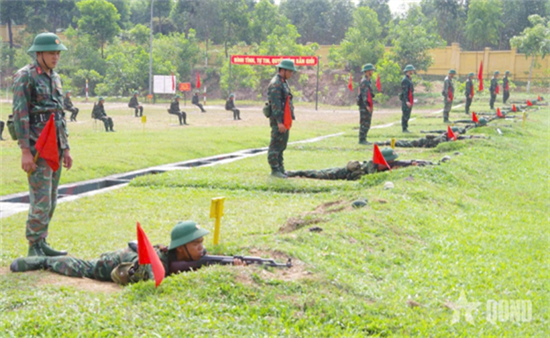 |
| A rifle shooting test held for new soldiers of Battalion 15 (photo: qdnd.vn) |
Besides, the Division assigns each party committee member and key cadre to directly monitor, inspect, and urge task execution at grass-roots level, taking training results as an important criterion for emulation and commendation. It strictly maintains briefing, inspection, and review regimes to promptly detect and rectify weaknesses as well as resolve arising difficulties. The role of staff, political, and logistics and technical agencies in providing guidance, inspection, and support to ensure close, smooth coordination among all forces is promoted. Moreover, the Division directs its agencies and units, especially those directly responsible for training, to intensify education and dissemination to raise awareness among officers and soldiers regarding the significance and importance of new soldier training, ensuring that all officers and soldiers thoroughly grasp the targets, requirements, advantages, and difficulties in the training of new soldiers. These efforts also help foster proper motivation and a strong sense of responsibility among troops and encourage officers and soldiers to proactively overcome hardships to fulfil all assigned tasks. As a result, high unity in both will and action is created, while the synergy and resolve to successfully accomplish this important mission is promoted.
Given the fact that new soldiers come from various regions with different education and physical fitness backgrounds, the Division focuses on screening recruitment sources, raising selection quality, and well performing the work of receiving new soldiers. In addition to selecting and assigning experienced officers to coordinate with local authorities during troop handover and reception, the Division directs its agencies and units to strictly take all steps under regulations, link officers’ responsibilities with the quality of soldiers from the outset, standardise plans for receiving new soldiers in a solemn, smooth fashion, assign forces to give detailed guidance and reception, and make thorough preparations, from organisational structure consolidation and cadre training to accommodation and daily living conditions, especially the very first meal, thereby creating a good impression from the first day at the unit and helping soldiers quickly integrate into and feel secure in their new environment. It closely coordinates with Military Hospital 7 to conduct health re-examinations under regulations, ensuring accurate assessment of troops’ health conditions as the basis for proper classification and training arrangements, creating favourable conditions for the subsequent stage.
Well performing preparatory work and holding preliminary training courses represent a measure prioritised by the Division to create a dynamic atmosphere and standardise training work from the very first days. Closely following directives and guidance from the Military Region, the Division directs its agencies and units to make comprehensive, careful preparations in personnel, facilities, and training grounds in order to best serve the task of training new soldiers from the outset. Emphasis is placed on consolidating the pool of cadres in charge of training new soldiers with a balance between experienced and young officers. Refresher courses for officers are organised with a focus on settling shortcomings from the previous year; attention is paid to new, important points such as methods of organising drills and correcting movements, skills in live-fire and grenade-throwing command and guidance during “three-explosion” tests, methods of grasping and conducting ideological work, and experience sharing in training, management, and discipline work. In particular, the Division has completed and employed the “skill set for identifying disciplinary violations and handling procedures”, thus improving its cadres’ capabilities in organisation, management, and command.
Moreover, to lay a solid foundation for achieving high results in official training, the Division actively organises preliminary training courses. Consideration is given to guiding and maintaining daily and weekly routines, military etiquette, barrack organisation and sanitation, helping new soldiers gradually become familiar with the military environment and develop disciplined conduct from the very first day and first week.
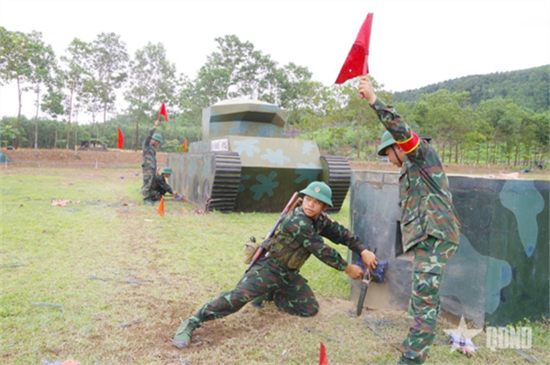 |
| Explosive detonation test for new soldiers (photo: qdnd.vn) |
In the training process, the Division focuses on renewing training contents and methods and strengthening safety assurance measures to contribute to comprehensively, sustainably improving the quality of training. Under the prescribed programme for training new soldiers, the Division requires its affiliates to effectively implement the motto “basics, practicality, solidity”, strictly maintain training procedures from theory to practice, take practical training as the main focus, and closely align explanation and demonstration with practice and correction. The role of model teams is promoted; the application of information technology, simulation, and electronic lectures integrating illustrative images and videos is stepped up; artificial intelligence is gradually applied in testing and assessment, thus enhancing visual vividness and helping soldiers quickly master training contents and movement essentials. The Division also strictly maintains regularity building and discipline in training from the very first hour and first week, attaching importance to correcting movements directly on the training ground, promptly and thoroughly remedying mistakes for each individual, preventing the formation of “bad habits”, especially in line-up regulations, infantry shooting techniques, grenade throwing, and explosive device assembly. After each exercise and training session, units across the Division organise competitions, testing, evaluations, and reviews as the basis for classifying trainees to adopt suitable mentoring and supplementary training measures and ensuring uniform progress.
Notably, most new soldiers have never been exposed to weapons and equipment; hence, safety risks are always present, especially during the “three-explosion” tests. To address this issue, the Division requires that before each training session, units thoroughly disseminate safety regulations and organise drills in accordance with full procedures, while officers directly and proficiently practise before troops conduct drills and tests. At the same time, inspection and supervision are strengthened throughout the process of practice and testing. As a result, since 2020, the Division has consistently ensured absolute safety in new soldier training, laying a solid foundation for comprehensively improving the quality of training.
In recent years, under the influence of various factors, especially the negative impacts of the Internet and social media, a number of new soldiers have shown a tendency towards limited communication and sharing; their psychology is easily affected and develops in complicated ways, which poses potential risks of disciplinary violation. Against that backdrop, the Division places special emphasis on ideological management, promoting the exemplary role of cadres, especially those directly responsible for management and training, creating closeness and trust and providing a firm spiritual support for new soldiers. Accordingly, immediately upon reception, units of the Division proactively grasp personal backgrounds and family circumstances, identifying special cases and assigning officers to monitor and assist them. The grass-roots democracy regulations are strictly implemented; activities such as “Political, cultural, and spiritual day” and “Comrades’ sharing sessions” are maintained; the role of “Three-strong teams” and “Pairs advancing together” is promoted to create an open environment for new soldiers to express their thoughts, resolve difficulties, and enable all-level cadres to grasp ideological developments, circumstances, strengths, and preferences of each individual in order to adopt appropriate management and education measures.
Leaving the protection of their families to enter the military environment with strict self-discipline is no small challenge for each new soldier. Therefore, cadres, especially at company, platoon, and squad levels - those who live, study, and train alongside new soldiers every day and every hour - play an extremely important role. From this practical reality, the Division requires its cadres to stay close to their troops, heighten education through demonstration and leading by example as the basis for soldiers to learn and follow. All-level cadres are required to closely combine education and persuasion with discipline maintenance in a serious yet flexible manner, avoid imposition and pressure, and assist new soldiers in making steady progress. Cultural, artistic, physical training, and sport activities are intensified to develop a healthy living environment and help new soldiers quickly integrate into their units. The Division enhances coordination with local authorities and families in the management and education of soldiers, maintaining two-way communication via appropriate channels to promptly exchange information on troops’ study and training conditions. It also maintains the practice of inviting local authorities and relatives of soldiers with good training results to attend the oath-taking ceremony for new soldiers, thus cementing military - civilian unity and spreading a sense of pride, honour, and responsibility among its troops. As a result, the work of managing and resolving ideological issues within the Division has achieved practical effectiveness; new soldiers have always felt secure in their duties and actively engaged in training.
With its high determination and recorded results and experience, Division 395 strongly believes that it will successfully accomplish the task of training soldiers in 2026 and subsequent years, continuously improve its overall quality and combat power, and remain ready to undertake and excellently fulfil all assigned missions.
Sr. Col. NGUYEN HUY TOAN
Commander of the Division