
Thoroughly grasping the guidelines set by the Party, the Central Military Commission (CMC), and the Ministry of National Defence (MND) on science and technology development, innovation, and digital transformation, the Air Defence - Air Force Service has been adopting various breakthrough measures, creating clear improvements in logistics and technical support, meeting the requirements of airspace management and protection, contributing to building a revolutionary, regular, elite, modern Service.
Stepping up science and technology development, innovation, and digital transformation constitutes a sound strategic line of our Party and State; it serves as a key driving force and strategic breakthrough to unlock resources and improve productivity, work efficiency, and national power. This is of even greater significance for the Air Defence - Air Force Service as a technical and combat force.
 |
|
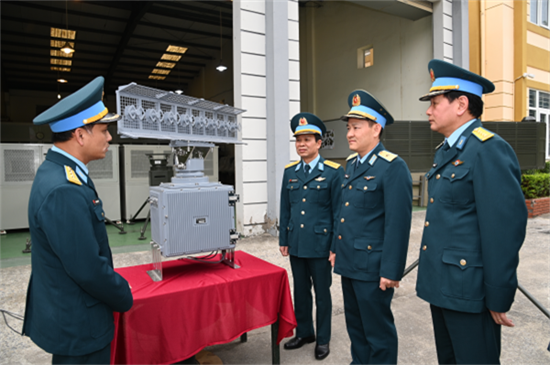
The Service Command inspects technical initiatives at Air Defence - Air Force Technical Institute |
Over the years, the Service’s Party Committee and Command have thoroughly grasped higher-level resolutions and directives, issuing Resolution 1953-NQ/ĐU, dated 28 February 2025, on breakthroughs in science and technology development, innovation, and digital transformation, Plan 474/KH-PKKQ, dated 29 January 2026, on digital transformation and the implementation of Project 06, together with a system of guiding documents to exercise their unified leadership and direction throughout the Service. These documents lay an important foundation for the Service’s Logistics and Technical Branch to formulate and adopt measures suited to the Service’s particularities.
With strong political determination and synchronised, appropriate measures, within a short period of time, the Logistics and Technical Branch has made positive progress in science and technology development, innovation, and digital transformation, directly contributing to improving the quality of support work. Notably, agencies and units across the Service have applied information technology in commanding and managing logistics and technical work, developing specialised databases, digitalising records, managing weapons and equipment via specialised software, adopting electronic document transmission and digital signature, promoting military administrative reform, thereby laying a foundation for turning logistics and technical agencies and units into "digital" ones. Research institutes, factories, and logistics and technical establishments across the Service have successfully carried out numerous scientific research projects and technical initiatives with high practical value. They have mastered many advanced technologies for the repair, upgrading, and integration of radar systems, missile systems, aviation equipment, and other technical assets, producing numerous "Made in Vietnam" components and products, contributing to enhancing self-reliance in technical supply support, extending the service life of equipment, and saving billions of VND. The professional competence of logistics and technical officers and employees has steadily improved, enabling them to better fulfil support tasks, particularly the operation, preservation, repair, and integration of modern weapons and equipment.
Alongside these achievements, science and technology development, innovation, and digital transformation within the Logistics and Technical Branch still face a number of shortcomings and challenges. Digital infrastructure and specialised databases remain incomplete; there is a shortage of high-quality technological personnel, particularly specialists in artificial intelligence (AI), big data, cyber security, and automation. To continue making breakthroughs in science and technology development, innovation, and digital transformation within its Logistics and Technical Branch, the Service will focus on several main solutions as follows.
First, renewing leadership thinking and enhancing awareness and resolve among technical staff at all levels. This is the fundamental solution to ensure that the task of science and technology development, innovation, and digital transformation within the Logistics and Technical Branch is performed in a coordinated, properly directed, effective manner. Accordingly, the Service will continue to direct the Logistics and Technical Department as well as its affiliates to grasp and translate higher-level resolutions, directives, and guidance into their own specialised resolutions and action plans suited to their functions and missions, with clearly defined objectives, road maps, priorities, and breakthroughs in every field of work. Methods of leadership, direction, and implementation will be renewed by shifting from traditional management to management based on data and digital technology. Efforts will be devoted to improving management mechanisms, promoting decentralisation and delegation of authority in conjunction with the responsibilities of commanders, and managing work according to clearly defined objectives, schedules, and deliverables, thereby ensuring unified, coordinated, effective, efficient leadership and direction.
Additionally, emphasis will be placed on education to raise the awareness and sense of responsibility of logistics and technical staff, particularly party committees and commands at all levels, regarding the role and importance of science and technology development and digital transformation in improving the quality of logistics and technical support. Innovative thinking, initiative, creativity, and the spirit of daring to think, daring to act, and daring to take responsibility will be encouraged, while conservative attitudes and reluctance to embrace new technologies will be handled. Inspection, preliminary reviews, and comprehensive evaluations will be strengthened to promptly resolve emerging difficulties and obstacles, replicate effective models and approaches, and create momentum for the modernisation of the Service's Logistics and Technical Branch.
Second, focusing investment on building synchronised, modern, secure digital infrastructure to facilitate staff, command, and management work for logistics and technical support. This is regarded as the principal breakthrough by the Service’s Party Committee and Command in building a unified, integrated digital ecosystem capable of ensuring seamless data connectivity and sharing, as well as in raising the quality of staff, command, and management work for logistics and technical support.
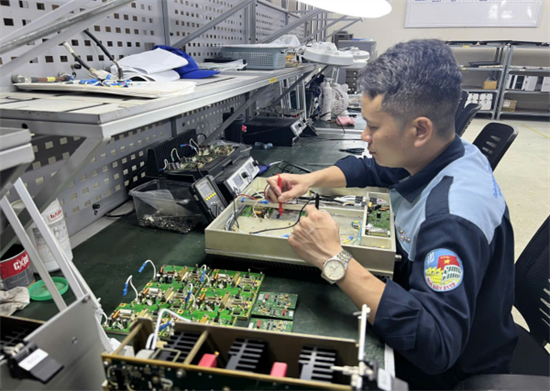 |
| A workers of Factory Z119 takes part in research and production operations |
The Service will continue to complete digital infrastructure from headquarters down to subordinate units in a synchronised, modern manner, with priority given to key logistics and technical establishments and specialised branches. It will gradually modernise data centres, servers, workstations, military data transmission networks, and cyber security solutions. Records relating to weapons, equipment, warehouses, supplies, fuel, quartermaster services, military medicine, transportation, and other areas will be digitalised rapidly. Specialised management software will be effectively operated to gradually establish digital methods of management and administration. Models such as “smart warehouses”, “smart factories”, and “smart hospitals” will be developed and expanded to improve the real-time monitoring and management of personnel, the operational status of weapons and technical equipment, and logistics and technical support. Electronic health records will be widely adopted, while digital services such as online medical appointment registration, medical consultation, result notification, and hospital fee payment will continue to be expanded. Efforts will be devoted to perfecting and launching a “logistics and technical management, synthesis, and reporting” software system, thereby raising the quality of staff, command, and management work across all areas of logistics and technical support.
Furthermore, attention will be paid to upgrading information security monitoring and warning systems, strengthening inspection and assessment of the security levels of databases, software, and information technology equipment. Digital skill training for professional staff at all levels will be intensified, digital working practices will be promoted, and strict compliance with regulations on information security and cyber security will be ensured so that digital transformation within the Logistics and Technical Branch can be implemented effectively, securely, and sustainably.
Third, developing a high-quality workforce capable of meeting both immediate and long-term mission requirements. Thoroughly grasping resolutions and directives of the Party, CMC, and MND on developing high-calibre human resources, the Service will continue reviewing and adjusting personnel planning, integrating training with professional development and employment to build an adept, compact, strong corps of logistics and technical officers and employees. Agencies and units across the Service will intensify training to equip personnel directly engaged in the management, operation, repair, and technical support of equipment at all levels with knowledge and skills in digital technology, AI, automation, and cyber security.
The “Digital Literacy” movement will be stepped up to turn staff members into “digital soldiers” capable of operating and exploiting modern systems for commanding and managing logistics and technical support. Cooperation with military and civilian educational institutions will be strengthened to develop a contingent of leading scientists and promising young officers in key disciplines such as radar technology, missile technology, electronics, aviation engineering, automation, new materials, cyber security, and AI. Further research will be conducted to give advice on improving mechanisms and policies for attracting, training, employing, and rewarding talented personnel, thereby creating favourable conditions for scientists and technical experts to maximise their research capabilities and make long-term contributions.
Fourth, promoting scientific research, actively expanding cooperation and technology transfer, enhancing self-reliance in logistics and technical support. The Service will continue realising the 2026 theme, “Resolutely researching and producing advanced, modern weapons and equipment”, with emphasis placed on research aimed at the improvement, modernisation, and service-life extension of weapons and equipment, localising materials and components, mastering technologies for the repair and integration of radar systems, missile systems, signal equipment, aviation equipment, and specialised technical production lines. Due regard will be paid to researching, acquiring, and gradually mastering foundational and core technologies essential to technical support, applying AI, big data, and digital technologies in command and management support for logistics and technical operations.
The Service will continue directing the establishment and development of strong research groups and specialist teams in key technological fields, focusing investment on highly practical products that directly help improve the quality of logistics and technical support. Cooperation with the Military Technical Academy, the Military Industry and Telecoms Group (Viettel), research institutes, and factories under the General Department of Defence Industry will be expanded in scientific research, technology transfer, the sharing of research and testing infrastructure, and the training of high-quality human resources to accelerate the acquisition and mastery of new technologies, thereby meeting the requirements of modernising logistics and technical support and building a modern Air Defence - Air Force Service capable of firmly protecting the Fatherland’s airspace under all circumstances.
Maj. Gen. PHAM TUAN ANH
Deputy Commander of the Air Defence - Air Force Service