
To meet the task requirements in the new era, in recent years, Signal Brigade 134’s Party Committee and Command have focused their leadership and direction on all aspects of their work. In this regard, making breakthroughs in the quality of training, regularity building, and discipline management has been identified as a central task aimed at improving the Brigade's overall quality and combat strength and bolstering its 60-year tradition of construction, combat, and development.
Signal Brigade 134¹, under the Signal Corps, was established during the fierce years of the resistance war against the US for national salvation.
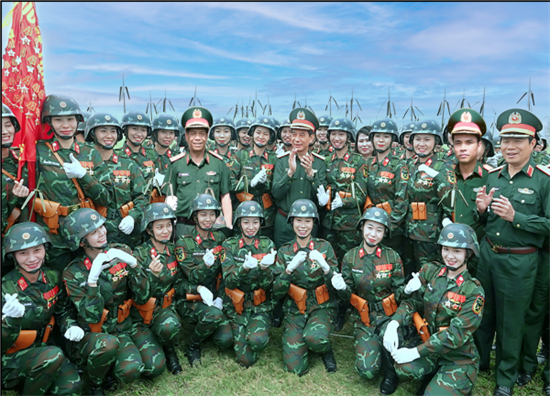 |
| Deputy Prime Minister, Minister of National Defence, Gen. Phan Van Giang gives encouragement to female signal officers during A50 mission |
Over the past 60 years of construction and combat, the Brigade has developed from a wired signal unit into a modern force. It has not only managed and operated traditional wired communications equipment but also received, managed, and efficiently employed new, high-tech, advanced, modern communications systems. Generations of the Brigade's officers, employees, and soldiers have remained united, surmounting countless hardships and challenges, ensuring seamless communications under all circumstances, achieving many brilliant feats of arms, making a worthy contribution to the heroic Signal Force’s glorious victories and tradition of “timeliness, accuracy, confidentiality, safety”. In recognition of these accomplishments, the Brigade was awarded the title of Hero of the People's Armed Forces by the State (20 October 1976), together with many other prestigious distinctions.
In recent years, as a strategic-level signal unit, the Brigade has been tasked with training, combat readiness, providing communications and television broadcasting support for leaders of the Ministry of National Defence (MND) in commanding agencies and units across the Military, ensuring routine communications support for agencies and units stationed in Military Regions 3 and 4, parts of Military Regions 1 and 2, and the Hanoi Capital Military Command.
The Brigade is stationed across a vast area, with affiliates dispersed over 41 locations in 13 provinces and cities, including numerous small, independent stations in remote, mountainous, border, ethnic minority areas, far from all-level headquarters and facing logistics challenges. Differences in troops’ educational backgrounds, together with the adverse effects of the market economy and complex social evils, have had a significant impact on the Brigade. Against that backdrop, the Brigade has directed its agencies and units to effectively perform all assigned tasks, with emphasis on making breakthroughs in the quality of training, regularity building, and discipline management, thereby contributing to building an “exemplarily, typically” comprehensively strong Brigade with great overall quality, combat strength, and capacity to ensure seamless, reliable communications under all circumstances.
Improving training quality - the central breakthrough to enhance combat power
Training quality is the key measure of combat readiness capability and the capacity to ensure communications for meeting mission requirements in all situations. Grasping higher-level resolutions, directives, and guidance on training work, agencies and units of the Brigade have made careful preparations and developed plans, with a focus on breakthrough innovations in training content, methods, leadership, and management. Great value has been attached to organising synchronised, specialised training towards modernity, taking political education as the foundation, regarding technical and specialised training as the priority, and improving cadres’ competence as the decisive factor. Attention has been paid to raising the proficiency of personnel responsible for routine communications support and combat readiness as well as highly mobile signal detachments, taking practical training as the core element, and guaranteeing relevance to assigned tasks and operational areas. Troops have been trained to be expert in traditional communications, highly skilled in mobile communications, and capable of mastering high-tech communications systems.
For officers, consideration has been given to improving their command and management skills, training them to master operational staff work relating to communications support, making them capable of closely managing and effectively operating communications systems, and broadening their knowledge in politics, socio-economic affairs, military science, technology, law, and foreign languages to meet their mission requirements.
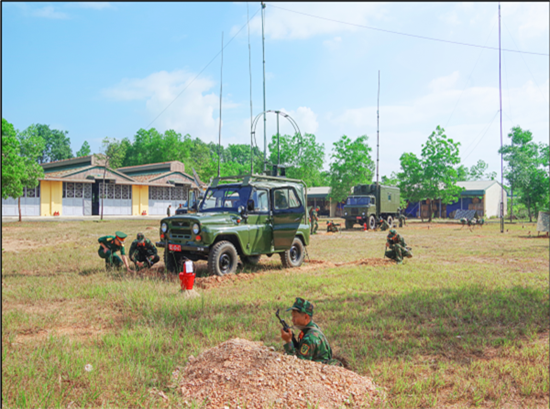 |
| Mobile signal units during a combat training course |
Professional servicemen and technical staff have been provided with training in advanced specialised knowledge and skills. Squad commanders have been trained to master methods of directing and correcting squad-level training, while technical staff, station commanders, and operators have been trained to become proficient in information technology and capable of operating and mastering both existing communications equipment and newly introduced modern, high-tech systems.
For its detachments, the Brigade has adhered to the principle of “basics, practicality, solidity”, applying training viewpoints, principles, and combinations effectively, emphasising synchronised, specialised training centred on practical exercises. Upon completion of training subjects, agencies and units have been required to master and fully exploit all the capabilities of technical equipment, especially newly introduced and upgraded systems, achieve high proficiency in specialised techniques and tactics, conduct independent operations, camouflage, and protection against enemy electronic warfare and high-tech weapons, and maintain the ability to manoeuvre flexibly under diverse combat, terrain, and weather conditions. Besides, mobile television teams have been developed to achieve strong professional competence, good skills, and flexible responses to operational situations.
For mobile communications units, training has been aimed at developing an “elite” force with high mobility, rapid deployment and withdrawal capabilities, flexible connectivity, and independent operations across all terrain and weather conditions. Units have conducted intensive infantry tactical training integrated with specialised tactics and operational plans to enable every individual to excel in their primary position and remain capable of undertaking one or two additional positions when required. Alongside training troops to master equipment and ensuring the independent operational capability of each team and detachment, the Brigade has strengthened integrated specialised training among its teams and stations, including the deployment, interconnection, and withdrawal of communications networks, stations, and switching centres of various scales under night-time, harsh terrain and weather, electronic and high-tech warfare conditions. Basic programme training has been closely combined with direct training conducted during mission execution.
Given their dispersed deployment, units of the Brigade have properly adjusted their training methods. They have strictly sustained training routines, intensifying exercises on mobile communications and television support across different forms of combat, simulated scenarios, diverse types of terrain, and harsh operating conditions. Training contests have been closely organised as the basis for drawing lessons and correctly evaluating training outcomes. Each year, the Brigade completes 100% of the prescribed training programme for all target groups, with training quality improving significantly. In 2025, all training subjects were rated good or excellent, with specialised subjects being rated excellent. The Brigade performed outstandingly in ensuring communications and television support for major political events of the nation and the Military, particularly the A50 and A80 missions, earning high praise and recognition from leaders of the MND and the Signal Corps.
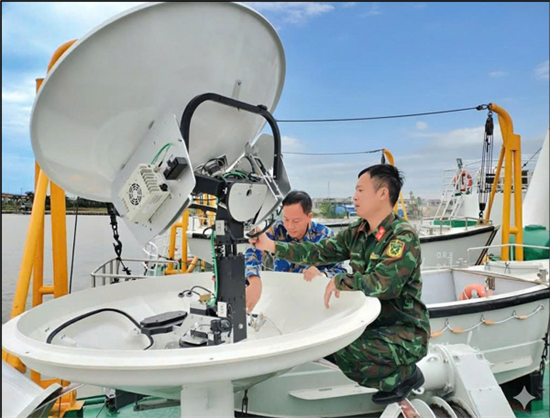 |
| Technical support for communications equipment on a vessel of Naval Region 1 |
Breakthrough in regularity building and discipline management - the foundation for stability and development
Regularity building and discipline management constitute a fundamental, consistent part of the building of a comprehensively strong Brigade, aimed at ensuring unity in both will and action and laying a foundation for fostering Brigade’s overall quality, stability, and sustainable development.
In regularity building, the Brigade has focused on improving all-level commanders’ performance of duties and tasks, particularly regarding accountability and inspection work. Accordingly, commanders from squad to company levels shall inspect their units on a daily basis; battalion-level commanders shall conduct inspections at least once each week; Brigade commanders shall inspect at least one battalion and one subordinate company on a monthly basis; Brigade headquarters shall carry out unannounced inspections of five to seven companies, platoons, and stations every quarter. Moreover, the Brigade has consistently maintained daily and weekly routines, ensuring proper military etiquette, standardising signs, noticeboards, and internal administrative arrangements appropriate to each agency and unit.
In discipline management, the Brigade has strengthened education to raise awareness and a sense of responsibility among its troops regarding the observance of law and discipline. It has proactively reviewed, supplemented, refined, and rigorously implemented regulations on troop management at all levels. Alongside managing personnel numbers, agencies and units across the Brigade have stepped up oversight of troops’ quality, health, ideology, family and social relationships, particularly during their days off, rest hours, off-base duties, independent missions, and leave. In particular, agencies and units of the Brigade have effectively maintained the “self-awareness - self-management - self-improvement” model in ideological work and troop management. They have promoted the role of their mass organisations, Soldiers’ Councils, “psychological and legal advisory teams”, “three-strong teams”, and “security soldiers”, closely coordinating with local party committees and authorities and soldiers' families in the work of troop management and education. At the same time, the Brigade has made effective use of its surveillance camera systems deployed across all 41 locations, transmitting live images directly to the Brigade's duty office and headquarters for continuous monitoring, inspection, and supervision. As a result, it has obtained great progress in troop observance of discipline, with the overwhelming majority of its officers, soldiers, and employees demonstrating their self-improvement and strict compliance with State law and military discipline; there has been no violation arising from lax management.
In recognition of its achievements, particularly in training, regularity building, and discipline management, the Brigade was awarded the MND Emulation Flag of 2025. On the occasion of its 60th founding anniversary, it was honoured by the State with the Second-Class Fatherland Protection Order. These noble rewards provide an important source of motivation for the Brigade to keep making breakthroughs and achieving sustainable improvements in the quality of training, regularity building, and discipline management, bolstering its tradition of “loyalty, dedication, confidence, creativity, compassion” in the new era.
Sr. Col. NGUYEN QUANG TRUY
Brigade Commander
_____________________
1 - Formerly Signal Regiment 134, established on 8 August 1966 on the basis of Signal Battalion 134 - the first long-distance wired signal unit of the Vietnam People's Army). Following various organisational adjustments, under Decision 1093/QD-BQP, dated 20 April 2009, by the Minister of National Defence, Signal Regiment 134 was reorganised into Signal Brigade 134.