
Searching, collecting, and identifying the remains of martyrs is a particularly important political task; it is a sacred responsibility and duty that reflects the morality and profound sentiments of our entire Party, People, and Army toward the noble people who sacrificed their lives for the nation's independence. With this significance, the army and people of Military Region 4 continue to drastically implement the guidelines and solutions for successfully carrying out this highly important and meaningful task.
Throughout the struggles for national independence, defence of the Fatherland, and the fulfillment of noble international duties, Military Region 4 has had over 179,000 martyrs. According to the results of site investigations and the mapping of martyrs' remains, the number of martyrs originally buried in the region is 138,911; of these, 64,613 sets of remains have been collected; 30,824 remain unfound; and 43,474 still lack information. For the volunteer soldiers and Vietnamese experts who sacrificed their lives in Laos, Military Region 4 has found and collected 24,362 sets of remains.
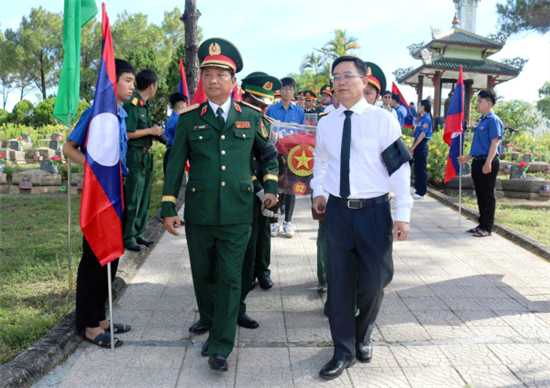 |
| Lt. Gen. Ha Tho Binh, commander of Military Region 4 participates in the visitation and burial ceremony of martyrs' remains in Hue city. |
In response to and conducting the “500-night-and-day Campaign to accelerate the search, collection, and identification of martyrs' remains” launched by the National Steering Committee, Military Region 4 has considered this a particularly important political task which must be thoroughly grasped and synchronously implemented with the highest political determination to achieve the set goals. Based on a thorough grasp of the viewpoints, guidelines, policies, and directives of the Party, State, Central Military Commission, and Defence Ministry on the search, collection, and identification of martyrs' remains, Military Region 4 Party Committee and Command have led and directed the synchronised implementation of solutions; promoted the role of the Standing Office of the Steering Committee in their advising on the building and issuance of action programmes and plans; and directed the implementation in close with the reality according to the “6-clear” principle, linking the leaders’ responsibility with the results of carrying out this important task.
Under the leadership and direction of the Military Religion’s Party Committee and Command, the Military Religion’s Steering Committee have actively gathered information, conducted surveys, searched for and collected martyrs' remains in the assigned areas in a strict manner and correct regulations; promoted the role of the Veterans Association, especially members who fought on the battlefields where the martyrs fell, to provide information; benefited from the dedicated and effective cooperation and assistance of the Party committees, authorities, armed forces, and people in Laos in their guiding and identifying martyrs' graves, searching and collecting the remains; and recognised the efforts of all organisations, forces, officers, and collection teams, etc. Hence, from the Campaign’s launching day to 9 June 2026, the entire Military Religion collected 170 sets of martyrs' remains; organised the memorial services, funeral rites, and burials in a strict, solemn, and thoughtful manner, which has been highly appreciated by public opinion.
Besides, the Military Religion has directed localities to conduct surveys of 100% of the martyrs' cemeteries in their areas on the history of collected remains, management, care, and related information. They have proceeded to count and compile statistics on martyrs' graves (with complete information, missing information, unidentified information, mass graves, etc.); analysed by period (anti-French, anti-American, national defence); subject; time of construction, repair, and renovation, thereby analysing and evaluating the status of unidentified martyrs' graves to advise and propose the collection of DNA samples. They have also established working groups and teams for collecting martyrs' remains, and specialised teams; increased professional forces (of military medicine, information technology), which could fulfill the task requirements and local realities; selected and assigned tasks to cadres, personnel, and soldiers with good morality, firm political stance, high responsibility, enthusiasm, dedication, good health, and suitable expertise in the “6-clear” principle; organised the professional training on taking samples, searching, collecting, and identifying martyrs' remains, of which, focusing on professional procedures and methods for collecting, managing, preserving, and handing over samples; and improved the proficiency in exploiting, managing and using software for the map database and information management on the search and collection of remains, ensuring the consistency, accuracy, synchronisation, and sufficient means, equipment, materials, and working conditions for the forces.
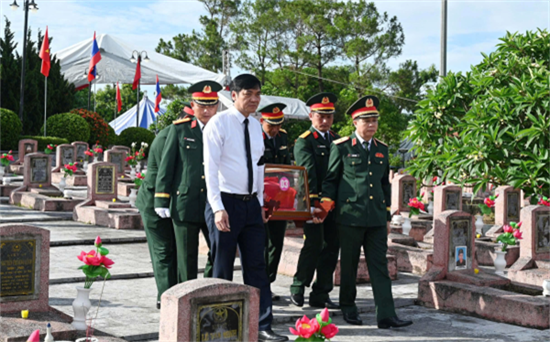 |
| Mar. Gen. Le Van Trung, deputy political commissar Military Region 4 participates in the visitation and burial ceremony of martyrs' remains in Nghe An province. |
The Military Region have directed Nghe An province to concentrate forces, means, and funds to organise the sampling and handover of martyrs' remains at Nghi Loc Cemetery (Dong Loc commune) in strict, scientific, and correct procedures, serving as a foundation for the National Steering Committee to hold a conference to learn lessons and replicate in other military regions, provinces, and cities nationwide. After that, Thanh Hoa, Ha Tinh, Quang Tri provinces and Hue city selected 01 martyrs' cemetery to take martyrs' remains samples before deploying it simultaneously.
During the implementation, the Military Region has developed many creative and effective methods for other localities to study and apply properly in their specific conditions, such as: applying the methods and experience in sampling remains by the collection teams returning from their 2025-2026 dry-season tasks in Laos; promoting local resources including militia and self-defence forces, youth union members, women, and people who regularly work at cemeteries; and developing a solution using ventilation pipes drilled into the covers of cinerary urns so that after DNA analysis results are obtained, the samples can be conveniently returned to the urns, etc. All localities have thoroughly grasped and strictly followed regulations on the management, provision, and use of information; well ensured the security and safety while doing tasks, especially during the process of sampling and handing over the remains; promoted the role of core and specialised forces in combating distorted and untruthful ideas about the tasks, purposes, and significance of the Campaign; maintained the absolute safety for personnel, vehicles, equipment, and data, etc. As a result, by early June 2026, the entire Military Region has exhumed 1,051 martyrs' graves, of which, 809 were eligible and already sampled, and properly handed over to the testing units in accordance to regulations, and implemented simultaneously on a wide scale.
However, the process of searching for, collecting, and identifying martyrs' remains has still faced many difficulties, such as: the number of martyrs who sacrificed their lives in wars within the Military Region 4 area and the 10 provinces in Laos was very large, but most of the archived records have been lost; information about martyrs and their graves was increasingly scarce and difficult to verify; the uncollected martyrs' graves were scattered mainly in remote and mountainous areas, which were significantly affected by socio-economic development and urbanisation; the success rate of sampling may be low because the remains in martyrs’ cemeteries have been buried for a long time, etc. These difficulties have been significantly affecting the search, collection, and identification of martyrs' remains.
For the Campaign to obtain good results, Military Region 4 continues to lead and direct the concentration of all resources to effectively implement several solutions as follows.
Firstly, continuing to thoroughly grasp the Party’s guidelines, policies and the State’s laws on the work of searching, collecting, and identifying martyrs' remains; promoting the leadership, direction, and involvement of the entire political system. The Steering Committee and its standing offices at all levels must strengthen their inspection, guidance, and grasp of the situation in their areas; synchronously implement solutions; enhance propaganda and information collection; create all conditions and resources, and promote the combined strength to ensure synchronised coordination between military agencies and local departments, sectors, and localities in implementation; focus the leadership and direction on accelerating the progress and effectiveness of searching, collecting, and identifying martyrs' remains, striving to complete the assigned targets.
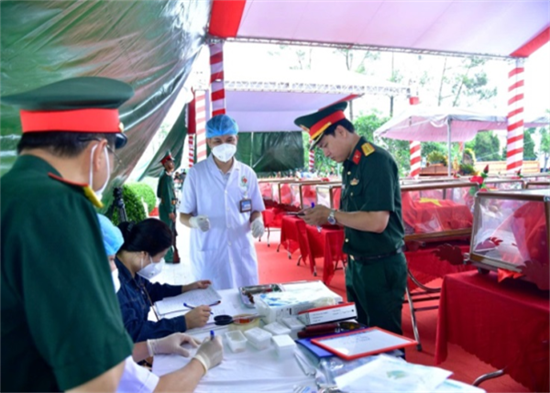 |
| Keeping records of martyrs' remains as required by procedure |
Secondly, reviewing and completing the system of leading and directing documents; strictly building plans and organising the sampling and handover of martyrs' remains, closely aligned with the characteristics and situation of the areas, in synchronisation at all levels. During the implementation, it is to focus on building forces with sufficient personnel, high professional quality, and a high sense of political responsibility; promote a dedicated and thoughtful spirit in every step and stage; promptly encourage the working groups and specialised teams on duty; strictly manage the sampling, information digitisation, and handover of remains in a procedural, scientific, safe, accurate, and effective manner, helping Thanh Hoa, Nghe An, Ha Tinh provinces to complete the sampling of martyrs' remains lacking information for DNA testing in 2026, Hue city before February 2027, and Quang Tri province before May 2027.
Thirdly, enhancing the propaganda and education to raise the awareness and responsibility among all levels, sectors, and the entire society for the work of searching, collecting, and identifying martyrs' remains. In this regard, propaganda must be conducted regularly and continuously in diverse, practical, and effective forms; combining propaganda in newspapers, radio, television, digital platforms, and social networks with visual propaganda, cultural and artistic activities, meetings with historical witnesses, storytelling, and paying tribute to martyrs' families, etc., making cadres, soldiers, and the people deeply aware that this sacred task is not only the responsibility of the army but the common one of the entire political system and society; focusing on spreading beautiful images and examples of responsibility, dedication, and humanity, thereby encouraging the entire people to provide information about martyrs and their graves, combating the hostile forces’ distorted and subversive arguments and manifestations of irresponsibility toward this noble task.
Finally, timely providing fund for the task under the Government’s regulations; managing and using it strictly, in the right purposes and regulations; paying attention to caring for and ensuring benefits and policies for the forces directly performing the duties, at the same time, mobilising resources and the combined strength of all levels and sectors, and the participation of the whole society, taking this as not only an immediate task but also a long-term political duty that must be carried out with sentiment, responsibility, and profound gratitude toward the Heroic martyrs and their families.
Bringing into play the achieved results, the armed forces of Military Region 4 continue to overcome difficulties, concentrate all resources, and accelerate the implementation of the Campaign with the highest spirit and responsibility. Each martyrs' grave found and identified is another time we fully fulfill the nation's fine moral principles of “When drinking water, remember its source” and “Paying debt of gratitude”.
Major General LE VAN TRUNG, Deputy Political Commissar of the Military Region