
Recognising the position and importance of defence and security education for students - the future generation of the country - Dai Nam University has implemented a wide range of synchronised measures to innovate and improve the performance of this important task.
Dai Nam University is an application-orientated, multidisciplinary higher education institution with the mission of “Educating learners so that, upon graduation, they enjoy a good life and become good citizens, contributing to the strong development of the nation’s education system”. Over the years, the University has consistently focused on building a comprehensive educational environment. In this regard, renewing and improving defence and security education has been identified as one of the key tasks aimed at fostering political steadfastness, a sense of discipline, and civic responsibility among students and meeting the requirements of Fatherland construction and protection in the new era.
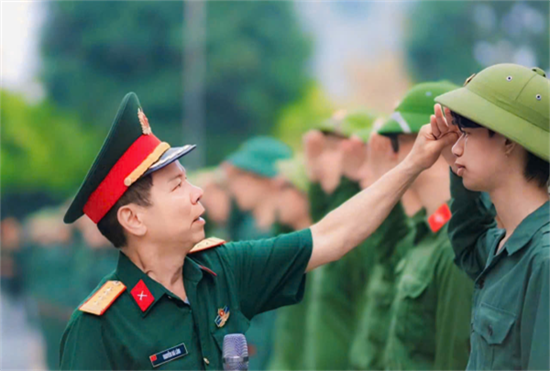 |
| Giving guidance to students on line-up regulations |
Innovation in leadership thinking, awareness, and action in defence and security education
For any higher education institution, the quality of education and training in general, defence and security education in particular, depends first and foremost on the awareness and sense of responsibility of all stakeholders, from party committees, the Board of Directors, cadres, and lecturers to students.
Therefore, over the years, Dai Nam University has always attached importance to promoting the core role of the Faculty of Politics, National Defence, and Physical Education in advising the University Board on developing and implementing annual training programmes and plans suited to the University’s specific circumstances. Due attention has been paid to renewing teaching methods, student management and training, and support work. Based on the Faculty’s advice, in recent years, instead of teaching the subject in the middle or final stages of academic programmes, the University now introduces the course in the first semester so as to cultivate disciplined study habits and self-discipline among students from the outset and lay a foundation for raising the quality of other subjects. This reflects an important shift in the University’s leadership approach to defence and security education.
At the same time, the University has strengthened awareness-raising and educational activities to enable all target groups to fully understand the significance and importance of the subject, thereby fostering motivation, self-discipline, and initiative in teaching, learning, self-improvement, and training. Particularly, emphasis has been placed on eliminating simplistic and formalistic perceptions that defence and security education is merely a “minor subject”, while individual accountability and performance have been linked to teaching quality and student management.
Building a highly qualified, dedicated, innovative teaching staff
The University’s Development Strategy to 2027, with a vision towards 2037, identifies the following objective: “To focus on building a team of highly competent lecturers who are devoted to their profession, the University, and their students, and constantly innovative in their work”. To that end, the University has introduced numerous measures to develop a contingent of lecturers of defence and security education sufficient in number, standardised in quality, ensuring continuity and long-term development, and characterised by innovation, enthusiasm, and dedication to students.
At present, the Faculty has 30 officers and lecturers in charge of the subject of Defence and Security Education, including 2 doctoral degree holders and 10 master’s degree holders. All of them have received appropriate specialist training and generally met their current task requirements. However, in order to meet the demands of expanding enrolment, the University has continued to recruit additional lecturers, giving priority to postgraduate degree holders, retired military personnel, and former military officers transitioning to civilian positions, with considerable practical experience and technological application capabilities. Great value has been attached to recruiting seconded military officers as part of the road map to develop the Faculty of Politics, National Defence, and Physical Education into a Defence and Security Education Centre in the years ahead.
Alongside strengthening its teaching staff, the University has concentrated on raising the quality of lecturers in a comprehensive and specialised manner, ensuring their adaptability to educational reform. Accordingly, in addition to selecting and sending its lecturers for postgraduate training, professional development, pedagogical training, digital transformation, and artificial intelligence (AI) application programmes, the University has directed the Faculty to regularly maintain teaching excellence contests, classroom observations, and post-observation reviews. Lecturers have been encouraged to engage actively in scientific research, compile textbooks and digital learning materials, and improve training models and aids. At the same time, consideration has been given to fostering a sense of responsibility, dedication, and creativity among lecturers, enabling them to serve as mentors, source of inspiration, and trusted companions for students in the process of study and self-improvement. These efforts have contributed to building a modern, humane educational environment characterised by discipline and creativity in accordance with the University’s development orientation.
Comprehensive innovation in teaching - learning content and methodology
One of the most notable innovations in the University’s defence and security education in recent years has been the comprehensive reform of teaching - learning content and methods in a practical and modern direction, with learners being placed at the centre of the educational process to facilitate the holistic development of their qualities and competencies. Closely following the framework curriculum and guidance of the Ministry of Education and Training and higher-level Defence and Security Education Councils, the University has regularly reviewed, updated, and supplemented content relating to the Party’s lines and the State’s laws and policies on defence and security, non-traditional security challenges, developments in the regional and international environments, and the requirements of safeguarding the Fatherland in the new situation. The University has organised extracurricular activities and field studies at Vietnam Military History Museum, creating practical learning environments to help students gain a more comprehensive understanding of the task of Fatherland construction and protection.
In addition to content reform, the University has focused on innovating teaching methods by shifting from knowledge transmission to competency development, promoting students’ initiative, creativity, and self-learning. Particularly noteworthy is the University’s “flipped classroom” model combined with AI applications in teaching and learning. Under this approach, all lecturers have been required to apply information technology and AI and make greater use of images and practical examples to transform lecture content into video-based learning materials. Students, for their part, have been required to study the materials provided in advance and prepare presentations in the form of videos or short clips based on their assigned topics. During lessons, student groups present their assigned topics, while other groups contribute additional viewpoints. Lecturers then guide discussions, offer further insights, and draw conclusions. This approach helps stimulate initiative, self-learning, teamwork skills, and the ability to adapt to modern learning environments.
With regard to practical training, the University has followed a progressive training approach, from simple to complex tasks and from basic to advanced skills. Subjects such as line-up regulations, infantry combat techniques, and marksmanship have been organised scientifically and rigorously to enable students to master and correctly perform procedures and movements and cultivate their sense of discipline, organisational awareness, and teamwork spirit.
Furthermore, the University has renewed its testing and assessment methods in a more substantive, objective, and transparent fashion. In addition to traditional forms such as essay examinations, multiple-choice tests, and oral examinations, the University has organised military-themed contests, including “Knowledgeable Soldier”, “Excellence in Barracks Management and Drill Formations”, and “Military Arena”, in order to provide a more accurate assessment of students’ competencies, eliminate achievement-orientated practices, create a vibrant competitive environment, strengthen solidarity, and enhance students’ interest in the subject.
Building a healthy military cultural environment via modern facilities and digital transformation
To ensure that each course truly provides students with the experience of “living in a military environment”, the University has focused on building a healthy, well-regulated, and disciplined military cultural environment. Accordingly, in addition to organising students into companies, platoons, and squads in accordance with established regulations, the University has assigned officers and lecturers to directly supervise daily study and training activities. Daily and weekly routines have been strictly maintained, while technology has been applied in student management through measures such as smart attendance systems and dormitory access control via magnetic cards. Besides, the University has created an educational environment suited to students’ psychological characteristics and age group. Management staff and lecturers have been required to serve as role models, demonstrate their sense of responsibility and dedication, and use their exemplary conduct to educate and guide students. The University has also strengthened cultural exchanges, artistic activities, and community service projects to foster a dynamic, united, humane learning and training environment.
To meet the requirements of defence and security education in the new era, the University has made investments in facilities and equipment in an integrated and modern manner. Apart from the use of general lecture halls, priority has been given to modern specialised classrooms and dedicated training grounds equipped with sufficient models, weapons, equipment, and training materials, including modified training rifles, MTB-3 shooting simulators, training grenades, instructional models, visual aids, dormitories, and dining facilities, as well as other supporting infrastructure, thereby ensuring the best possible conditions for students’ study and daily life. However, to meet the demands of expanding enrolment in the coming years, the University is actively mobilising resources to implement a project for constructing a dedicated defence and security education training area in Luong Son commune, Phu Tho province, with standardised training grounds and synchronised, modern infrastructure capable of accommodating more than 1,000 students per course. Moreover, the University continues to promote information technology application and digital transformation in management, administration, and teaching activities. To date, the University has completed a fully digitalised student management system covering admission, class assignment, personnel management, discipline maintenance, and the assessment of academic performance and student conduct. The University is concentrating on digitalising documents and textbooks, developing electronic lectures, digital learning resources, question banks, 3D simulation systems, and a shared electronic library and teaching database to create a modern and flexible learning environment.
With its great resolve and synchronised, appropriate solutions, since 2021, Dai Nam University has delivered numerous Defence and Security Education courses for over 11,700 students. 100% of the students have met the required standards, with over 75% achieving good or excellent results in this subject. The University has been regarded as one of the leading institutions in defence and security education among academies and universities nationwide.
Building on these achievements, the University is striving to develop the Faculty of Politics, National Defence, and Physical Education into a Defence and Security Education Centre, thereby further improving the quality of defence and security education and contributing to training high-quality human resources for the cause of Fatherland construction and protection in the new era.
Sr. Col. NGUYEN BA LAM, PhD
Head of the Faculty of Politics, National Defence, and Physical Education