
Stationed in an area facing numerous socio-economic challenges, Economic–Defence Unit 356 has effectively implemented the “Skilful Mass Mobilisation” emulation movement through various innovative models and approaches. These efforts have contributed to improving the People’s living standards, strengthening the great national unity bloc, consolidating the “people’s hearts and minds posture,” and maintaining political stability as well as social order and safety in the border area.
Economic–Defence Unit 356 under Military Region 2 performs its tasks in Dao San and Si Lo Lau Communes, Lai Chau Province—an especially disadvantaged border region characterised by rugged and highly fragmented terrain, a high proportion of poor and near-poor households, and latent complexities in political security and social order.
Deeply imbued with the principle that “the People are the root” and that “all tasks can be accomplished through skilful mass mobilisation,” and thoroughly implementing the resolutions and directives of the Party, the Central Military Commission, the Ministry of National Defence, and the General Department of Politics on mass mobilisation work, the Party Committee and commanders of the Unit have identified the “Skilful Mass Mobilisation” emulation movement as a central and enduring component of the Unit’s fulfilment of its political tasks.
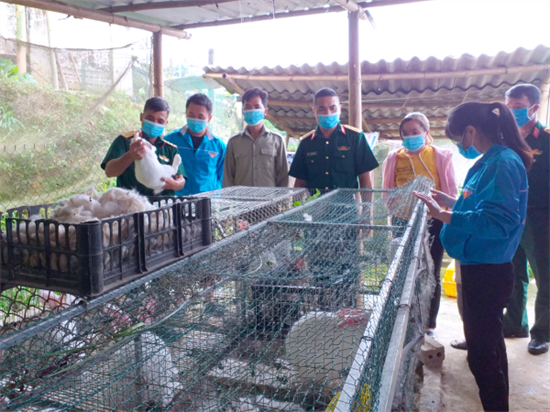 |
| Instructing local People in raising livestock |
The Unit Party Committee promulgated Resolution No. 217-NQ/DU, dated 29 September 2020, on strengthening leadership and direction to improve the effectiveness of mass mobilisation work in the new situation. The Resolution clearly defined objectives and targets for each production team and residential cluster, taking economic development outcomes, improvements in the People’s livelihoods, and the maintenance of defence and security in the area as key evaluation criteria. The responsibilities of party committees and commanders at all levels were specified in detail, while cadres assigned to localities were required to maintain a thorough understanding of demographic conditions, customs, traditions, and the living conditions of individual household groups and villages. Inspection, preliminary reviews, final reviews, and lessons-learned activities have been conducted regularly, enabling the timely adjustment of methods and approaches to suit local conditions and the Unit’s missions. Through this comprehensive and systematic implementation, the “Skilful Mass Mobilisation” emulation movement has become increasingly substantive, generating marked improvements in awareness, responsibility, and implementation effectiveness.
Stationed in an area where more than 90 per cent of the population are ethnic minorities, with uneven educational levels and diverse customs and traditions, the Unit Party Committee and commanders determined that, for the “Skilful Mass Mobilisation” emulation movement to achieve substantive results, it must first be “skilful” in educating and mobilising the People. Guided by the principle of “understanding the People in order to make them understand, trust, and follow,” the Unit has continuously renewed the content and methods of its mobilisation activities to suit local conditions and the characteristics of different ethnic groups. Particular emphasis has been placed on implementing the “four together” approach, living, eating, working, and speaking ethnic languages together with the People. Cadres and soldiers have actively learned local languages and familiarised themselves with the customs, traditions, and aspirations of the People so as to adopt appropriate communication methods. The Unit has also leveraged the core role of its cadres, employees, young volunteer intellectuals, and ethnic minority servicemen, while promoting the influence of village elders, village heads, and reputable members of local communities in persuading residents to abandon outdated customs and practices and build a new cultural way of life.
Through its close engagement with local communities and sustained presence in the area, the Unit Party Committee and commanders recognised that mass mobilisation can only be sustainable when closely associated with improving the People’s livelihoods. Accordingly, the Unit has mobilised and prioritised resources to support economic development and sustainable poverty reduction. The implementation of the “Skilful Mass Mobilisation” emulation movement and the building of a “Good Mass Mobilisation Unit” have been integrated with socio-economic development programmes and projects, particularly the Phong Tho Economic–Defence Zone Project (Lai Chau Province), the National Target Programme for Socio-Economic Development, and the model of military units working in close association with ethnic minority and mountainous communities during the 2021–2025 period. To date, the Unit has completed and handed over numerous civilian infrastructure projects that have been effectively put into operation, including the road linking Senh Sang A, San Cha, and Ma Can Villages in Dao San Commune (over seven kilometres), the domestic water supply system serving villages in Pa Vay Su Commune, and the Mo Si San Village kindergarten in Mo Si San Commune (with a water supply network extending over fourteen kilometres), among others. These projects have not only improved local living and production conditions but also contributed to fulfilling defence and military requirements.
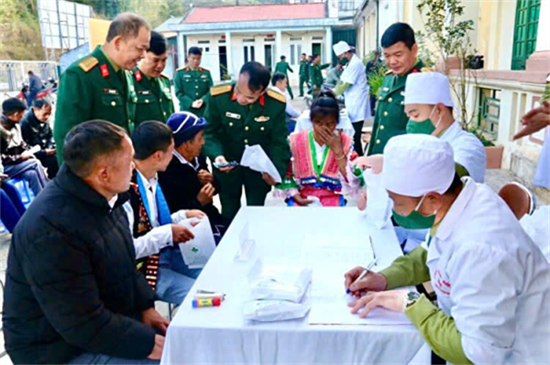 |
| Conducting healthcheck for local People |
Particular attention has been devoted to developing pilot models from which lessons can be drawn and replicated on a wider scale. To date, the Unit has successfully established and implemented eleven “Skilful Mass Mobilisation” models, including eight livestock production models and three crop cultivation models. Key initiatives include breeding buffaloes, cattle, and horses for reproduction; raising cold-water fish, indigenous black pigs, and commercial rabbits; and cultivating cymbidium orchids, ornamental peach trees, and medicinal plants. In addition, the Production Teams and Political Base-Building Teams, together with Enterprise 56, have proactively coordinated with businesses to prepare breeding stock and seedlings and provide initial care before transferring them to local households. Cadres are assigned to provide direct, hands-on guidance, supporting residents throughout the entire production process, from selecting suitable breeds and varieties, organising production, and providing technical care to marketing and product consumption. Particularly noteworthy is the model entitled “Each serviceman assists one poor household in economic development,” which has brought about positive changes in local people’s awareness, production methods, and living standards. The initiative has also contributed significantly to strengthening public trust and consolidating a firm “people’s hearts and minds posture” in the border area.
Given the harsh natural conditions, rugged and fragmented terrain, underdeveloped infrastructure, and the many hardships still faced by local communities, together with limited access to education and healthcare services, the Unit has focused on implementing practical and sustainable social welfare programmes. Since 2020, the Unit has supported the construction of 35 houses for poor households and one great national unity house; organised nine literacy and post-literacy classes for more than 300 local residents; conducted numerous medical examination and treatment programmes, health consultations, and free medicine distribution campaigns; and actively participated in disaster and epidemic response efforts in the area. In particular, the initiatives “Accompanying border-area students,” “Sponsoring students in especially difficult circumstances,” and “Hot meals for children at school” have been maintained effectively, helping to reduce school dropout rates while improving educational opportunities and healthcare conditions for border-area communities. Through these efforts, the Unit has continued to enhance the noble image of “Uncle Ho’s Soldiers” in the hearts of ethnic minority communities.
In implementing the policy of establishing a two-tier local government system, the grassroots political system in the area has achieved a number of significant initial results. Nevertheless, shortages in the number of grassroots cadres and uneven levels of professional competence remain major bottlenecks that directly affect the performance, effectiveness, and efficiency of local political institutions. In response, the Unit has proactively coordinated with local party committees, authorities, and relevant forces to strengthen the grassroots political system. Priority has been given to consolidating party organisations, local authorities, and mass organisations; improving the managerial and administrative capacity of grassroots cadres; developing and supplementing village conventions and regulations; and providing national defence and security education for relevant groups, thereby contributing to the enhanced performance of local defence and military tasks.
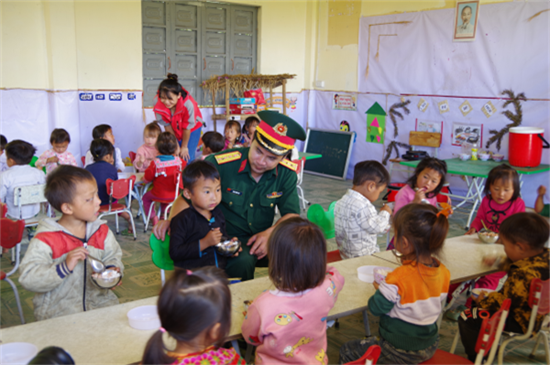 |
| Feeding local pupils at their schools |
The Unit has assigned cadres to participate directly in grassroots activities, providing guidance and assistance to party organisations, local authorities, and mass organisations in strengthening their leadership capacity and task implementation. Particular emphasis has been placed on mass mobilisation, party membership development, party cell activities, and improving the management and administrative capabilities of village cadres and reputable community figures. Throughout the process, the Unit has consistently adhered to the principle of “staying close to the People, remaining close to the grassroots, working concretely, and delivering practical results,” while proactively monitoring local developments and promptly advising on the resolution of emerging issues at the grassroots level. These efforts have contributed to consolidating and enhancing the leadership, management, and administrative capacity of the grassroots political system, strengthening the great national unity bloc, and creating a solid foundation for maintaining stability in the border area.
At present, hostile forces are increasingly exploiting issues related to ethnicity, religion, democracy, human rights, and the socio-economic difficulties faced by people in remote, isolated, and border areas to distort the Party’s guidelines and policies, incite separatist tendencies, and undermine the great national unity bloc. In response, the Unit Party Committee and commanders have identified the need to closely integrate mass mobilisation work with the task of safeguarding the Party’s ideological foundation and maintaining political security and social order in the area. Accordingly, agencies and units have regularly disseminated and rigorously implemented Project 1371, entitled “Promoting the role of the Viet Nam People’s Army in legal dissemination and education and in mobilising the People to observe the law at the grassroots level during the 2021–2027 period,” and Project 57, entitled “The Military’s participation in educating and mobilising ethnic minority communities to actively defeat the divisive schemes and tactics of hostile forces against the great national unity bloc in the new situation.” These efforts are aimed at enhancing public vigilance and strengthening the capacity of local people to identify and counter false and distorted narratives propagated by hostile forces.
The Unit has proactively maintained close coordination with local party committees, authorities, and relevant forces in exchanging information, closely monitoring developments in the area, and sustaining effective legal education and dissemination models. Since 2020, the Unit has organised nearly 270 awareness-raising and legal education sessions, attracting the participation of more than 5,000 people. These activities have helped local residents improve their ability to recognise and counter false and distorted narratives, while strengthening their resolve not to listen to, believe in, or follow the incitement of hostile and reactionary forces. The Unit has also promoted the role of cadres and party members, particularly specialised personnel, in firmly combating erroneous and hostile viewpoints and promptly guiding public opinion among the People. By closely linking information and education activities with the resolution of the People’s legitimate concerns and aspirations, the Unit has fostered broad consensus, strengthened public trust, maintained local stability, and contributed to the firm protection of national sovereignty and border security.
The practical experience of implementing the “Skilful Mass Mobilisation” emulation movement at Economic–Defence Unit 356 demonstrates that, in border areas, mass mobilisation can only achieve substantive effectiveness when party committees and commanders at all levels provide close leadership and direction, and when cadres and soldiers genuinely stay close to the People, understand them, respect them, and assist them through concrete and practical actions. When public trust is strengthened, the People’s living standards are progressively improved, and the great national unity bloc is reinforced, a solid foundation is created for maintaining political stability, consolidating a firm “people’s hearts and minds posture,” and safeguarding national sovereignty and border security. These experiences also constitute valuable lessons for the Unit as it continues to enhance the effectiveness of the “Skilful Mass Mobilisation” emulation movement in the years ahead.
Senior Colonel LE HOANG MAI, Secretary of the Party Committee and Political Commissar of the Unit