
Distorting and denying the cultural values of “Uncle Ho’s Soldiers” remains a consistent and central theme of hostile forces, particularly during major celebratory events of the Party, the State, and the Military. Therefore, identifying, resolutely combating and refuting these distorted narratives is an urgent requirement, ensuring that the culture of “Uncle Ho’s Soldiers” continues to shine in the new era.
In the course of national history, the culture of “Uncle Ho’s Soldiers” represents a unique system of values within Vietnam’s military culture in the Ho Chi Minh era. It is the crystallisation of wisdom, political and ethical qualities, and a noble lifestyle, as well as the boundless dedication and sacrifice of generations of cadres and soldiers of the Vietnam People’s Army.
From the arduous years of resistance to the current cause of national construction and defence, the cultural values of “Uncle Ho’s Soldiers” have been continuously forged and enhanced, becoming an integral component of Vietnam’s culture in the Ho Chi Minh era. Regardless of the circumstances and situations, this culture remains the foundation and source of strength that empowers every cadre and soldier of our Army to strive tirelessly, maintaining absolute loyalty to the Party and wholeheartedly serving the Fatherland and the People, steadfastly pursuing the goals and ideals of fighting for national independence and socialism, completing every task, overcoming every difficulty, and defeating every enemy.
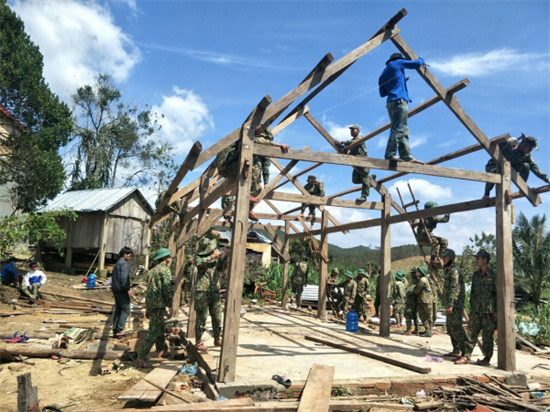 |
| Troops of Gia Lai province help the locals in disaster relief (Photo: VNA) |
However, with the intent to undermine the Party, the State, and the Military, hostile forces are exerting great efforts to distort the cultural values of “Uncle Ho’s Soldiers” across three fundamental aspects: denying the contemporary value of the cultural identity of the “Uncle Ho’s Soldiers”; distorting the image of the “Uncle Ho’s Soldiers” in peacetime; and separating the culture of the “Uncle Ho’s Soldiers” from revolutionary ideals. Therefore, struggling to refute these distorted narratives and denials is a vital requirement and task on the ideological and theoretical front, as well as a responsibility for every cadre, Party member, and individual within the Army.
There is absolutely no basis for the claim that the cultural identity of the “Uncle Ho’s Soldiers” is merely a self-proclaimed title of the Army rather than a value honoured by the People. Such assertions are illogical, unscientific, and ahistorical distortions propagated by hostile forces. This is because the title “Uncle Ho’s Soldiers” crystallises the trust, affection, honour, and objective recognition of the People toward the qualities, ethics, and lifestyle of the revolutionary soldier. For more than 80 years, the image of soldiers who were “determined to brave death for the survival of the Fatherland”, who always stood at the forefront of the struggle against aggressors with the spirit of “rather sacrifice everything than lose our country, rather sacrifice everything than be enslaved”, who are “ready to fight and sacrifice for the independence and freedom of the Fatherland”, and who are “remembered by the people when leaving and cherished when staying”,... has been deeply engraved in the hearts of millions of Vietnamese people, becoming a noble symbol of revolutionary heroism. It is the People - those who have nurtured, protected, sheltered, and stood together with the Army - who are the true subjects honouring our cadres and soldiers with the title “Uncle Ho’s Soldiers”, and this is not a self-proclaimed title as hostile forces have falsely claimed and distorted.
Moreover, the title “Uncle Ho’s Soldiers” is not merely an appellation; it embodies the noble qualities and traditions of our Army, making an important contribution to the cultural values of the nation and the era. It represents the synthesis of military ethical standards, first and foremost social values forged in the practice of combat, labour, and service; in the flesh-and-blood bond between the Army and the People - an Army that comes from the People, fights for the People, lives among the People, and is protected and nurtured by the People. It is the environment that has nurtured, cultivated, and enriched such noble cultural values. Therefore, deliberately denying the socio-humanistic origins of the “Uncle Ho’s Soldiers” culture, and labeling it as a “self-proclaimed” product of the Army, is not only a blatant distortion but also aims to break the close relationship between the Army and the People. This is an extremely sophisticated tactic employed by hostile forces, one that requires vigilant identification and resolute refutation.
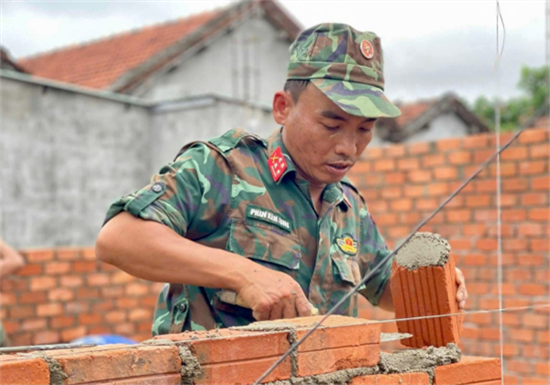 |
| Military troop builds new house for local people in Lam Dong province |
Any distorted claims suggesting that the culture of “Uncle Ho’s Soldiers” is merely a byproduct of wartime, now “outdated” or “unsuitable” in the context of international integration and military modernisation, are fundamentally flawed and intended to sever the historical continuity of the noble cultural values of “Uncle Ho’s Soldiers”. Those propagating these arguments intentionally conflate the evolution of organisational structures, equipment, and technology with the “expiration” of spiritual and moral value systems, despite these being two distinct categories.
The culture of the “Uncle Ho’s Soldiers” is not merely a “wartime” value in a temporary sense, tied to a specific historical context and fading away as circumstances change. On the contrary, it constitutes a core value system that crystallises the revolutionary qualities of the Vietnam People’s Army. In peacetime, qualities such as absolute loyalty to the Fatherland, to the Party, the State, and the People; humanism and compassion; and the virtues of diligence, thrift, integrity, righteousness, and impartiality continue to be vividly demonstrated by cadres and soldiers in training and combat readiness, in disaster prevention, in search and rescue missions; in epidemic prevention and control; in assisting the People in hunger eradication and poverty reduction, in building new-style rural areas, and in participating in United Nations peacekeeping operations, etc.
Currently, in implementing the policy of building a “revolutionary, regular, elite, and modern” Army, the culture of the “Uncle Ho’s Soldiers” serves as the spiritual foundation and ethical standard that enables each soldier to constantly train, master new weapons, overcome material temptations, uphold discipline, preserve revolutionary qualities, and successfully accomplish all assigned missions. Technology may change, force structure may be adjusted, and combat methods may evolve; yet the political qualities, moral standards, and cultural values of the revolutionary soldier remain the soul and the “root” that amplify and unlock the power of all other factors.
Therefore, claiming that the culture of the “Uncle Ho’s Soldiers” has become “outdated” is not only a denial of a noble value that continues to shine, but also a calculated attempt to erode the revolutionary nature of the Army, which has been forged and cultivated over more than eight decades. Such arguments are misguided, one-sided, and entirely detached from objective reality.
There is no grounds for the distorted claim that “Uncle Ho’s Soldiers” of today are no longer what they used to be, that “peacetime soldiers have lost their qualities, grown distant from the People, and are no longer worthy of the title”. In recent times, taking advantage of a few isolated cases of disciplinary violations within the Army, hostile forces have deliberately distorted the facts, misrepresenting phenomena as the essence in order to sow doubt, undermine the prestige and image of cadres and soldiers, and erode the People’s trust, thereby seeking to diminish the cultural value of the “Uncle Ho’s Soldiers”. Yet the vivid realities of social life have decisively refuted such false and distorted claims.
The image of cadres and soldiers of the Army performing the mission of “combat in peacetime”, overcoming dangers and hardships, ready to sacrifice in search and rescue operations, assisting the People in dealing with the consequences of natural disasters, participating in epidemic prevention and control, building new-style rural areas, and strengthening grassroots defence and security,... has become vivid testimony to the spirit of “selflessly serving the People”, and to the noble nature and traditions of the “Uncle Ho’s Soldiers” in the new era. Discipline constitutes the strength of the Army, therefore, the Army consistently handles violations committed by cadres and soldiers in a strict and impartial manner, with “no forbidden zones and no exceptions”. The seriousness, responsibility, and courage to face the truth and speak the truth, along with the fair and reasonable handling of issues within the Army are not manifestations of degradation; rather, they affirm the Army’s political courage and its capacity for self-rectification and self-purification. This is one of the noble qualities of the culture of the “Uncle Ho’s Soldiers”. Therefore, we can not generalise from a few cases or misinterpret specific phenomena as the essence; even more wrong to use isolated mistakes to deny what is universal, progressive, and dominant. The undeniable truth is that the cultural values of “Uncle Ho’s Soldiers” are constantly being nurtured and continue to shine brightly.
The argument that “the Army belongs to the People and only needs to be loyal to the People, not to the Party” is not new; however, it is an extremely dangerous claim propagated by hostile forces with the aim of “neutralising” and “depoliticising” the Army - a key element that constitutes the cultural value of the “Uncle Ho’s Soldiers”. The reality shows that every army bears a class nature; “the Army cannot and should not be neutral. Do not dragging the army into politics - this is the slogan of the hypocritical lackeys of the bourgeoisie and of the Tsarist regime”. The lesson drawn from the collapse of socialism in the Soviet Union and Eastern Europe stands as a typical example: when the Communist Parties abandoned their leadership over the armed forces, the armies were “depoliticised”, and lost their combat purpose.
For the Vietnam People’s Army, from its very inception it has been placed under the absolute, direct, and comprehensive leadership of the Party, bearing the nature of the working class. From a small force equipped with rudimentary weapons, under the Party’s leadership and together with the entire people, it achieved the great victory of the August Revolution, continued to defeat two powerful imperialist aggressors, and, together with the entire Party and people, it has firmly safeguarded national independence, sovereignty, unity, and territorial integrity. Under all circumstances, our Army has consistently upheld the principle of “Loyal to the Party, devoted to the People, ready to fight and sacrifice for the independence and freedom of the Fatherland and for socialism. Any task will be accomplished, any difficulty will be overcome, any enemy will be defeated”. That foundation has created the immense political and spiritual strength of our Army, in which the culture of the “Uncle Ho’s Soldiers” serves as the very soul of that strength. If the culture of the “Uncle Ho’s Soldiers” were separated from the Party’s ideological foundation, then that value becomes merely a superficial shell, losing its core content; it no longer possesses its identity and ideals, and is easily manipulated by external forces. Therefore, it is absolutely impossible for the Army not to be loyal to the Party!
Denying the cultural value of the “Uncle Ho’s Soldiers” is to deny the nation’s history; to defame the noble image of the revolutionary soldier; to negate the immense contributions and sacrifices of generations of cadres and soldiers of the Army; and to insult the People - those who have nurtured, protected, and honoured our soldiers. Separating the cultural value of the “Uncle Ho’s Soldiers” from revolutionary ideals is a scheme aimed at stripping the Army of its great political and spiritual strength, thereby weakening the whole-people defence. Therefore, resolutely combating and refuting distortions and denials of the cultural value of the “Uncle Ho’s Soldiers” is an urgent task at present, contributing to the firm protection of the political foundation, safeguarding the trust, honour, prestige, and combat ideals of the Army. It ensures that our Army remains an absolutely loyal and reliable political and fighting force of the Party, the State, and the People; ready to accomplish any mission, overcome any hardship, and defeat any enemy. Forever remaining worthy of the heroic tradition of the heroic Vietnamese nation.
Colonel, PhD. VU VAN BACH