On the basis of the creative application and development of Marxism - Leninism and Ho Chi Minh Thought, our Party’s theory on the renewal policy has been gradually formed, supplemented, and perfected. The great achievements of historic significance over 40 years of renewal have affirmed the correctness, scientific and practical value, and vitality of the renewal policy and the path towards socialism in Vietnam.
Renewal marks a milestone of profound historic significance in the course of the Vietnamese revolution. Amid major changes in the domestic and international situation, the centralised, bureaucratic, state-subsidised planning mechanism increasingly revealed its limitations. No longer capable of meeting the demands of national development in a new era, its historical role came to an end. In the spirit of looking straight at the truth and speaking the truth clearly, the Party’s 6th National Congress (in 1986) set out the renewal policy, with the renewal of thinking, particularly economic thinking, as its foremost priority. Since then, the Party’s theory on the renewal policy has been increasingly developed and perfected. Together with Marxism - Leninism and Ho Chi Minh Thought, it has become a road map for the cause of building and defending the socialist Vietnamese Fatherland, contributing to great achievements of historic significance.
 |
| Flag-salute ceremony at the 14th National Party Congress (photo: VNA) |
However, hostile forces have sought to distort and deny the renewal policy, portraying this policy as a mistake or a “deviation” from the socialist path. On that basis, they challenge the leadership role of the Party and attempt to steer Vietnam onto a different path of development. Therefore, clarifying the scientific and practical value of the theory on the renewal policy is an important requirement today. It contributes to firmly protecting the Party’s ideological foundation, consolidating the confidence of cadres, Party members, and the People in the path of national development, and resolutely refuting hostile forces’ distortions and denials.
The scientific value of the theory on the renewal policy
One of the outstanding scientific values of the theory on the renewal policy lies in its steadfast adherence to and creative application of Marxism - Leninism and Ho Chi Minh Thought within the specific conditions of Vietnam. It has constantly clarified the model and path towards socialism in Vietnam, in which renovation of economic thinking is the breakthrough. Our Party has creatively, effectively applied and developed an important methodological principle of Marxism-Leninism: the dialectical unity between theory and practice in both perception and action. Grounded in the country’s realities, the Party has consistently pursued a development path suited to Vietnam’s circumstances rather than mechanically replicating the models of other nations. A commitment to drawing lessons from practice, adhering to objective laws, and consistently evaluating the implementation of its policies has enabled the Party to expand its theoretical understanding and progressively perfect the theory and practice of the renewal policy.
Before the renewal process, both the domestic socio-economic landscape and the international environment had undergone significant changes. The centrally planned, bureaucratic, and state-subsidised economic management mechanism increasingly revealed its shortcomings and gradually hindered national development. That underscored the need for a fundamental transformation in thinking, particularly economic thinking and governance method. In response, the Party gradually formulated a series of innovative viewpoints, including the liberation of productive forces, the recognition of commodity production and the effective use of commodity - money relations in accordance with the laws of commodity production, the application of the law of value in policies on prices, wages, and currency, the identification of a multi-sector economy as a characteristic of Vietnam’s transition to socialism, the gradual dismantling of the centralised, bureaucratic, and state-subsidised mechanism, and greater attention to the economic rights and legitimate material interests of working people. These measures have provided a powerful impetus for mobilising social resources, fostering productive forces, enhancing labour productivity, and improving the People’s living standards.
These innovations in thinking show that the renewal policy was not formed by negating revolutionary goals and ideals. Rather, it emerged from the need to better understand and apply objective laws, liberate and develop productive forces, and improve production relations in accordance with their level of development. In this way, it has gradually realised the goal of building socialism in Vietnam’s specific conditions. The Resolution of the Party’s 14th National Congress affirms: “The renewal cause initiated and led by our Party is a historic choice reflecting the continuous development of the Party’s thinking, theoretical understanding, and leadership in national development and protection”. After 40 years of renewal, “our Party has drawn valuable theoretical lessons, gradually building and perfecting the theory on the renewal policy, providing important practical guidance for the country’s revolutionary cause in the new stage”.
These understandings were formed, supplemented, and developed through continuous reviews of practical experience, thereby gradually clarifying the basic issues of the path towards socialism in Vietnam. Renewal is an ongoing revolutionary process, replacing the old with the new that better suits objective laws and the requirements of national development. Renewal is guided by principles and remains steadfast in the goal of national independence and socialism. It embraces innovation in methods and practices, but does not alter the nature of the Vietnamese revolutionary cause. Advancing to socialism is the goal and ideal of our Party and People, and the consistent orientation throughout the renewal process.
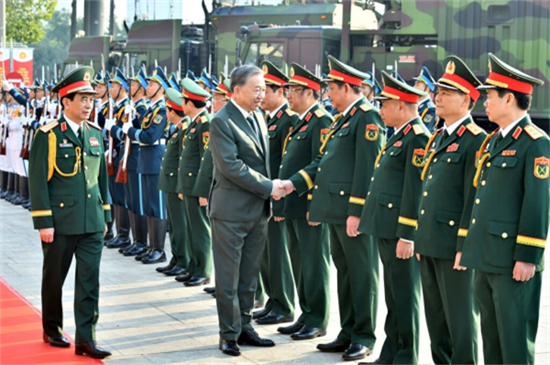 |
| General Secretary To Lam attending the 80th founding anniversary of the Vietnam People’s Army (photo: baocaovien.vn) |
Over the past 40 years, the development of theoretical understanding has gradually formed a theoretical system on the renewal policy that is scientific and revolutionary, and also has profound practical value. It represents “the creative application, supplementation, and development of Marxism - Leninism and Ho Chi Minh Thought in the renewal period. It is the creative supplementation and development of the theory on socialism and the path towards socialism in Vietnam, in line with objective laws, the country’s realities, and the trends of the times. It inherits the fine traditions of the nation and selectively absorbs the cultural values and development achievements of humanity”.
The world is undergoing rapid, profound, and complex changes. Science, technology, innovation, digital transformation, and artificial intelligence are developing at an unprecedented pace. Strategic competition, climate change, non-traditional security challenges, and global issues are increasingly complex. These emerging issues require the Party to review practice, supplement and develop theoretical understanding, and perfect its lines and policies to meet the requirements of development in the new era.
In this context, the Party’s 14th National Congress marked a significant development by affirming: “Remain steadfast in, apply, and creatively develop Marxism - Leninism, Ho Chi Minh Thought, and the theory on the renewal policy, remain steadfast in the goal of national independence and socialism, remain steadfast in comprehensively and synchronously promoting the renewal cause, remain steadfast in the principles of organisation and operation of the Party, ensure strategic autonomy, renovate the development model, use development to guarantee stability and use stability to promote rapid and sustainable development of the country, improve the living standards and happiness of the People, and firmly defend the socialist Vietnamese Fatherland”.
The practice of renewal affirms the value and vitality of the theory. At the same time, it requires the continuous development of theory to address emerging challenges in the cause of national construction and defence. In this process, steadfastness does not imply adherence to outdated understandings or rigid thinking; renewal does not mean abandoning established goals and principles. The core issue is to remain unwavering in fundamental objectives and guiding principles. On that basis, the Party constantly supplements and develops theoretical thinking and perfects its policies and mode of leadership to suit practice. It is precisely the unity between steadfastness in goals and principles and the proactive renewal of thinking and action that has affirmed the vitality and success of the renewal process and helped refute distortions that renewal is a deviation from socialism.
The practical value of the renewal policy
The value of a theory lies not only in how scientific its system of viewpoints is, but, more importantly, in its capacity to provide strategic direction and to prove its validity through practice. After 40 years of renewal, the remarkable historic achievements in all fields have affirmed the practical value of the renewal policy, demonstrating its capacity to translate theoretical understanding into lines, policies, and national development outcomes.
Domestically, the achievements of renewal are visible across many areas: economic, cultural, and social development, better living standards, human development, social security, defence and security, and foreign affairs. From 2021 to 2025, the economy grew by an average of about 6.2% a year, placing Vietnam among the fastest-growing economies in the region and the world. Growth reached 8.02% in 2025 and 9.01% in the first nine months of 2026, providing a solid foundation for the goal of growth of 10% or more from 2026 onward. “GDP in 2025 exceeded 514 billion USD, 1.48 times the 2020 level, ranking 32nd in the world. GDP per capita reached 5,026 USD, joining the group of upper-middle-income countries, which has been highly regarded by many prestigious international organisations. Growth quality has also improved, and the contribution of total factor productivity (TFP) to economic growth has reached about 47%”.
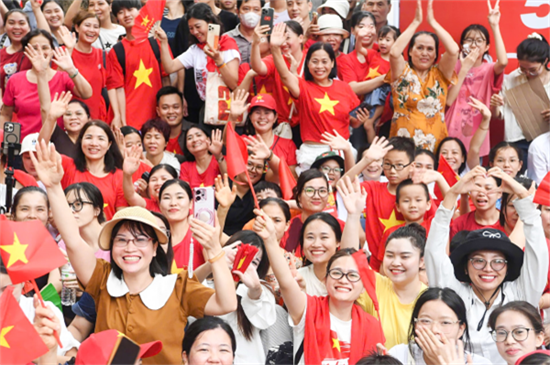 |
| Illustrative photo (tienphong.vn) |
The fields of culture, society, education and training, science, technology, and health care continue to see many positive changes. The country has gradually shaped and affirmed its systems of national values, cultural values, family values, and standards for the Vietnamese people. Vietnam’s Human Development Index (HDI) in 2023 reached 0.766, ranking 93rd out of 193 countries and territories, 14 places higher than in 2022 and within the high human development group. In the 2025 happiness index, Vietnam ranked 46th out of 143 countries, 37 places higher than in 2020. The multidimensional poverty rate fell from 4.4% in 2021 to about 1.3% in 2025. In the same year, more than 3.5 million people received regular social assistance, 55% of them elderly. Health insurance coverage rose from 90.9% in 2020 to 95.2% in 2025. Average life expectancy reached 74.8 years in 2025, with healthy life expectancy of about 67 years.
Education and the quality of human resources continue to improve. Vietnam’s adult literacy rate has reached nearly 99%, and university and college enrolment is almost 20 times higher than it was before renewal. In 2025, 29.2% of workers held a degree or vocational certificate. The country’s science and technology capacity and its start-up and innovation ecosystem are also growing. In 2025, Vietnam maintained 44th place out of 139 countries and economies in the Global Innovation Index (GII). Protection of natural resources and the environment and response to climate change are prioritised. In 2025, Vietnam scored 73.4 points on the Sustainable Development Goals (SDGs) Index, ranking second in Southeast Asia, an increase of 27.4% compared to 2015. These results show that the achievements of renewal are reflected not only in economic growth but also in better living standards, human development, social progress and equity, and steady movement towards sustainable development.
Along with domestic achievements, Vietnam’s position and prestige in the international arena have been increasingly affirmed. The renewal policy has laid a strong foundation for Vietnam to integrate into the world proactively and actively, expand its foreign relations, and take a broader and deeper part in multilateral mechanisms. The country has established itself as a friend, a reliable partner, and a responsible member of the international community. Once under siege and embargo, Vietnam has now developed diplomatic relations with 195 countries. It has comprehensive, strategic, and comprehensive strategic partnerships with 42 countries, including all 5 permanent members of the United Nations Security Council. Vietnam is an active member of more than 70 international organisations, taking a broader and deeper part in multilateral mechanisms, undertaking many important international roles and making a responsible contribution to peace, cooperation, and development in the region and the world.
Vietnam’s trade openness has reached nearly 200% of GDP. Our country is deeply integrated into global supply chains, ranking among the world’s 20 largest trading economies, becoming one of the leading destinations for foreign direct investment (FDI). It has signed and implemented 17 free trade agreements (FTAs) with more than 60 countries and territories, including new-generation FTAs such as the CPTPP, EVFTA, UKVFTA, and RCEP. Vietnam is also among the world's 10 largest recipients of remittances. At the same time, Vietnam’s culture, tourism, and image have continued to improve. Many cultural and natural heritage sites have been recognised by UNESCO, and Vietnam has become a well-known tourist destination in the region and around the world.
From economic and social change to wider foreign relations and deeper international integration, 40 years of renewal show that the policy has fundamentally transformed the country’s position and strength. These results provide solid evidence to refute all distortions and denials of the practical value of the renewal policy and the path towards socialism in Vietnam.
To promote the scientific and practical value of the renewal policy, our Party must keep strengthening its capacity to forecast the situation, review practice, develop theoretical thinking, and turn strategic orientations into lines and decisions that meet the needs of national development. It is also necessary for the Party and the political system to foster self-renovation and self-rectification, and keep renovating and perfecting its mode of leadership and governance. Due attention should be paid to building a strong contingent of cadres at all levels, renewing personnel work fundamentally and comprehensively, and attracting and making good use of talented people, in line with the viewpoints of the 4th Plenum of the 14th Party Central Committee.
Amid new opportunities and challenges, steadfast commitment to national independence and socialism must go hand in hand with unlocking all resources, harnessing the strength of great national unity, accelerating innovation, and raising productivity and the quality of development. This lays the cornerstone for realising the aspiration of a prosperous, civilised, and happy country confidently advancing into a new era of development.
Associate Prof. VU VAN PHUC, PhD
Former Editor-in-Chief of the Communist Review