In the cause of building and defending the Fatherland, particularly during 40 years of renewal, with sound lines and policies, our Party and State have consistently maintained political stability, creating a solid foundation for the country to develop. This is a core value and also a testament to the credibility, position, and leadership role of the Communist Party of Vietnam, which is trusted and followed by all cadres, party members, and the People, internationally recognised, and undeniable by anyone.
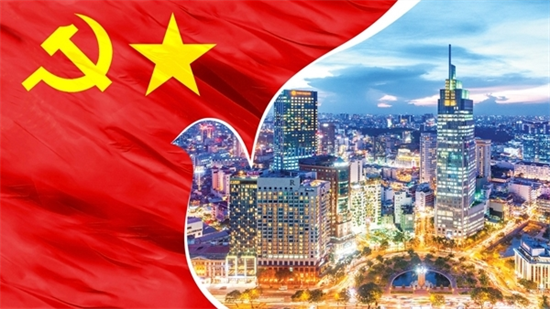 |
| Illustrative photo (baochinhphu.vn) |
Political stability and hostile forces’ plots
Political stability is the core component of social stability, reflecting the resilience and integrity of the regime. However, it is not a static state, but rather a special form of orderly and disciplined social transformation towards development and upward progress. Within this, the structure and function of stability, especially the nature of the political regime, are maintained and strengthened, free from disorder or instability, serving as a favourable environment and condition to propel social development. Political stability must be viewed in the totality of its structure, function, movement, and the nature of the regime - especially the political regime - inextricably linked to the nation’s actual conditions and specific historical context.
Among the major relationships that must be addressed during the process of renewal and socialism building in Vietnam, the dynamic “between stability, renewal, and development” has been gradually perceived in a more comprehensive manner by our Party and identified as the foremost major relationship. In that dialectical relationship, “stability” is the prerequisite, “renewal” is the driving force, and “development” is the goal. This demonstrates the immense importance of stability, particularly political stability, to the cause of national renewal and development.
In Vietnam, the constituent elements of political stability include: (1). The ideological foundation and political awareness of the People are maintained and enhanced. (2). The leadership of the Party, the management of the State, and the role of socio-political organisations are sustained and strengthened. (3). The renewal process and the goal and path of national independence and socialism are steadfastly pursued and developed. (4). The relationships among organisations within the political system, between the Party, the State, the People, and the armed forces, among various forces within the people’s armed forces, and ethnic and religious relations are consolidated. (5). Movements and socio-political activities, the fight against corruption, wastefulness, and negative practices, and lines and measures of the Party and State to maintain political stability, etc., are implemented in the right direction, substantively, and effectively.
The aforementioned elements are closely interrelated and interact with one another, creating a solid foundation and a prerequisite for maintaining political stability for national development. This is also the root cause, nature, and characteristic of political stability in our country.
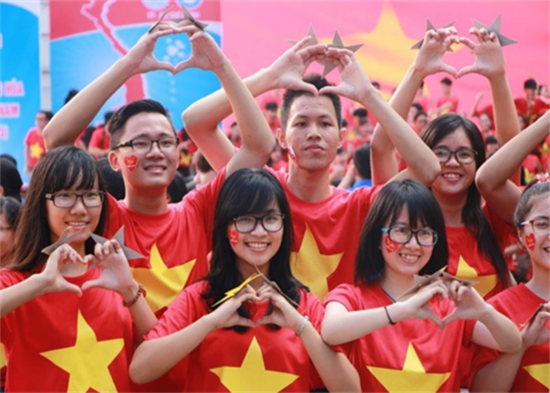 |
| Illustrative photo (baochinhphu.vn) |
Recognising the importance and immense value of stability, especially political stability, to Vietnam’s development, hostile, reactionary, and politically opportunistic forces frantically carry out acts of sabotage in a bid to cause social disorder, diminish the People’s trust in the Party, the State, and the path to socialism, disrupt political stability, and ultimately abolish the leadership and ruling role of the Party and the socialist regime in Vietnam. They attack all the constituent elements and root cause of political stability in our country, focusing on the fundamental, core political issues of the regime. They widely disseminate distortions that Marxism - Leninism and Ho Chi Minh’s Thought are “obsolete” and “backward”, and that socialism is no longer suited to Vietnam’s reality, adding that if we “blindly” follow it, the country will run into a “dead end”. In particular, taking advantage of the struggle to prevent and combat corruption, wastefulness, and negative practices, as well as the revolution to streamline the apparatus of our political system, they distort the situation by claiming it is an “internal power struggle” and a “systemic error that cannot be rectified”, before wrongly concluding: “The Party no longer has a role in leading the country”. Therefore, they argue, “The Party must relinquish its leadership role” and must “change the political regime in order to fundamentally solve the problem, so that society can be stable and develop”!
These sabotaging schemes are exceptionally dangerous; it is imperative for us to heighten vigilance, proactively identify them, and resolutely fight against and defeat them.
The immense value of political stability for national development in Vietnam: a truth that cannot be distorted or denied
First, thanks to the maintenance of political stability, our Party and State possess the foundation and conditions to persistently and consistently implement lines and policies to develop an independent, self-reliant, rapidly growing, and sustainable economy; long-term development policies are executed consistently, continuously, and effectively. Because these policies do not change abruptly, laws are clear and appropriate, and mechanisms are increasingly being streamlined and refined, Vietnam’s economy has maintained strong and sustainable growth, “averaging approximately 6.2% per annum in the 2021 - 2025 period, ranking among the high-growth countries in the region and the world. Notably, economic growth in 2025 reached 8.02%, creating a solid foundation for the growth target of 10% or more from 2026 and subsequent years”.
Second, a stable and safe political environment, particularly geopolitical stability, is a key factor for development; it ensures national security and order, creating the trust needed to strongly promote investment activities, attract foreign direct investment (FDI), and stimulate domestic business investment, especially within the private sector. The State enjoys favourable conditions to effectively foster constructive development, helping foreign enterprises feel secure and confident to invest and cooperate in long-term production and business in Vietnam. A Vietnam with stable politics generates immense trust among international friends regarding cooperation and the signing of diplomatic treaties, particularly economic and trade agreements.
Currently, “Vietnam has economic, trade, and investment relations with 224 markets across all continents; it has accelerated international integration, participated in over 500 bilateral and multilateral agreements across various fields, and attracted a massive amount of FDI,... placing Vietnam among the 32 largest economies in the world and the top 20 economies in terms of trade and foreign investment attraction”; it is recognised and evaluated by the international community as a shining example “of social safety and stability”.
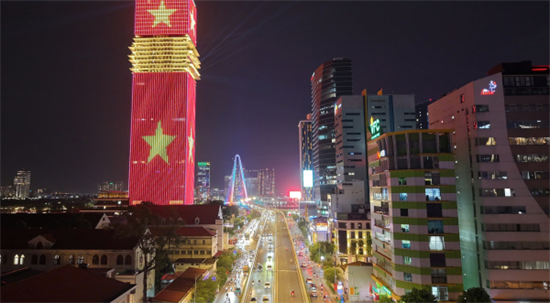 |
| Marina Central Tower in Ho Chi Minh City on the occasion of Independence Day (photo: vtv.vn) |
Third, political stability creates conditions for the State to proactively prevent crises, focus on national construction, develop the economy, culture, education, and health care, improve the People’s livelihoods, strengthen national defence and security, firmly protect independence and sovereignty, and respond effectively to internal and external challenges, as well as traditional and non-traditional security threats.
Precisely by maintaining political stability, Vietnam has had the conditions to focus on national development and has moved out of the low-income developing country group to become a middle-income developing nation. The happiness index of the Vietnamese people has been continuously improved; “compared to 2016, the happiness index of the Vietnamese people has risen by 48 ranks”. The People’s trust in the Party and State has been elevated; social consensus and great national unity have been firmly strengthened.
These immense results of historical significance reflect the exceptionally important value of political stability to Vietnam’s development. They affirm that political stability is truly the foundation and prerequisite for the national fortune, potential, international standing, and prestige we have today. This is inextricably linked to “the comprehensive and absolute leadership and direction of the Party, the unified management and effective administration of the State, and the efforts and mastery spirit of the People”. This is the “core” value and the “root cause” of political stability in our country, the decisive factor in our national development throughout the past four decades and in the new phase of development. This is a truth that no force can distort or deny.
Maintaining political stability - an urgent and critical requirement in the new era
First and foremost, it is necessary to clearly recognise the immense value and role of political stability in national development. It is an “invaluable asset”, a “core foundation”, a “precious resource”, a “strategic advantage”, and a “prerequisite and critical condition” to protect national independence, develop the country, and bring a peaceful and happy life to the People. However, political stability is not a fixed state or a “heaven-sent resource”, but rather the result of efforts and determination of the entire Party, the entire people, and the whole political system in building, consolidating, and maintaining it. Accordingly, it is imperative to deeply grasp the viewpoint of “using development to maintain stability, and using stability to promote sustainable development, continuously improving the People’s standard of living”, demonstrate a high level of determination, and take correct actions to maintain political stability for national development.
Second, we must fight to defeat all plots and tactics of hostile forces aimed at destroying and disrupting political stability in our country. This struggle must be closely linked with the fight to prevent and combat “peaceful evolution” and subversive plots, firmly defend the Party’s ideological foundation, protect the Party, the State, the People, and the socialist regime, safeguard national independence, sovereignty, security, and interests, prevent and combat corruption, wastefulness, and negative practices, and repel the degradation of political ideology, morality, and lifestyle, as well as manifestations of “self-evolution” and “self-transformation”. We must realise the motto: “Proactively prevent risks of war and conflict, create and maintain a peaceful and stable environment, firmly defend the Fatherland, and fully utilise external resources and favourable conditions for national development”, enhance comprehensive national strength, and elevate Vietnam’s international standing and prestige.
Third, continuing to step up the building and rectification of the Party, so that our Party remains the symbol of “intellect, honour, and conscience of our era” and becomes truly “moral and civilised” on par with its tasks. Political stability depends primarily on the Party itself, on the integrity and strength of party organisations, and on the exemplary conduct of the contingent of cadres and party members. Therefore, attention must be paid to building a pool of cadres and party members with sufficient qualities and capabilities, who uphold a pioneering and exemplary spirit, and a responsibility to serve the Fatherland and the People. “Every cadre and party member, primarily leaders, must self-reflect, self-correct, and set an example through the results and effectiveness of their work”; the higher the position held by cadres and party members is, the more exemplary they must be. In addition, Party organisations must focus on enhancing the “resistance”, “immunity”, and “self-protection” capabilities of every cadre and party member against all fluctuations and impacts of the situation. Also, we must build and increase the strength of the complex of elements: “The economy must be solid, national defence must be strong, national competency must be robust, the people’s hearts and minds must be at peace, politics and society must be stable, and the entire nation must be a unified bloc of solidarity”.
At the same time, it is essential to consistently promote the spirit of patriotism, the will for national self-reliance, and the trust and dedication of the entire people and the Military towards the building of an increasingly prosperous, civilised, and happy country.
Associate Prof. NGUYEN MANH HUONG, PhD